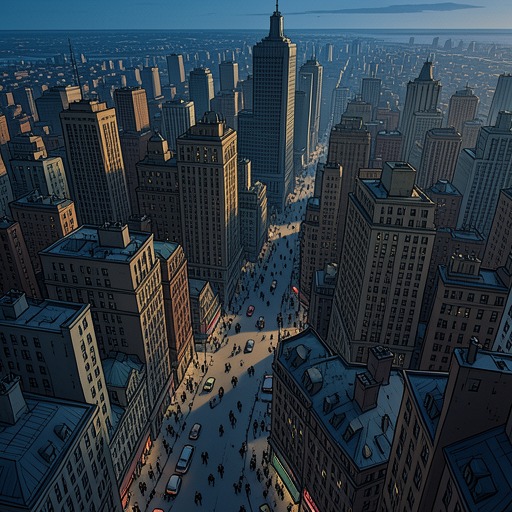
Wall Street
American PsychoWall Street functions as both a real district and a governing symbol of the novel's social order. It is the point of departure for a cab ride, the professional world associated with Pierce & Pierce, and a source of the money, status, and institutional anonymity that shape the characters' lives. Yet the district is never presented as securely separate from the city's misery: its routes lead directly past graffiti, beggars, traffic, and signs of social breakdown. Wall Street therefore names not only a workplace but a system whose polished surfaces coexist with, and help organize, the suffering visible in the streets.
Setting and First Appearance
Wall Street first appears through a moving view from the back seat of a cab. Near the corner of Eleventh and First, the words "Abandon all hope ye who enter here" have been scrawled in blood-red lettering on the side of Chemical Bank. The warning is large enough to be seen from the cab, but a bus carrying an advertisement for Les Misérables immediately blocks the view. The sequence places finance, theatrical spectacle, and gothic threat in the same urban frame: the bank wall offers a prophecy of damnation, while commercial advertising temporarily conceals it.
The passengers leave Wall Street in traffic while Timothy Price talks about his professional value and financial expectations. He describes himself as resourceful, creative, young, unscrupulous, highly motivated, highly skilled, and an asset society cannot afford to lose. His anxiety is not poverty but the fear that his work and compensation do not adequately reflect his perceived worth. The movement away from Wall Street thus begins with a characteristic contradiction: the district produces confidence in elite identity while also intensifying dissatisfaction within it.
Finance, Consumption, and Social Performance
Wall Street's culture is carried through objects and displays rather than through explicit institutional explanation. In the cab, Price complains about the city's filth while using expensive personal technology and discussing sophisticated Blaupunkt sound systems. He puts an expensive-looking Sony Walkman into a new Tumi calfskin attaché case alongside a Panasonic cordless portable folding Easa-phone, then reads a newspaper filled with reports of murder, disease, homelessness, gridlock, and urban catastrophe. The attaché case, electronic equipment, tailored clothing, and financial vocabulary form a portable version of the district's status economy.
The same logic governs the social scenes connected to Wall Street. At Pastels, Patrick Bateman displays a new business card from a gazelleskin wallet costing $850 and waits for the others' reactions. At the meal's conclusion, the $475 check is divided among the group, but Bateman puts his share on an American Express Platinum Card so that he can collect the others' mostly fresh fifties. Even the small dispute over a ten-dollar reimbursement for a sixteen-dollar appetizer becomes a performance of money, precision, and rank. The abandoned bottle of champagne outside the restaurant and the beggar asking first for change and then for food sharpen the contrast between elite consumption and unmet necessity.
Wall Street's social world also depends on bodily presentation. Patrick Bateman and his companions are identified through designers, fabrics, ties, shoes, water, music, and grooming. At another gathering, the mixture of several designer ties and fragrances becomes a "cold, sickening perfume," a sensory emblem of wealth turned into sameness. Clothing operates as a credential, but because the men possess nearly interchangeable wardrobes and manners, it also erodes individual identity. The financial district's power is consequently inseparable from a culture in which people are recognized through brands while remaining difficult to distinguish from one another.
Routes Across the City
Although Wall Street is a concentrated financial center, the narrative repeatedly connects it to a larger circuit of privileged spaces. After leaving the Pierce & Pierce office, Patrick and Price walk toward Harry's, passing an ugly homeless man crouched beneath a Dumpster on Stone Street. The route does not erase the poor from the city; it makes them part of the background through which the professionals travel. A wolf whistle directed at a passing woman occurs beside this unacknowledged figure, showing how sexual appraisal, class contempt, and professional camaraderie occupy the same streetscape.
Patrick's movements extend from Wall Street to restaurants, clubs, apartments, and private facilities. At Evelyn's brownstone, he and Price are received by Courtney Lawrence, whose ritualized air-kissing and carefully selected clothing belong to the same system of social display. At Xclusive, a private health club four blocks from Patrick's Upper West Side apartment, the annual membership costs $5,000 and the facilities include multiple courts, pools, aerobic studios, machines, saunas, tanning booths, and a juice bar. The distance between Wall Street and the Upper West Side is therefore not a movement between unrelated worlds but a passage through a network of institutions that preserve elite appearance and bodily discipline.
The narrative also follows the reverse route, from nightlife toward neglected and dangerous urban spaces. After a party, Patrick walks through the antique district below Fourteenth Street, where the streets are empty and filled with garbage, steam, taxis, and signs of disorder. The city he encounters is spatially continuous with the world of Wall Street, but its services and protections have fallen away. The polished financial center is revealed as one privileged node in a much larger geography of uneven visibility.
Violence Beneath the Surface
Wall Street's proximity to violence is established before the narrative presents violence directly. Price reads a newspaper account of two people who disappeared during a party aboard a yacht, leaving only spattered blood and smashed champagne glasses; the police suspect a machete, but there are no bodies and no suspects. The report mirrors the novel's recurring pattern of spectacle without resolution, evidence without accountability, and luxury settings contaminated by brutality.
That pattern becomes more explicit when Patrick considers killing Luis Carruthers. In a men's room, he moves toward the stall where Luis is urinating and places his hands around Luis's neck. The scene grows out of a Wall Street social environment in which romantic rivalry, physical appraisal, and professional identity are treated as competing assets. Patrick's contemplation of murder is not detached from the district's culture; it is an extreme expression of its logic, converting another person into an obstacle whose removal might improve his position.
The city beyond the financial center is likewise marked by Patrick's violence and by his dehumanization of those who cannot participate in elite display. At the Central Park Zoo, he wanders while unable to maintain a credible public persona, threatens a custodian with a knife, and throws coins into the seals' pool despite a warning that coins can cause ulcers, infections, and death. Later, returning from Central Park, he sees a homeless man he previously blinded, accompanied by a dog and a sign identifying him as a Vietnam veteran who is hungry and homeless. The movement from Wall Street's offices to these exposed bodies makes social inequality spatially legible: wealth is enclosed, while vulnerability remains publicly available.
Institutional Anonymity and Significance
Wall Street ultimately represents a structure that absorbs both performance and transgression without producing stable recognition. After a night of shootings, Patrick reaches what he believes is his new office, signs in with a night watchman, takes the elevator upward, and phones Harold Carnes. He leaves a confession claiming responsibility for thirty, forty, or a hundred murders, then watches police activity at another building while speaking into Carnes's machine. The scene places the criminal confession inside the same professional architecture that has supported Patrick's public identity, yet the confusion over buildings and identities prevents the confession from achieving clear public consequence.
The district's deepest significance lies in this collapse of boundaries. Wall Street is associated with money, career, taste, and institutional legitimacy, but the narrative continually overlays those signs with homelessness, disease, disappearance, racist abuse, sexual commodification, and murder. Its banking walls can carry a warning about entering a place without hope, but advertising quickly hides the words; its professionals can speak fluently about assets while ignoring people in the street; its offices can provide anonymity even when violence erupts. Wall Street thus becomes the novel's condensed image of a society in which wealth organizes space and perception, while the human costs of that organization remain visible only in fragments.