Xclusive health club
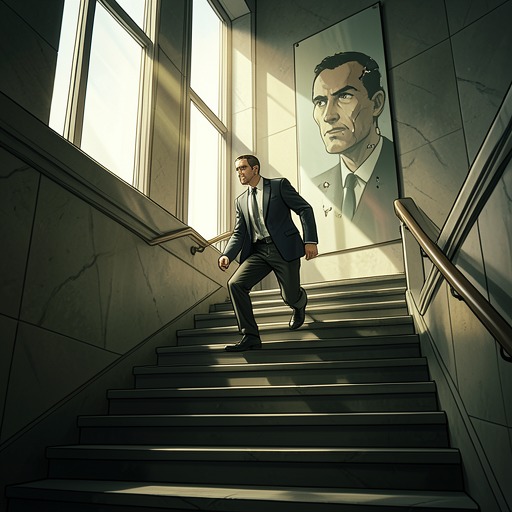
American PsychoXclusive health club is a private fitness club four blocks from Patrick Bateman’s apartment on the Upper West Side. In the two years since he joined, it has been remodeled three times, and its five-thousand-dollar annual membership places it within the exclusive consumer world that governs his daily life. More than a place to exercise, Xclusive functions as a showroom for disciplined bodies, expensive equipment, branded clothing, and competitive self-presentation; it is one of the institutions through which Bateman turns physical maintenance into a social identity.
Facilities and Membership
Xclusive offers an unusually comprehensive inventory of fitness and leisure facilities. Its equipment includes Nautilus, Universal, and Keiser weight machines, extensive free weights, ten tennis and racquetball courts, aerobics classes, four aerobic-dance studios, two swimming pools, Lifecycles, a Gravitron, rowing machines, treadmills, and cross-country-skiing machines. The club also provides one-on-one training, cardiovascular evaluations, personalized programs, massage, sauna and steam rooms, a sun deck, tanning booths, and a cafe with a juice bar. The entire complex was designed by J. J. Vogel, who also designed the new Norman Prager club, Petty's, linking Xclusive to the same branded network of luxury institutions that organizes Bateman’s professional and social world.
The club’s abundance makes exercise inseparable from consumption. Membership costs five thousand dollars annually, while the setting offers specialized technologies, individualized assessment, grooming-related amenities, and spaces for both athletic performance and display. Xclusive therefore presents health as a purchasable lifestyle, one in which bodily control and economic privilege reinforce one another. Its repeated remodeling also suggests that even a supposedly stable institution must continually renew its surfaces to remain competitive.
Bateman’s Routine and Social Performance
Bateman approaches Xclusive through a highly managed sequence of preparation. After leaving the office in a six-button double-breasted chalk-striped Ralph Lauren suit, he changes in the air-conditioned locker room into crow-black cotton-and-Lycra shorts and a tank top by Wilkes. He clips his Sony Walkman to the shorts, checks himself in the mirror, returns to his briefcase for mousse when his hair fails to satisfy him, applies moisturizer, and covers a blemish beneath his lower lip with Clinique Touch-Stick before entering the gym. The workout begins only after the body has been styled for inspection.
The club’s front desk is another stage in this performance. Cheryl, a staff member who is in love with Bateman, brightens when she sees him and says hello, but he moves past her without acknowledging her because the Stairmaster is immediately available. He treats the machine’s efficiency as a scarce advantage: ordinarily, he notes, members wait twenty minutes for it, although it burns more calories per minute than almost any other aerobic activity except Nordic skiing. The language of optimization turns a brief encounter with a human being into an opportunity-cost calculation.
Bateman completes twenty minutes on the Stairmaster and then stretches for fifteen minutes before moving to the Nautilus machines. Even within this routine, the club becomes a hierarchy of bodies and gazes. He notices the men around him according to whether they appear sufficiently muscular, sexually desirable, socially useful, or contemptible, while his own exercise remains bound to anxiety about appearance. The result is a paradoxical institution: Xclusive promises self-mastery, yet Bateman’s attention is continually diverted from health toward surveillance, judgment, and status.
The Club as a Boundary and a Threat
Xclusive is close to Bateman’s apartment, but its privacy and cost distinguish it sharply from the streets and public spaces through which he moves. The club’s controlled membership, specialized staff, and managed facilities establish a protected interior, while the surrounding city contains workers, passersby, homeless people, and strangers who do not possess the same access to comfort or recognition. The institution thus materializes the social boundaries separating Bateman’s privileged world from the exposed lives he encounters elsewhere in New York City.
That boundary does not eliminate violence; it gives violence a more polished setting. At Xclusive, Bateman can convert the body into a project of repetition, measurement, and display, but he also brings into the locker room the fantasies and weapons that his public persona suppresses. The club’s clean routines coexist with the threat of bodily harm, making the contrast between cultivated surface and concealed impulse especially stark.
The Uzi in the Locker Room
On a moonless night, after working out for two hours, Bateman remains in Xclusive’s stark locker room wearing two-hundred-dollar black Lycra bicycle shorts, with a Valium beginning to take effect and the Walkman over his head. In his locker is an Uzi that cost seven hundred dollars. He is also carrying a Ruger Mini, priced at four hundred and sixty-nine dollars, in his Bottega Veneta briefcase, but he dislikes its appearance and finds the Uzi more dramatic and more masculine.
The gun is not treated merely as a practical instrument. Bateman calls it a symbol of order and feels tempted to take it from the locker. The impulse follows his satisfaction with a recent rape and murder, yet he unexpectedly places the weapon back in the locker. He has videotapes to return, money to withdraw from an automated teller, and a difficult dinner reservation at 150 Wooster. The ordinary schedule does not cancel the violent desire; it temporarily reabsorbs it into appointments, errands, and consumption.
This moment gives Xclusive its most important narrative reversal. A place devoted to bodily improvement becomes the setting in which Bateman weighs whether to unleash a weapon, while the locker acts as both concealment and postponement. The Uzi remains available for another time, so the apparent restraint is not moral transformation. It is a temporary deferral within the same system of control that governs his workouts, wardrobe, medication, and reservations.
Narrative Significance
Xclusive condenses the novel’s opposition between appearance and reality. Its facilities promise measurable discipline, its staff maintain orderly service, and its members present bodies designed to signify success. Bateman participates perfectly in that front-stage culture: he arrives in expensive clothes, changes into technical athletic wear, grooms himself, selects the most efficient machine, and leaves his weapon hidden behind the institutional surface. Yet the club also exposes the instability beneath the performance, because his attention repeatedly shifts from fitness to contempt, sexualized surveillance, drug use, and fantasies of violence.
The club’s significance therefore lies in its simultaneity. It is a place of health, luxury, routine, and social filtering, but also a repository for aggression that cannot be openly displayed. Xclusive does not stand outside Bateman’s world as a refuge from it; it is one of the mechanisms that produces that world, teaching its members to treat bodies as projects, commodities, and evidence of rank. In the locker room, the polished institution and the concealed weapon occupy the same space, making visible the violence already implicit in its culture of disciplined surfaces.