Billy Poe and Buddy Harris’s relationship
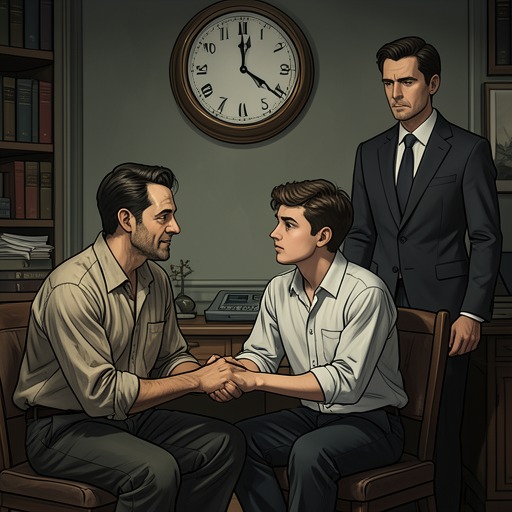
American RustBilly Poe and Bud Harris’s relationship is a long-standing bond between a young man and the local police chief, built on earlier help and tested when Poe becomes implicated in a killing. Harris’s protection of Poe carries real consequences: it leads him to conceal evidence and bend ordinary police discretion, even as he considers whether loyalty has compromised his duty. Their connection is therefore not merely personal kindness. It becomes one of the pressures shaping how the case is handled and what Poe is asked to do next.
Earlier Favor and Local Reputation
Before the factory death, Harris had helped Poe get out of an assault charge stemming from a fight with a teenager from Donora. The episode was known around town, and Poe understood that Harris had given him a significant break. In the immediate aftermath of the later killing, Poe thinks that he might turn to the chief again, then recognizes that the opportunity has passed: with the new death, approaching Harris could make both of them look guilty. The prior favor offers no easy escape from the present case.
Poe’s thoughts also associate Harris with his mother. He wonders whether Grace had been involved with the chief and recalls the rumor that Harris’s intervention followed their time together. This is presented through Poe’s suspicion, not as confirmed fact. Its importance lies in how Poe interprets Harris’s help: the earlier act of leniency seems to him bound up with adult loyalties and a personal connection to his family, making the chief’s protection feel intimate as well as official.
The favor’s shadow deepens Poe’s sense of what he has lost. He feels guilt over the dead man and thinks of the college opportunity he had declined, including Colgate, where his coach had helped him gain admission. Harris’s earlier rescue cannot restore that path or settle whether Poe acted in self-defense. By the time Poe considers contacting him, the question is no longer simply whether the chief can help; it is whether renewed help would expose the connection between them.
Harris’s Conflict as Chief
Harris’s conduct makes the relationship visible from the other side. After an anonymous tip brings him to the crime scene, he feels relief on seeing that the dead man is a transient, because he expects fewer painful calls and visits if the victim has no known family or friends. He then hides Poe’s jacket. People come and go through the day without noticing it. The concealment is a direct exercise of police discretion, but Harris tells himself that overlooking minor wrongdoing can be part of maintaining a community’s unspoken understanding of what it means to do right.
That justification does not quiet his doubts. Harris recognizes that the central question is whether he should be protecting Poe at all, and considers the opposing view that he should retrieve the jacket and arrest him. He calls the cautious voice in his mind Even Keel, but also thinks of that voice as cowardly. Instead of acting at once, he remains in his truck to watch and see which judgment proves right. His hesitation does not erase the decision already made: the jacket remains hidden, and his personal attachment to Poe has become part of his professional conduct.
Steve Ho names the difficulty plainly, warning Harris that the town knows he previously spoke up for Poe. The reminder makes the old favor a public liability, not just a private history. Harris’s conflict also unfolds while the department is under pressure: the city’s budget cuts its share from $785,000 to $541,000, requiring reductions in training, continued use of aging vehicles, and the layoff of three full-time officers. The evidence does not make those cuts the cause of Harris’s choices, but they place his discretion within a department facing severe constraints.
Protection During the Investigation
When Harris encounters Poe, he first asks whether he is Billy Poe, then notices a cut on his neck. At another encounter, Harris finds Poe hunting near the trailer and approaches the concealed hunting spot. Poe fears he will be caught poaching, but Harris tells him to take his rifle back to the house so it will not rust. The exchange shows the chief recognizing Poe’s presence and choosing a restrained response rather than escalating the encounter into an arrest. His leniency remains practical and specific, not a declaration that Poe is beyond the law.
When the killing is under investigation, Harris tells Poe that he did the right thing and urges him to explain what happened and identify who else was in the plant, so the case can be presented as self-defense. He warns that a jury may see only that Poe killed a man and fled. Harris’s advice thus combines reassurance with a demand: protection depends on Poe giving an account that could support a legal defense. The relationship gives Harris reason to help, but it cannot itself determine what the evidence or a jury will make of the case.
Harris lets Poe go home for the night, invoking Poe’s mother, and says he will return the next day to take him in before the state police do. He tells Poe to get rid of the shoes and burn any box or receipts that could connect them to him, while warning him not to run. This is the sharpest contradiction in Harris’s role: he is trying to prepare Poe for an arrest and a possible defense while also instructing him to destroy evidence. His care for Poe operates through actions that may deepen the legal danger they are meant to manage.
Consequences and Limits
The case does not remain a private matter between the two men. Poe’s photograph appears on the front page of the Valley Independent beneath a headline identifying a football star charged in a killing. Lee learns that the police chief has come looking for Isaac, likely a witness and, at that point, not a suspect. The public charge and the search for a witness show how quickly the investigation reaches beyond Harris’s personal decisions and draws family members into competing obligations.
Harris later examines the witness Murray Clark’s record: DUI arrests in 1981 and 1983, followed by a disorderly-conduct arrest in 1987, with nothing since. He considers that Clark may have turned himself around and doubts the old record will be enough to discredit him. By then, Harris thinks his earlier maneuver with Poe’s jacket no longer matters. The change is consequential: concealing the jacket may have expressed loyalty, but it cannot control the evidence or the witness’s importance to the case.
The relationship is thus defined by both a genuine history of aid and its limits. Poe remembers that Harris once got him out of trouble; Harris continues to offer him shelter, advice, and a route toward a self-defense claim. Yet those acts do not remove the possibility of arrest or resolve what happened at the plant. Their bond exposes the instability of Harris’s attempt to be both chief and protector: in a town where his prior favor is widely known, even a choice meant to help Poe becomes part of the case’s moral and public burden.