Billy Poe is arrested and jailed for Otto Carson’s death
American RustBilly Poe’s arrest and imprisonment for Otto Carson’s death turn a concealed moral crisis into a public and institutional one. Removed from Grace Poe’s home, identified during a lineup, and delivered to a prison whose gates close behind him, he loses control over where he can go and whom he must face. The episode’s reach extends beyond the arrest itself: Grace is left to reckon with the cost of her choices, while Billy’s first encounters with prison reveal a social order that will shape his daily prospects.
Arrest and Separation
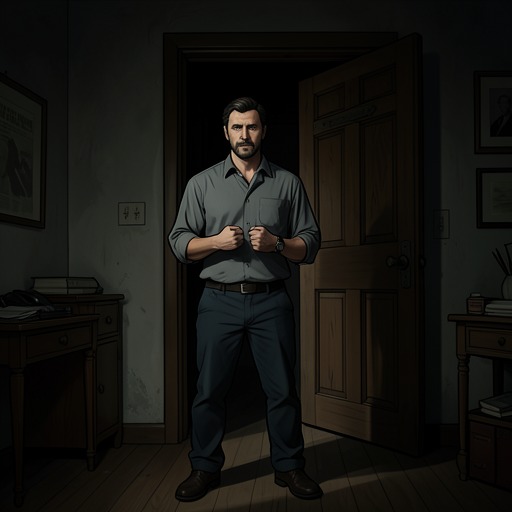
The arrest begins at home, with Bud Harris entering the bedroom where Billy has fallen asleep beside Grace. Harris wakes him and says it is time to go. Billy flinches when Harris touches his shoulder, then stands between Harris and his mother, blocking the view of her. The gestures make the departure intimate as well as procedural: Billy is being taken away, but he is also trying to shield Grace from the sight of what comes next.
On the drive, Harris pulls over before they reach the main road. He explains that Billy will have to ride behind the partition and be handcuffed because state police may be waiting at the station. Billy lets Harris cuff him, and the confinement calms him. The detail marks an early reversal: what might ordinarily signal humiliation or resistance instead offers a temporary limit to the uncertainty of the arrest. Harris is both the officer taking him in and the person trying to prepare him for what awaits.
At the station, Billy is placed in a holding cell and later brought to stand against a wall with five men of roughly his age and height. One of the men is a police officer who had been in the lobby but is now dressed in civilian clothes. They face a mirrored window before Billy is returned to his cell. Harris later tells him that the identification did not take long. The lineup turns suspicion into a consequence Billy can no longer avoid, even though the account does not detail who made the identification or what they saw.
Harris says he is trying to persuade a local public defender to take Billy’s case. Billy thanks him, but the offer cannot change the immediate fact of his detention. He is taken from the station in a caged van, traveling through winding country roads before arriving at a newly built prison on a hill. The compound’s high fences, razor wire, guard towers, patrol vehicle, and dirt yard establish a setting organized around surveillance and containment. At the gate, Billy watches the way back recede as it closes behind him.
Intake and the First Night
Inside, guards take the large manila envelope containing Billy’s wallet and watch, count his money in front of him, and direct him through a search. The process reduces the possessions he brought from outside to items to be inventoried and checked. Afterward, he asks about dinner and is told that he has missed it. He makes his bed, looks for something to occupy himself, drinks water, and lies down. The first night brings no settled adjustment: his thoughts race, and he feels that he does not belong in a place like this.
That response gives the transfer its emotional weight without making prison seem like a single, completed ordeal. Billy has crossed a threshold, but he has not yet learned how to inhabit the world on the other side. The institution controls his movement and access to ordinary comforts; the uncertainty of his case and the absence of familiar support leave him confronting confinement before he can understand its routines.
Grace and the Cost of His Absence
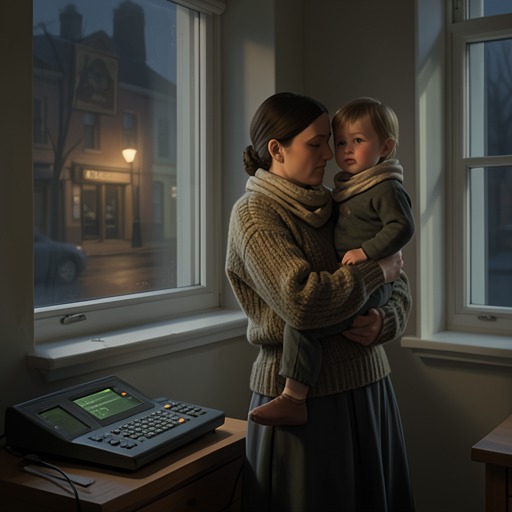
When Grace returns from work, the lights in the trailer are off and everything is as she left it, except that Billy is gone. She cannot bring herself to start a fire or get up from her chair. Her earlier hope that nothing would happen to him gives way to the possibility that he may not come home for a long time, perhaps ever. His arrest therefore separates them in more than physical terms: the person she has spent her life caring for is now beyond her reach, and she has to imagine a future defined by his absence.
Grace connects that loss to decisions made over many years. She thinks she stayed with Virgil rather than moving away, and that her choice helped leave Billy in the Valley; she also recalls abandoning her college education when Virgil could not manage the bills alone. Her account is not a simple explanation of the arrest, but an anguished effort to trace the circumstances that preceded it. The event makes her question what love and compromise have cost, while showing how Billy’s imprisonment reverberates through the life of the person left at home.
Prison’s Informal Order
Billy’s first trip to the cafeteria shows that confinement has a social structure beyond its formal rules. In the crowded corridor, prisoners move through a bottleneck beneath fluorescent lights. The cafeteria is loud and divided into racial sections; white prisoners form a smaller, quieter group. At one end of their area sit three large, tattooed men who appear to command authority. Billy studies the room and his own football tattoos, aware that he has entered a community where status and affiliations may be read from appearance, even though he did not choose his tattoos with prison in mind.
That order soon presses on him through Dwayne and Black Larry. Black Larry says Billy should keep his head down until an issue with the DCs is settled, and Dwayne offers to provide something from his cell. Billy refuses to follow Dwayne back, unwilling to enter a private space with a man he barely knows. The others laugh, and Dwayne reassures him. The exchange exposes the uncertain terms of assistance: protection and material help may be available, but accepting them can mean entering relationships Billy does not understand.
Later, Billy is told that Fisher’s name will be on a shirt and that no one else will be there; he is instructed simply to do what he does. When Billy asks why, Clovis complains about the questions. The episode does not explain the full plan, but it makes clear that Billy is being drawn toward an action whose purpose is withheld from him. Still later, he enters the cafeteria, sees Clovis with younger men and Dwayne, and turns away. He attempts to leave through the route toward the recreation yard, but the doors are locked; Clovis and several of the younger men catch up behind him. The arrest has become an ongoing condition of exposure to prison authority and pressure from other prisoners, with neither formal confinement nor informal alliances offering him an uncomplicated path to safety.