Billy and Virgil Poe’s estranged father-son relationship
American RustBilly and Virgil Poe’s estranged father-son relationship is defined less by a single rupture than by a long imbalance: Virgil remains part of Billy’s family life, but Grace Poe bears most of the work of raising him. The consequences surface in Billy’s adulthood, in Grace’s account of the choices she made around the family, and in the violence that Billy associates with his father and the generations before them.
Family structure and Virgil’s role
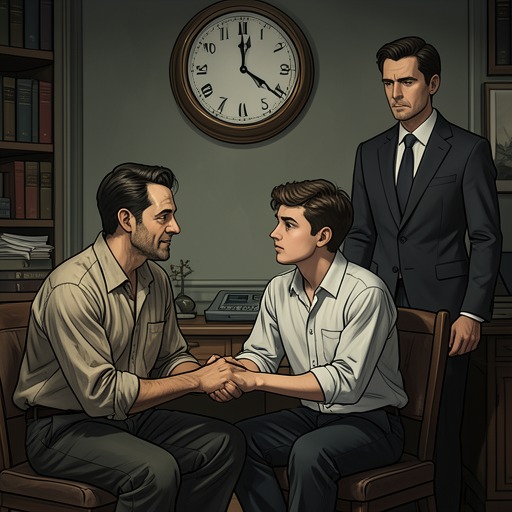
Billy grows up with Grace and Virgil, but Grace remembers herself as the parent who carried the daily responsibility. At a football game during Billy’s senior year, after he scored for the Eagles, Virgil treated their achievement as shared. For Grace, the moment exposed how differently they understood parenthood: in her view, Virgil’s limited participation, including throwing a football with Billy for about an hour a week, did not amount to raising him. Her recollection makes the couple’s disagreement more than a dispute over credit. It reveals the gap between Virgil’s occasional performance of fatherhood and Grace’s sustained care.
Bud Harris presents a similarly stark account of Virgil’s material contribution. He tells Billy that Virgil had made only two child-support payments in his life. Harris also recalls trying, six years earlier, to persuade Grace to take a job he had arranged for her in Philadelphia: a senior executive assistant position with an annual salary of thirty-four thousand dollars and a pension. Harris says Grace had been reluctant to move Billy away from Virgil, while Billy was still playing football and living at home. This is Harris’s retrospective account, offered while Billy is in custody, and it arrives as part of his rebuke; still, it identifies the family choice at stake. Remaining near Virgil was presented as a reason to pass up a more secure opportunity.
Billy’s circumstances later make that lost possibility especially pointed. The town had expected him to attend college and continue playing football, but he is instead living in Grace’s trailer, with his former prospects behind him. He has worked as a stockboy, though the store owner laid off its employees. Harris cites Billy’s dependence on Grace and difficulty keeping work as evidence of immaturity. The novel places those criticisms beside the family history: Billy is judged for not having established an independent life, while the father whose support was scant remains part of the history that constrained Grace’s decisions.
Violence and inheritance
Billy’s account of his childhood links Virgil not only to absence or limited contribution but also to physical violence. He recalls that Virgil had hit him repeatedly. When Billy was seven, during a hunting trip with Virgil and Hiram Poe, he accidentally startled deer and spoiled Hiram’s shot. Virgil defended the child at the time, but Billy later learned that Hiram had been angry at him; he also remembers Hiram hitting him on an occasion when Virgil was not present. The episodes distinguish Virgil’s occasional defense of Billy from the broader pattern of harm Billy experienced within the family.
Billy reflects on that pattern as something passed down through generations, locating its cause somewhere before either Virgil or Hiram. That thought frames violence as inherited, but it does not erase what the men did or what Billy endured. The family’s history can explain how its conduct came to feel ordinary without making it inevitable or harmless. Billy’s reflection also suggests how difficult it is for him to separate his own identity from the behaviors associated with his father. In prison, he considers himself poorly suited to classroom learning but unusually capable when playing football: competition brings an intense, almost future-seeing perception of other players and the field. His athletic self is a version of himself he likes best partly because, in those moments, he feels governed by something beyond his ordinary sense of self. That contrast gives weight to his fear that his life decisions and his violent reactions are entangled with the family history he has inherited.
Grace’s choices and the cost of staying
Grace’s reflections after Billy’s arrest broaden the father-son relationship into a history of compromises. She remembers beginning college and then giving it up because Virgil could not manage the bills alone. She also recalls that he resented her education and repeatedly asked when it would pay off. In retrospect, she sees her own opportunities narrowing: she took work she disliked and remained in a marriage in which Virgil, she believes, manipulated her into supporting his easier life. She recalls his claims that he was looking for work and says that, when he did earn money, he sometimes cashed his pay himself rather than bringing all of it home. These details establish the economic pattern behind her sense that she was left to carry the household.
Her decision not to pursue Harris’s Philadelphia offer had a direct family dimension. She had thought Billy might flourish, and the prospect of moving him away from Virgil weighed on her. Years later, after Billy is taken into custody, she sees that choice alongside the consequences of abandoning college and remaining in the Valley. She does not place all responsibility on Virgil; she blames her own decisions as well, while recognizing how his influence and conduct helped shape them. Her account therefore complicates any simple division between a wholly responsible mother and a wholly absent father: Grace claims the burden of care, but also describes how her attachment to Virgil affected the options she chose for herself and Billy.
Estrangement and its consequences
Virgil’s place in Billy’s life remains emotionally consequential even when he is not present in the scenes between Billy and Harris. Harris tells Billy that he has too much of Virgil in him, using the comparison to condemn Billy and to emphasize the harm he believes Virgil has caused the family. Billy responds with anger rather than accepting Harris’s judgment. The exchange shows how paternal resemblance becomes a weapon in the present: Billy is made to answer for the father he has known, while also being warned that he may be repeating him.
Grace, meanwhile, remembers that Billy now hates his father and admits that this gives her a small measure of satisfaction. The feeling is not a sign of reconciliation; it registers how thoroughly the marriage has divided the household. At the same time, the novel does not reduce Billy to Virgil’s copy. Billy’s reflections reveal his awareness of inherited violence and of the decisions that have left him stalled, even as his actions and circumstances keep him bound to the family history. The relationship’s significance lies in that unresolved tension: Virgil’s limited support and harmful influence help shape Billy’s world, but neither Grace’s account nor Billy’s own understanding turns that inheritance into a complete explanation of who he becomes.