Bud Harris kills Murray Clark
American RustBud Harris’s killing of Murray Clark grows out of a conflict between protecting Billy Poe and allowing the legal case against him to proceed. Grace Poe silently accepts the possibility that Harris will kill the witness, while Harris approaches Murray believing that he can frighten him into leaving the Valley. The encounter ends with Murray dead and Harris himself under attack.
Background and Stakes
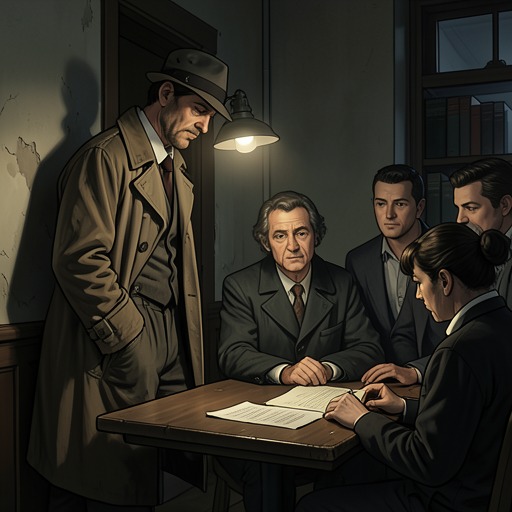
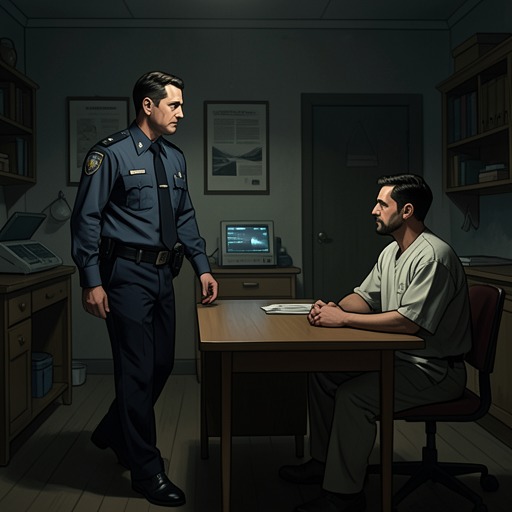
After leaving Grace Poe’s house, Harris goes directly to the police station, weighing the danger of intervening against the prospect of Billy standing trial. He considers Murray a poor witness before a jury because he is a drunk, but recognizes that any harm to him would prompt the district attorney to investigate intensely. The choice is not simply whether Billy might be convicted: Harris understands that acting against the witness could place both himself and Billy in prison.
Murray remains in the area because Carzano is paying him one hundred dollars a week in state funds under the label of witness protection, although the arrangement does not actually protect him. Harris reasons that Murray will stay as long as the payments continue unless someone makes him believe he is unsafe. To Harris, that means making an impression strong enough to drive him away; the plan sets the immediate terms of the confrontation.
Grace’s private deliberation establishes the emotional pressure behind Harris’s decision. She has not eaten for two days and sits outside, repeatedly considering whether to call Harris and ask him not to act. Each time, she imagines Billy dead and cannot bring herself to make the call. She wants Murray dead because his testimony threatens her son, while recognizing that Murray may have truthfully reported what Billy did. Grace also understands that silence is not neutral: although she has not directly asked Harris to kill Murray, she knows she is accepting his decision and sharing responsibility for what follows.
The Confrontation and Its Outcome
Harris finds Murray and points his revolver at him, telling him to leave the Valley. Murray says he will go, but makes a sudden movement; sensing someone behind him and believing he must either turn or fire, Harris shoots. A person then tackles Harris and tries to take his gun. Harris is unable to stop the struggle immediately, and his hand is injured; the available account does not identify the attacker.
In the darkness outside, Harris searches with a flashlight and spots Murray moving through brush roughly twenty to twenty-five yards away. Murray freezes when the light reaches him. Harris fires twice, then catches up with him in the tall grass. Murray is no longer moving. The encounter has turned Harris’s attempt to frighten a witness into a killing, with the attack on Harris adding a second, unresolved act of violence to the scene.
Harris’s Discretion and the Moral Threshold
Before confronting Murray, Harris had already been weighing whether to protect Billy through police discretion. He had hidden the jacket that belonged to Billy and, sitting with Steve Ho, found himself more troubled by that connection than by the act of hiding it. Harris understood such choices through an informal community compact: people were not arrested for every offense, and doing right sometimes meant stopping someone, sometimes letting them go. Yet another voice in his mind insisted he should get out of the truck, find the jacket, and arrest Billy. He chose to wait and see which judgment proved right. The later encounter with Murray marks a sharp escalation from that divided restraint: Harris no longer merely delays enforcement but directly intervenes against a witness.
That shift gives the killing its particular moral weight. Harris initially approaches Murray intending to frighten him into leaving, but the effort to protect Billy crosses into lethal action, while Grace’s silence has already made clear that private loyalty can carry responsibility even without an explicit request. The scene leaves Harris alive but shaken, unable to holster his weapon after he finds Murray motionless. His earlier language of balance and discretion cannot contain what he has done: the choice he once treated as a question of when to enforce the law has become an irreversible act against the person whose testimony threatened Billy.
The Town’s Strained Institutions
The killing takes place amid mounting pressure on Buell’s already limited public institutions. The city’s new budget cut the police allocation from $785,000 to $541,000, the largest reduction in the department’s history; training would be curtailed, aging vehicles kept in service, and three full-time officers laid off—nearly the entire staff. At the same time, the city faced crumbling infrastructure and an order to repair a sewer system that spilled sewage into the Mon during heavy storms. These conditions do not explain or excuse Harris’s decision, but they place his personal exercise of authority in a town where formal capacity was shrinking and civic problems were accumulating. The contrast sharpens the episode’s stakes: a witness’s safety and a murder investigation depend on choices made within institutions under strain, while Harris’s intervention turns public responsibility into private violence.