Buell steel mill
American RustBuell steel mill is the vast, partly dismantled industrial complex that once sustained Buell and the surrounding Mon Valley. Closed in 1987, it remains among the forests and riverbanks as a ruin overtaken by vegetation and wildlife. Its history reaches beyond the mill itself: the collapse of steelmaking and the industries around it depleted local employment, strained public services, and altered the lives of workers and their families. The mill’s surviving structures make that economic history visible in the landscape.
Setting and Physical Remains
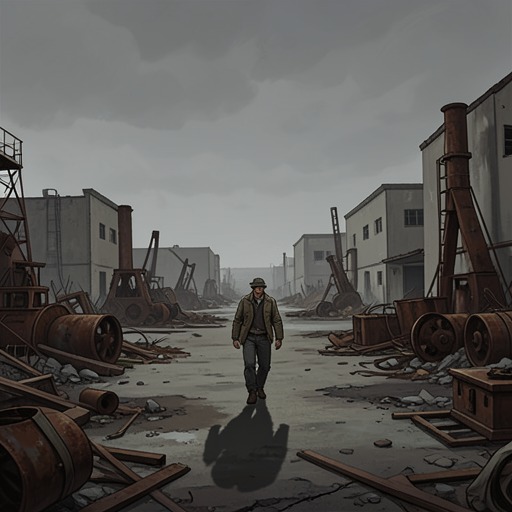
From an overlook above Buell, the mill appears within a landscape of rolling hills, forest, and the muddy river. Its grounds, once comparable to a small city, have become an overgrown expanse. Bittersweet vine, devil’s tear thumb, and tree of heaven cover the remains; deer and coyote tracks cross the site, where human squatters are occasional. This return of vegetation and wildlife contrasts with the scale of the complex that had occupied the ground.
The abandoned works remain imposing even at night. Long, empty buildings—each described as a quarter mile long and twenty stories high—stand beside four remaining blast furnaces and their powerhouses. The furnaces are rusted black; enormous pipes wind around the buildings, and slag cars remain on their tracks. Stacks of I-beams, T-beams, and other structural members have also been left behind. Dismantling stopped when money ran out, and no buyer wanted an old steel mill with its associated liabilities. The site is not simply empty: unfinished removal has left industrial equipment and materials embedded in the ruins.
From Industrial Center to Ruin
For a hundred years, the Valley had been a center of steel production in the United States and, in a broader sense, the world. Coal from the surrounding region supplied steelmaking, while a network of smaller industries—including tool and die works, specialty coating, and mining-equipment businesses—supported the mills and depended on them. The mill therefore belonged to a larger system of employment and production. When steelworks closed, the interconnected local economy contracted with them.
The narrative dates the mill’s closure to 1987 and its partial dismantling to ten years later. Across the Valley, the decline was measured not only in abandoned industrial sites but in lost work: since Isaac and Billy Poe were born, the area had lost 150,000 jobs. Many towns could no longer afford basic services, and some had little or no police presence. The account connects this regional loss to a broader industrial contrast. Penn Steel and other major American mills had gone years without investment in their facilities, while German and Japanese producers had continued to modernize. The result is presented not as a sudden local failure alone, but as the consequence of decisions about investment and the changing organization of steel production.
The Mill in Local Memory
The mill’s presence persists in the memories of people who grew up around its work rhythms. Isaac recalls walking streets at shift change, when traffic stopped and workers came out of the billet mill coated in steel dust. Among them was his father, once tall and able to lift him. The recollection places the mill inside family life: it gave shape to the working day and to Isaac’s childhood image of his father, before an accident changed the father’s mobility and the family’s circumstances.
Grace’s memories similarly mark the distance between the former industrial town and its present condition. She remembers the whistle and the crowds of workers and their families filling Buell’s streets. The town had once seemed so full of life that its rapid destruction was hard to imagine. She also remembers soot-heavy air: on some days streetlights were on at midday, and laundry could not be hung outside without becoming dirty. The mill’s legacy thus includes both the vitality associated with abundant work and the pollution that accompanied it.
Regional Consequences and Narrative Significance
Buell steel mill’s closure forms part of a wider account of economic insecurity rather than an isolated episode. Grace’s schooling ended when layoffs and the absence of available jobs left her caring for a young child. Her household waited for mills to reopen, but layoffs continued and plants closed. Later, Virgil completed job training in robotics without finding the jobs the training was meant to lead to, and a barge-making plant where he worked also shut down. These experiences show how the collapse of the industrial economy narrowed options across generations and across different kinds of work.
The consequences extend to housing and municipal life. Grace recalls that her trailer entered foreclosure before local resistance to sheriff’s sales led to a moratorium that eventually became law. Elsewhere in the Valley, shrinking budgets and a lack of infrastructure investment left towns facing large problems with limited resources. The population could begin to grow again even as incomes fell and municipal budgets tightened. In this setting, the mill’s abandoned buildings stand for more than a vanished workplace: they mark the disconnection between the region’s industrial importance and the diminished means of its communities.
The ruin also gives the book a material measure of time. The remaining stone and steel, the unfinished dismantling, and the plants growing across the grounds register both human construction and its gradual loss of control. Isaac wonders how long it will take for the industrial remains to rust away and for the Valley to return to a primitive state, imagining that only stone might endure. The mill is therefore at once a specific place, a record of industrial decisions, and a setting in which nature’s persistence makes the scale of economic change visible.