Deindustrialization of the Mon Valley
American RustThe deindustrialization of the Mon Valley is a structural force in the novel: the collapse of steel and its supporting industries remakes the region’s landscape while narrowing the choices available to its residents. Its effects appear not as a single closing-day event but as a long chain of layoffs, abandoned buildings, foreclosed homes, migration, and weakened public services. The valley’s beauty and signs of ecological return coexist with the material losses, making recovery visible without suggesting that the former prosperity can simply be restored.
The steel economy and its collapse
For a century, the Mon Valley had been a major center of steel production, described as the leading center in the country and, technically, the world. Steelmaking supported a much wider industrial system: coal supplied the furnaces, while tool-and-die shops, specialty-coating businesses, and mining-equipment makers depended on the mills and served them. When the mills closed, the interconnected industries fell with them. The contraction cost the area 150,000 jobs, leaving many towns unable to afford basic services and some without police.
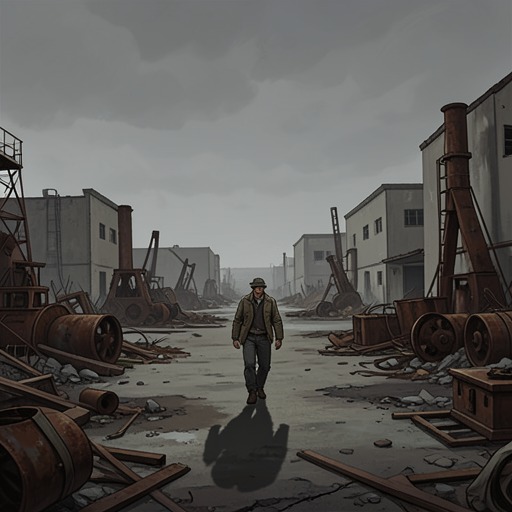
Buell gives this history a physical form. Its mill had once been like a small city. The plant closed in 1987 and was partially dismantled ten years later; the remaining buildings stood overgrown with bittersweet vine, devil’s tear thumb, and tree of heaven. Deer and coyote tracks crossed the grounds, where human squatters appeared only occasionally. The town itself retained white hillside houses, church steeples, cobblestone streets, and the silver domes of an Orthodox cathedral, but much of the historic downtown was boarded up. Some blocks still maintained the appearance of care; others had been abandoned altogether.
The novel also resists an explanation that treats the industrial collapse as the result of worker costs alone. One account recalls that Penn Steel had invested nothing in its factories for fifteen years, while many other large American mills were similarly neglected. Some plants retained single-process technology until they closed, while German and Japanese producers had been using basic-oxygen steelmaking since the 1960s and continued investing in infrastructure. Against that comparison, arguments blaming unions appear incomplete: the mills’ failure to modernize helped ensure their decline. The contrast places local hardship within decisions made by companies and industries, rather than presenting it as a simple consequence of individual choices.
Work, unemployment, and constrained choices
The contraction reaches households through layoffs and blocked routes into other kinds of work. Grace Poe remembers beginning on the rolling line at Penn Steel after high school. She had planned to continue her education, and after becoming a parent she attended classes while caring for a young child; layoffs ended that effort before she completed her associate degree. Her husband, Virgil Poe, survived several rounds of cuts but was eventually laid off with only five years of seniority, short of the ten or fifteen years increasingly needed to hold a job. He had been proud of working in the mill, especially in contrast to the coal-patch background of his family.
Attempts to replace steel employment brought little security. Virgil completed two years of training in robotics, but the anticipated jobs did not materialize. He later worked at a barge-making plant that also closed, as ship and barge production shifted overseas. At the regional level, jobs in newer fields offered no easy substitute: office work often required college, the number of such positions was limited, and some work was moving abroad as steel jobs had before it. A growing population did not mean growing prosperity. Incomes continued to fall, municipal budgets shrank, and infrastructure had gone without investment for decades.
Leaving the valley was itself difficult. Men went to Houston, New Jersey, and Virginia, sometimes sharing motel rooms and sending money back to their families, but many returned. Moving required money, while finding work was one reason to move; neither was readily available to families already struggling. Grace and Virgil had no relatives elsewhere, and staying among familiar people could seem preferable to being poor far from home. The result was not a simple choice between staying and starting over, but a bind in which the loss of local work made departure necessary while the costs of departure made it hard to manage.
Household hardship and local adaptation
The mill closures turn economic decline into immediate threats to housing and family stability. After the layoffs, Grace and Virgil waited for the mills to reopen, but layoffs continued and plants shut down. They had little money and a young child. The loss of homes and families was not an abstraction: Virgil’s cousin, who had held a mill job and made large payments on a house with an in-ground pool, lost the house, his wife, and his daughter in a single day after the bank changed the locks. He later died by suicide in the kitchen of the home he had entered. His story stands among the many accounts of catastrophe associated with the valley’s industrial collapse.
Grace and Virgil’s trailer also faced foreclosure. Residents began picketing sheriff’s sales, with deer rifles kept in car trunks; after a banker arrived to press for action, protesters overturned and burned his Cadillac. The judge imposed a foreclosure moratorium to prevent people from being shot, and the pause eventually became law. The couple kept their home, but survival meant relying on a food bank and venison poached by Virgil. They ate venison for two years, leaving Grace unable to bear its taste. This adaptation preserved the household while recording the cost of doing so.
The region’s changing labor market is visible in what remains available. A later observation describes housing for older people being built across the valley and home-health work becoming one of the few accessible forms of employment, while teaching jobs were scarce. This shift does not restore the wages or security associated with steel. It instead shows how the local economy reorganizes around care work and an aging population as industrial employment recedes.
Public institutions and the altered landscape
The same contraction strains municipal government. Buell’s police department faces recurring budget crises and the prospect of disappearing into a regional force. In one earlier shortfall, the city ran out of money in late November; for the last four weeks of the year, employees borrowed against their paychecks from a local bank, and the city paid the loans after the New Year. The episode conveys how routine public administration has become precarious. More broadly, small-town budgets confront problems associated with much larger places, while deteriorating infrastructure and declining incomes compound one another.
The police cannot repair the economic conditions that produce instability. The narrative links secure employment, pensions, and health insurance with the everyday stability of households, while showing how public criticism can demand that officers solve problems rooted in a weakening social order. That tension sharpens the distinction between visible enforcement and the underlying absence of stable work. The region’s difficulties are not reducible to policing, nor can the department replace the economic foundation that has eroded.
The valley’s altered landscape makes the duration of that erosion visible. An abandoned house can stand in a nearly empty neighborhood, its yard overgrown, while deer move down the paved street at midnight. At the former mill, vegetation spreads through the remnants of the plant. Elsewhere, fields that had been overgrown are returning to woods, and bears, coyotes, and deer are again present. These changes suggest that nature can reclaim places left behind by industry, but they do not reverse the human costs of lost work, abandoned homes, or diminished services.
What recovery can and cannot mean
The younger generation encounters the valley after its industrial height. One perspective sees the good parts of the landscape without having experienced the prosperity that made steelworkers’ wages a local measure of what had been lost. The land is beautiful, creeks are plentiful, and woods are expanding; yet the region will not again be the wealthy place it once was, and residents must adjust to work that pays less. This difference in experience makes decline neither a uniform memory nor a finished historical episode: those who remember the mills measure the present against abundance, while those born later may recognize what remains as valuable in its own right.
The novel’s account of deindustrialization therefore holds two forms of endurance together. The Mon Valley’s industrial network, jobs, and municipal capacity have suffered lasting damage, and individual households carry that damage through curtailed education, insecure housing, and difficult decisions about migration. At the same time, people find ways to stay, and the nonhuman landscape grows back through the ruins. Ecological return is real, but it is not an economic recovery; the green growth around Buell’s mills marks a changed relationship between land and industry rather than the restoration of the community that steel once sustained.