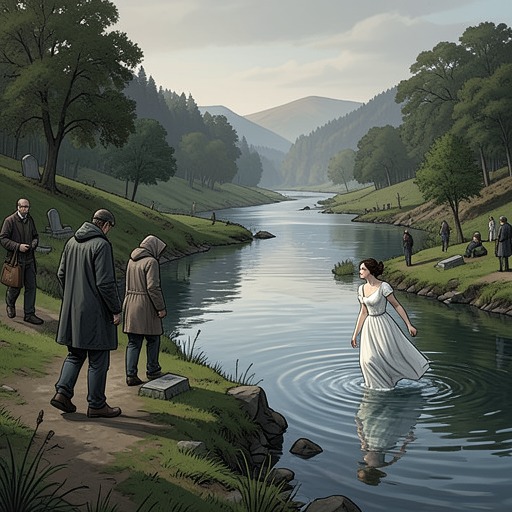
Drowning death of Isaac and Lee’s mother
American RustMary English’s drowning is a defining loss for Isaac English and Lee English, but its circumstances never become fully knowable. Her body was recovered from the Lock Four channel after two weeks missing; the autopsy established drowning, while the stones in her coat pockets and Henry English’s suspicion of murder leave the family confronting questions the available evidence does not settle.
Disappearance and Discovery
Mary English was missing for two weeks before she was found in the actual lock channel at Lock Four. Isaac recalls that the pale cement walls made her body visible against the channel. Lee had told him where she was recovered, though no one knew where she had entered the river. The distinction between where Mary went in and where she came out remains central to the account: the place of recovery is known, but the events leading to it are not.
Henry English was convinced that Mary had been murdered, suspecting skinheads, but the autopsy found water in her lungs and no other wounds. That finding established drowning without explaining how she came to be in the river. The narrative does not resolve the gap between Henry’s suspicion and the medical finding, or establish the precise circumstances of her death.
The Stones and Isaac’s Memory
The detail that most sharply unsettles Isaac is that eleven pounds of river stones were in Mary’s coat pockets. He had estimated their weight by collecting field stones and checking them on a scale. In the same memory, he recalls that Henry caught him weighing himself. The connection makes the stones more than a forensic detail in Isaac’s mind: they bring his mother’s death into contact with his own past thoughts about the river and the weight needed to sink a person.
Isaac imagines Mary walking along the river, gathering the stones and humming. This is his reconstruction, not a witnessed account of what happened. As he remembers her, he also considers that she had her own pain, a suffering he understands as inward. His response shifts from trying to account for the physical evidence toward acknowledging a distress he cannot fully know or undo.
The River and Its Industrial Setting
The memory returns to Isaac while he is traveling beside the river at night. Across from Charleroi, he sees the lights around the cranes at Lock Four and recognizes the site where Mary was found. Barges and towboats move through a river that is also part of the region’s working landscape; elsewhere Isaac observes coal traffic, power plants, and the extensive Clairton coke works. The river’s natural and industrial features coexist, but the evidence does not connect pollution or industrial activity to Mary’s death.
The wider setting is one in which environmental damage and everyday life are closely entangled. Isaac knows that fish from the river carry mercury and PCBs, though people still eat them, and Buell’s failing sewer system spills sewage into the Mon during heavy storms. These details establish the compromised condition of the waterway, not a cause of Mary’s drowning. Against this landscape, the lock channel is both a working piece of infrastructure and the place where the family’s unanswered loss becomes concrete.
Aftermath and Significance
Mary’s death recurs in Isaac’s thoughts as he moves through the same river country. The recovery site gives his memory a fixed location, but not a complete explanation: Lee can tell him where Mary was found, while the point at which she entered the river remains unknown. The stones invite inference, yet neither Isaac’s imagined scene nor Henry’s suspicion closes that uncertainty.
The episode also shapes how Isaac thinks about death and the obligation to the living. At the river, his recollection of Mary’s suffering sits beside his effort to affirm the value of life. Her death is therefore not only a past family tragedy but a continuing pressure on Isaac’s own choices: he confronts the possibility of despair while trying to turn attention back toward living. The account preserves both the weight of what happened and the limits of what the survivors can know.