English family home
American RustThe English family home is a Georgian Revival house in Buell, Pennsylvania, built for a steelmill manager and inherited by a family whose fortunes became inseparable from the Valley’s industrial rise and decline. It is at once a substantial relic of better-paid mill work and a strained domestic space: Henry English lives there in a wheelchair, Isaac English has made its rooms crowded with books, and Lee English returns after years away to confront what care for her family will require. The house gives the family shelter, but its failing condition and emotional history make remaining there difficult to distinguish from being trapped.
Setting and Industrial Legacy
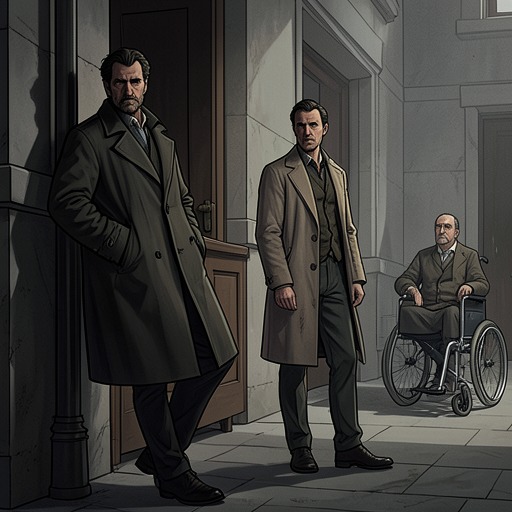
From the property, the landscape opens onto rolling hills, forest, pastures, and fields, with a spring and familiar trees below the house. When Isaac leaves, he looks back at Henry seated in his wheelchair on the back porch, facing that view. The quiet scene carries the history of the house: Henry had worked overtime to buy it and had been proud of owning it. Its Georgian Revival design and manager’s origins place it within the prosperity once generated by the steelmill, while the family’s diminished circumstances expose how little that former status can protect them from later hardship.
That history belongs to a wider regional collapse rather than to one household alone. The Valley had been a center of steel production for a century, but had lost 150,000 jobs in the years since Isaac and Billy Poe were born. Towns struggled to afford basic services, while Buell’s former mill stood partly dismantled and overgrown. The house’s value therefore rests uneasily between its original connection to industrial prosperity and the weakened local economy that surrounds it. It remains physically imposing, but its meaning has changed with the community that once made such a home attainable.
Rooms, Memory, and Daily Life
The house’s interior registers both neglect and Isaac’s habits. When Lee lies on the living-room couch, she sees water-stained ceilings, wallpaper curling away from dry plaster, and Isaac’s books spread across shelves, the upright piano, and other available surfaces. Thrift-store science textbooks, magazines, and books about nature and popular science have accumulated until the living room seems crowded, leaving barely enough room for Henry’s wheelchair to pass. Lee recognizes the books as evidence of her brother’s curiosity and self-education, but also worries that his world is narrowing around the house.
The family’s rooms divide care and separation without resolving either. Henry sleeps in a den converted into a bedroom off the kitchen; Lee hears his snoring and notices pauses in his breathing as she moves through the small dining room and kitchen. Upstairs, Isaac keeps to his second-floor room. When Lee comes to see him, he locks the door and later pretends to be asleep beneath the covers while she stands silently outside. The house enables proximity, but the siblings’ encounter is defined by what they do not say.
The building itself needs substantial work. Lee inventories the roof, paint, plaster, rotted window trim, and brickwork that needs repointing. Though she considers the house beautiful, she doubts that repairs would cost less than the amount the family could recover by selling it as it stands. She contrasts a possible two-million-dollar price in Boston or Greenwich with perhaps forty thousand dollars in the southern Mon Valley. A neighbor’s house has been empty for twelve years, its For Sale sign faded and rotted; even a new highway north toward Pittsburgh seems to pass through a place with too little activity to use it. The comparison makes the home’s value depend not simply on its structure but on the fortunes of the region around it.
Family Conflict and the Question of Leaving
Lee’s return brings the question of the house into direct conflict with her own departure. Having left for Yale, she has found a sense of belonging away from the Valley and does not want to give it up by moving back permanently. Yet she feels responsible for Henry and Isaac, and thinks that Simon’s family will pay for a nurse; she has begun making calls and plans to interview candidates. In her view, the arrangement could allow her to help her family without surrendering the life she built elsewhere.
She also believes Isaac should no longer remain in the house with Henry. She has been considering telling their father that both children need to leave: Henry could stay with a nurse or move to a care home, but Isaac’s continued place there has become untenable to her. Her judgment is entangled with guilt. Lee sees that she left Isaac behind, and that she has delayed returning to address the family’s circumstances. She recalls how Henry treated Isaac as less fully his own than Lee, partly because Isaac was small and intellectually curious in ways Henry did not value in a son. The house thus holds an unequal family history as well as the practical demands of Henry’s disability.
Isaac’s actions make the home a point of departure and return. After taking four thousand dollars from Henry’s desk to finance his planned escape west, he comes back the following night. He and Henry look at one another and nod; Henry says nothing about the money. In the morning, Isaac hears the old man moving downstairs and watches Lee arrive in a Mercedes. He assumes she knows about the theft and avoids facing her, locking his door before she can enter. Later, when Billy Poe appears at the edge of the field, Isaac dresses, leaves through the window, and drops to the ground. His quiet exit makes the house a refuge he cannot yet accept and a family obligation he has not resolved.
A Home Under Pressure
The English family home’s significance lies in the collision of attachment, care, and economic decline within one domestic space. Its porch can frame a peaceful landscape and Henry’s pride in what he once achieved; its crowded rooms also reveal Isaac’s isolation, Lee’s distance, and the daily limits imposed by Henry’s condition. The proposed nurse, the possible sale, and Lee’s insistence that Isaac leave remain plans and intentions, not completed outcomes. The evidence leaves the family at that threshold: the house still shelters them, but its physical decay and accumulated disagreements have made staying together there an increasingly unstable arrangement.