Gang standoffs and informal order at Fayette prison
American RustFayette prison’s informal order is not a substitute for its formal rules so much as the system that shapes daily life beneath them. Segregated spaces, armed surveillance, factional influence, and conditional protection govern where Billy Poe can go and what risks he can take. His brief rise within a prison group offers cover, but also makes him a source of friction; in the end, the pressure becomes visible in his decision to leave the cafeteria rather than face Clovis.
Space, surveillance, and division
Poe first encounters prison as a place of movement under observation. In a crowded main corridor, people stream in from different cellblocks and form a bottleneck. He keeps his gaze on the fluorescent lights and polished floor rather than meeting other inmates’ eyes. The cafeteria extends this social geography: its long tables have fixed benches, and its occupants are separated by race. The white inmates are described as a smaller, quieter, apparently older group. The arrangement is more than background. It makes group boundaries legible while putting Poe in a setting where simply choosing where to sit or whom to approach has consequences.
The yard seems to offer open space, but it is bounded and watched. On Poe’s third day there, inmates move in small and large groups beneath guards stationed in towers with rifles. Beyond the double fences and razor wire, the green Valley remains visible, yet Poe feels that it has become a different place to him. The view emphasizes the distance between the world outside and the prison’s enclosed social order: the landscape is still there, but it no longer represents uncomplicated freedom.
Factions and conditional protection
The weight pile has its own hierarchy. Shotcallers and lieutenants occupy the center, while other inmates run errands, maintain a perimeter, and sometimes obstruct the guards’ view of events. Poe enters an inner circle with Black Larry and several other men, but understands that his position is provisional. He follows the group’s cues, laughing and expressing anger when they do, careful not to assume that his presence means he is accepted without conditions. In this setting, belonging is something demonstrated through conduct and continually tested.
Relations among factions make the cost of that provisional standing clear. Clovis warns Poe that many inmates are against him, and points out the danger of approaching the weight pile controlled by the DC Blacks. He refers to a previous incident in which an inmate was struck with a heavy fish, a story that establishes the threat without making it an abstract possibility. Poe’s association with Black Larry’s group does not remove him from danger; it places him inside a shifting balance between groups.
Black Larry tells Poe to keep a low profile while matters with the DCs are worked out. Dwayne later explains that Poe has embarrassed a senior figure in front of other inmates and revived old tensions between the groups, creating difficulties for the people who had worked to settle them. The circle’s protection is therefore also a political obligation. Poe has received accelerated acceptance, but the advantage brings exposure: others may target him to curry favor, and the dispute affects more than his own standing. Black Larry’s later assurance that the group will respond together if Poe is attacked makes solidarity explicit, while also showing how quickly a personal conflict can become a group confrontation.
Daily exchanges and the law’s limits
Informal order is sustained through small exchanges as well as threats. A yard inmate gives Poe a hand-rolled cigarette; Dwayne sees him smoking it, shakes his head, and offers a cigarette from a package. Poe returns the roll-up to the inmate, who finishes it. The moment is modest, but it shows him moving among different social positions and learning the etiquette of exchange. Elsewhere in the yard, visitors discreetly drop items for later retrieval, while factional representatives meet privately. These gestures suggest a practical economy that does not depend on official channels alone.
Poe’s own understanding of legal authority becomes less secure as he considers what may be expected of him. He suspects that a request involving a guard could be a setup, and doubts that prosecutors understand the prison’s daily realities. He sees a gap between the law as an official claim and the conditions inmates experience, where personal intentions and the threat of harm can matter more than formal rules. The account does not make prison authority disappear; armed guards, cellblocks, and controlled movement remain constant. Instead, it shows that formal control does not settle who is protected, who is exposed, or how inmates interpret an apparent demand.
Outside the prison, Bud Harris also weighs official duty against local discretion. While deciding what to do about a jacket belonging to Billy Poe, he reasons through the community’s tacit expectation that people should generally do right, while allowing that not every minor offense results in arrest. He debates whether to protect Billy or act against him and chooses to wait and see. In another encounter, Harris says that two people appear fine and considers giving them a ride home rather than taking them into custody. These choices are not the same as prison factional rule, but they reinforce the wider distinction between written authority and the judgments made by people exercising it. The Buell Police Department faces a sharp budget reduction, from $785,000 to $541,000, alongside crumbling infrastructure and the prospect of laying off three full-time officers. The institutional limits outside help explain why local decisions carry unusual weight, without resolving their moral consequences.
Retreat and the unstable bargain
A separate instruction to Poe that no one else will be present and that he should simply do what he is there to do adds to the uncertainty surrounding what others expect of him. The available account does not establish the instruction’s full purpose, but it belongs to a pattern in which Poe cannot easily distinguish an ordinary demand from a trap. His uncertainty is not resolved by the prison’s formal structure; it deepens as he tries to interpret the intentions of those around him.
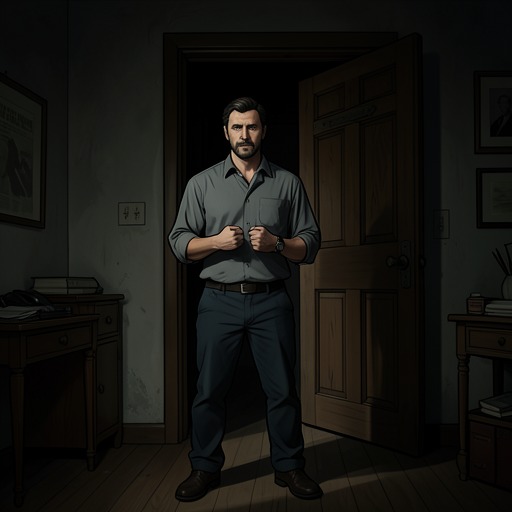
The pattern reaches a visible turning point when Poe enters the cafeteria and sees Clovis with younger lieutenants. Dwayne looks down and pretends not to notice him, while Clovis rises with an expression that suggests he has been expecting Poe. Poe’s legs begin to shake. Rather than approach the tables or remain where he might be cornered, he turns and walks out. He moves through the corridor, changes direction rather than returning to his cellblock, and makes his way toward the recreation yard and the doors. His departure is a choice made under pressure, not proof that the danger has passed. It brings together the prison’s central bargain: factional belonging can offer protection, but it also binds a person to conflicts that may leave retreat as the only available response.