Grace Poe
American RustGrace Poe is Billy Poe’s mother, a sewing worker living in a trailer outside Buell whose care for her son becomes a central pressure in her own life. Her story joins the intimate work of keeping a household warm and a child safe to the economic limits of the valley: even imagining a different future can feel like a luxury, while protecting Billy eventually requires her to make a morally difficult choice.
Identity, Work, and Daily Limits
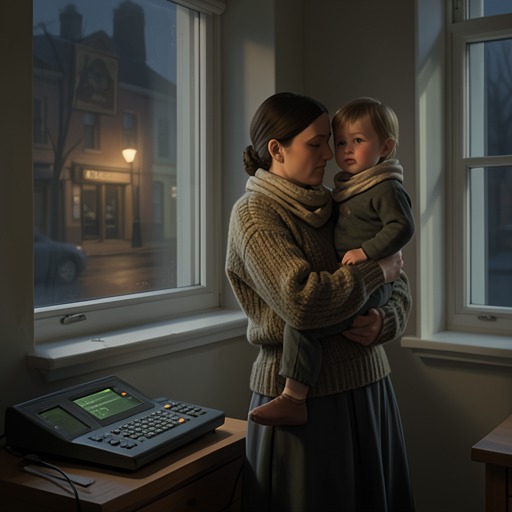
Grace’s ordinary surroundings register both her hopes and her constraints. She sits among the trailer’s brown panel walls, sometimes turning off the television simply to think. Her imagined escape is far from her actual circumstances: a journey to the Holy City or a sunny, rocky coast in Italy, with castles, warmth, and wine. She knows these trips will not happen. At home, the firewood has run out, and she wraps herself in blankets rather than use electric baseboard heaters that cost too much. Installing propane or oil heat would mean investing in the trailer she has long hoped to leave; to her, that expense would make staying feel permanent. She had never expected to live in a trailer or in the country, and the cold is bound up with that stalled expectation.
Her work gives her some flexibility but little security. Arthritis affects her hands when the weather changes, and after five or six hours of sewing they can stiffen until she can barely use them. A union organizer once suggested that the problem might be a repetitive stress injury, but the other women at the shop would not speak with him because they feared losing their jobs. Grace does not regard her employer, Steiner, as wholly bad: he lets her set unusual hours as long as she keeps producing. The arrangement accommodates her limitations while remaining dependent on her continued ability to work. She earns Brownsville wages sewing wedding dresses sold in Philadelphia, as the business expands toward New York, but rising costs make her wonder whether she can keep living this way. Fast-food and retail jobs offer little alternative; she briefly tried a second job at Wendy’s and lasted only a week.
Billy’s Absence and Her Care for Him
When Billy is away, Grace encounters his reputation in ordinary public places. At work, Lynn Booth and Kyla Evans gossip about his football violence, and even her friend Jenna Herrin joins in. At the Giant Eagle, Nessie Campbell pretends to study frozen fish until Grace reaches the checkout. The attention leaves Grace exposed to the town’s judgments while she continues her sewing, trying to keep her stitches even. At home, cold weather and unfinished tax forms add small obligations to a mind already occupied by her son’s situation.
Her worry turns into direct care when she sees Billy outside in the snow. He does not respond when she calls, and when she reaches him he is barely able to focus; she finds him badly chilled and wounded. Grace tries to lift him, supports him until he can stand, and guides him toward the house. She gets him into the bathroom and runs a hot bath with him still dressed. The scene makes her care physical and immediate: she does not wait to understand what has happened before trying to bring him inside and warm him.
Virgil and Harris
Grace’s relationship with Virgil reaches a point of separation when she tells him to take what he brought and watches him leave. At first she forces herself to get up rather than remain in bed, then cries after recognizing what she had resisted believing: that he may have returned because he was short of money or had been left by another girlfriend. She throws away the whiskey he leaves, unwilling to drink from a bottle he has touched. Her anger also clarifies what she sees in him. She connects Billy’s quick temper to Virgil, recognizes that she had noticed Virgil’s cruelty before, and understands that she had chosen to disregard it. The change is not simply disappointment at his departure; she feels her attachment to him switch off.
Bud Harris occupies a different, unresolved place in her life. Grace thinks about whether calling him will help or harm Billy, and later Harris visits her trailer with wine. They kiss, but when he enters the house he says he knows nothing more about Billy. His admission leaves Grace without reassurance even as their personal intimacy resumes. For Grace, the decision to contact him is not separate from her fear for her son: she has to weigh what she feels for Harris against whether he can do anything for Billy.
Choosing to Seek Help
As Billy’s absence stretches on, Grace’s concern deepens into an examination of her own motherhood. She enters his room, sits on his bed, and takes in its posters, clothes, hunting magazines, school papers, and the curtain rod he never repaired. The familiar room feels still and empty. She thinks she has done her best but fears it was not enough, and recognizes how often Billy had given her a reason to keep going. His hunting bow and rifle, carefully maintained and mounted on wooden pegs he made himself, sharpen the force of the room’s quiet: these are the possessions he consistently cared for, now left behind while he is gone.
Grace’s distress does not resolve into a simple distinction between personal goodness and maternal loyalty. She tells herself that the man connected to Billy’s predicament is homeless and regarded by Harris as a nobody, but she decides that Billy must come first. She regards the choice as self-defense, while acknowledging that it is not how she is supposed to think. After a long bath, she calls Harris, who promises to come over. The call is a consequential change from wondering whether to involve him to asking for his help.
Grace’s arc is shaped by decisions made under limited options: whether to spend money on a trailer she hopes to leave, how to manage work with painful hands, whether to accept Virgil’s return, and whether to ask Harris to act for Billy. Her imagined travel offers a private counterworld of warmth and freedom, but her decisive actions remain local and practical. She tries to bring Billy in from the cold, faces the emptiness of his room, and finally seeks help despite the moral unease of the choice.