Grace Poe's grief and despair
American RustGrace Poe’s grief and despair begin with Billy Poe’s sudden absence from home and deepen into a conflict between maternal loyalty and responsibility for what follows. She feels the town watching and judging her son, and she struggles to manage ordinary routines while fearing for him. As her distress narrows around his room and his possessions, she considers giving Bud Harris a gun and accepts his promise to help. Her silence later becomes part of the chain of events that ends with Harris killing Murray Clark.
Public judgment and private disruption
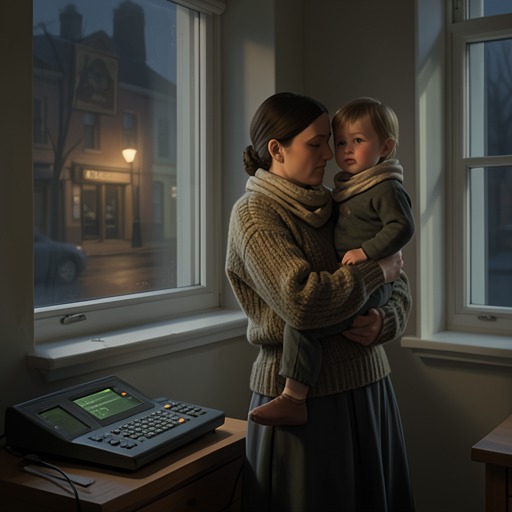
Billy Poe has been gone for only three days, but in Buell the news has already spread. At work, Grace hears coworkers discussing his violence on the football field and condemning the assault that led to his absence. She keeps her eyes down and continues feeding fabric through the sewing machine, maintaining even stitches while the talk turns her son into a public verdict. The contrast is central to her distress: the town reduces Billy to the violence it has heard about, while she remains his mother, responsible for living with what he has done and what may happen to him.
Home offers no relief. On April 15, with the house cold and the day overcast, Grace tries to turn to the unfinished tax forms. She realizes she has forgotten the deadline, but the paperwork is plainly minor beside the crisis surrounding Billy. Her inability to concentrate shows grief disrupting even the practical tasks that ordinarily structure a day. She cannot make the household’s problems orderly by attending to forms; her attention is held by her son’s absence and uncertain future.
Billy’s room and the possibility of harm
After a sleepless night, Grace calls in sick and finds herself at Billy’s bedroom door. A hole he once punched and covered with masking tape remains there, though she cannot remember what had prompted the outburst. Inside, she sits on his bed and confronts the difference between the boy she has cared for and the adult he has become. The room’s stillness makes his absence palpable without resolving what she should do for him.
His hunting bow and rifle are carefully kept and mounted on wooden pegs he made himself. Grace lifts the Winchester Model 94 rifle and cocks its hammer without checking whether it is loaded. She handles the uncertainty as a private, dangerous possibility, thinking that if the weapon were loaded the consequences would not be her fault. The thought is not presented as a settled plan; it marks how despair has begun to distort her sense of agency and responsibility. She recognizes that she should give the gun to Harris, yet also feels that the possibility has already taken hold.
Her anger has no audience. She picks up one of the old beer bottles on Billy’s dresser and wants to throw it through the window, scream, and smash the room, but there is no one present to hear or see her. The passage links her isolation to the difficulty of expressing grief: without a witness, even the act of making noise seems to her not to count. She also recalls the work she does at a women’s shelter and the people she has helped, measuring that record of care against the present crisis. Her suffering is not a simple belief that she deserves punishment; she resists that conclusion while feeling unable to escape the consequences gathering around her son.
Seeking help and accepting the bargain
Grace takes a long bath using sandalwood bubble soap she had saved for a year, a gift from the women at the shelter. She wonders what they would think, then reasons that any mother would make the same choice and that there was no alternative. She calls Harris, who promises to come over. The sequence moves from private despair toward action, but the action does not free her from the moral problem: she seeks help from a man whose judgment and choices will affect another person’s fate.
Harris has already urged Billy to explain what happened at the plant and who else was present, arguing that an account could support a self-defense case. Without that information, Harris warns, the jury may see only that Billy killed a man and fled. The legal stakes make Grace’s reliance on Harris consequential: protecting Billy may require truth and cooperation, yet the later plan turns instead toward the witness, Murray Clark. Grace does not directly tell Harris to harm him. She understands, however, that her silence is not neutral. She recognizes that the two of them already know what is being considered and rejects the excuse that Harris alone will be responsible if he acts. Her private certainty converts grief into complicity without making her an uncomplicated or fully informed participant in every detail.
Harris’s violence and the limits of her knowledge
Harris considers whether Murray might be persuaded to leave, but understands the choice as a trade made for Billy. His own memories of Vietnam bear on the decision: he once killed a man and felt that the act demanded punishment, despite the routine debriefing and confirmation recorded by an officer. His recollection that the dead had once been alive makes the later decision to kill Murray part of a longer history of violence and unresolved responsibility, not merely an expedient solution to Billy’s case.
When Harris and Murray confront one another, Harris draws his .45 and shoots Murray as he tries to leave. Grace’s role is not to perform the killing, but her awareness and silence connect her to the decision that precedes it. The distinction matters: the story neither equates her with Harris’s direct act nor lets her shift all responsibility onto him. She knows that the witness went to the police when Billy did not, yet continues to place her son’s protection first.
Grace does not know that Billy has also been stabbed in prison and nearly died after refusing for several days to see his lawyer. Harris has not told Isaac English, and he knows Grace does not yet know. This withheld information emphasizes the limits of what her distress can respond to: she is making decisions for Billy while unaware of another immediate danger to him. Her grief remains unresolved, shaped by loyalty, fear, and the knowledge that choosing to protect someone can still make a person answerable for harm to others.