Grace's silent complicity in Harris's plan
American RustGrace Poe’s complicity in Bud Harris’s plan against Murray Clark is made of an unspoken understanding rather than an explicit request. Knowing that Harris may kill the witness whose testimony threatens her son, Billy Poe, she considers stopping him and does not. The scene makes her silence consequential: she recognizes that she cannot pass responsibility to Harris simply because she never gives the order aloud.
The Choice on the Porch
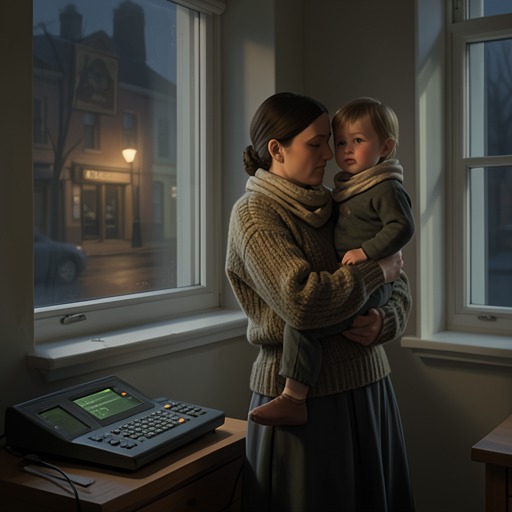
Grace spends the scene sitting on her porch, looking over the Valley as the light changes. She has gone two days without eating. Three times she considers going inside to call Harris and tell him not to act, imagining the consequences of refusing his plan; each time, she also pictures Billy dead. The competing possibilities narrow the choice to her son’s safety and the life of the man whose account may expose him.
Her thoughts return to Billy’s dependence on her from the beginning of his life. She remembers carrying him for nearly ten months, his reluctance to be born, and the fact that she never became pregnant again. That history gives the immediate decision its force: Billy has occupied the center of her care, and she sees him as someone who has always needed all her attention. Yet the landscape that once felt inseparable from her and capable of calming her now seems cold and hostile. Its continuity offers no comfort or guidance; the hills and pastures do not share her suffering or decide for her.
What Grace Knows—and Cannot Know
Grace tells herself that Harris, a former auto mechanic, has tried to kill Billy before and is trying again. Almost at once, she questions that account. She does not know exactly what Harris has done, or what Billy has done, and admits that her certainty about Harris’s intentions may be a story she is telling herself. The facts that might clarify innocence or guilt remain unresolved for her; her choice proceeds despite that uncertainty, not because she has settled it.
What she does know is why she wants the witness dead: he saw, or may be lying about seeing, Billy do something. Grace’s reasoning arrives at a blunt distinction between the man’s possible truthfulness and the danger his testimony poses to her son. She acknowledges evidence she would rather ignore: the witness went to the police when Billy did not. That detail complicates her preferred account of the situation, but does not alter her desire to protect Billy. Her maternal loyalty becomes a decision to discount evidence when accepting it could endanger him.
Silence as Participation
Grace never directly tells Harris to kill the man. She relies on that fact momentarily, insisting to herself that Harris will make his own decisions. But the attempted separation does not hold. She knows they understand each other without speaking and recognizes that she does not have to state her wish for it to be understood. In her reckoning, if Harris acts, she cannot treat his choice as separate from hers. Silence is not a neutral absence of instruction; it is the means by which she lets the plan proceed while preserving the appearance that she did not authorize it.
Her attention to the possible cost makes that complicity more, not less, deliberate. Grace anticipates that people in town will learn what happened and that she may be driven out or face something worse. She recalls the quiet surrounding Harris’s earlier effort to get Billy out of trouble, a secret that did not stay secret. The local consequences are already visible in a small estrangement: Ed Cultrap, whom she has known for twenty years, has looked at her without waving. Grace imagines further judgment and social exclusion, but accepts the risk. Her priority is that the cost fall on her rather than on Billy.
Consequence and Significance
The episode belongs to a wider pattern of Harris exercising discretion in the name of doing right. After finding a body identified as a transient, he hides Billy’s jacket, worries that it belongs to Billy, and debates whether he should defend him or expose the evidence. Rather than resolve that conflict immediately, he decides to wait and see which part of himself proves right. His divided judgment helps explain the space in which Grace’s unspoken assent operates: protection and law are already competing in his decisions, but her silence aligns her with protection at the witness’s expense.
Grace’s choice does not establish what Billy did. It establishes what she is willing to do without knowing. She recognizes that the witness may be telling the truth, understands that Harris may act against him, and sees that her own tacit consent carries responsibility. Her loyalty is both intimate and destructive: the same attachment that has organized her life around Billy now makes another person’s possible death seem acceptable. The scene’s moral turn is therefore not a confession of legal guilt, but Grace’s recognition that she cannot honestly place the whole burden on Harris.