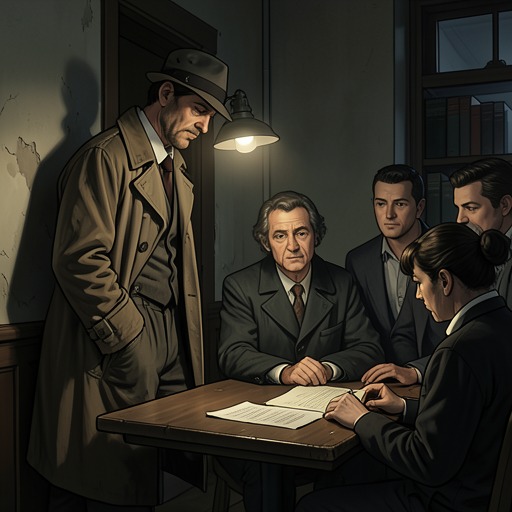
Harris hides the jacket and lets Isaac and Poe go
American RustBud Harris’s concealment of Billy Poe’s jacket and decision to let Billy Poe and Isaac English leave turn a murder investigation into a test of personal judgment against police procedure. Harris has found a body and recognizes the jacket as Billy Poe’s; rather than disclose it, he hides it and later chooses not to arrest the two young men. His actions do not establish what happened at the scene, but they reshape how the case will be handled and expose the burden of discretion in a small, financially strained police department.
Discovery and concealment
Harris is the first officer to arrive after an anonymous tip brings him to the crime scene. Seeing the body, which he takes to belong to a transient, initially brings him relief: he expects not to have to make painful calls or visits to people he knows. That response gives way to a more consequential discovery when he notices a familiar jacket. As a state trooper approaches along the old access road, Harris picks up the jacket and hides it behind a workbench. The trooper enters shortly afterward, sees the body, and does not notice what Harris has concealed.
The jacket remains behind the workbench, unnoticed as people come and go during the day. Harris’s anxiety is less about the act of hiding it in itself than about whose jacket it is: it belongs to Billy Poe. He has also stopped taking Zoloft several weeks earlier, a circumstance that he connects with his present difficulty keeping his thoughts separate. The scene therefore places a concrete piece of potential evidence beside Harris’s effort to reason through what he has done; the jacket stays out of view while the question of what to do with Billy Poe becomes harder to avoid.
Discretion as a personal code
Harris considers the choice through an informal community standard. In his view, the town’s unspoken agreement is to do right, which can mean enforcing the rules in one case and letting someone go in another. He compares the decision to overlooking minor offenses: good people may receive one free pass, while young people may receive two, with the second potentially ending in a ride in the police vehicle. This is not a formal legal rule, but a personal account of how he believes local policing works.
That justification competes with a more direct judgment. Harris thinks he should go down, find the jacket, and arrest Billy Poe. He recognizes this as one side of the argument inside him, associated with “Even Keel,” his self-name for the cautious, controlled voice that has shaped other choices, including buying a remote mountain cabin. He calls that voice cowardly, but does not immediately act against it. Instead, he decides to remain in his vehicle and see which judgment proves right. His hesitation is itself a choice: while the hidden jacket could prompt an arrest, he waits to observe what the two men do.
The return to the scene
Harris forms a theory of the crime before the men’s return. He imagines that Billy Poe and friends came to the area to drink and perhaps obtain methamphetamine, that events turned violent, and that Billy Poe killed one of them before fleeing. Harris then interprets the return as an attempt to clean up the scene. This is his reconstruction, not an independently confirmed account in the episode. He also worries that another young man has been drawn into the situation and considers whether that person might still be kept clear of it.
When Harris turns on his light bar to call the two men over, they freeze. The gesture makes his surveillance visible, but it does not lead to an arrest. Harris tells them that he will not arrest them and says that, from where he is, their shoes look fine. He proposes giving them a ride home if they promise to stay out of trouble, then warns them not to return to that area. The jacket remains concealed; instead of bringing the evidence forward, Harris uses warnings and an offer of transport to manage the immediate encounter.
Letting Billy Poe go
Harris later speaks directly with Billy Poe and tries to guide him toward a legal defense. He tells Billy Poe that he did the right thing and urges him to explain what happened and identify who else was in the plant, framing the account as necessary to establish self-defense. Harris warns that a jury might see only a killing followed by flight if Billy Poe does not give that account. This advice combines a proposed route through the legal process with an effort to influence what Billy Poe says about the event.
Harris then allows Billy Poe to go home for the night, citing his mother, and says that he will return the next day to pick him up before the state police do. He instructs Billy Poe to make sure the shoes no longer exist and to burn any box or receipts connected with them. He also warns him not to run, telling him that flight would ensure a prison sentence. The instruction extends Harris’s intervention beyond the decision not to arrest: he directs Billy Poe to remove items that could matter to an investigation, while presenting the next day’s pickup as the course Billy Poe should follow.
Institutional and human consequences
Harris’s decision takes place amid severe constraints at the Buell Police Department. The Buell City Council has issued a new budget while the city’s infrastructure is deteriorating and sewage continues to spill into the Mon River during heavy storms. The department’s allocation falls from $785,000 to $541,000, its largest cut to that point. Harris expects reduced training, continued use of worn-out vehicles, and the layoff of three full-time officers—nearly everyone on the force. The budget facts do not explain or excuse his concealment, but they place his exercise of individual authority within an institution under pressure.
The case also divides people beyond the crime scene. Lee English hears Billy Poe describe having nearly frozen in his yard because he could not face his mother after what happened. As she listens, she realizes that lawyers will be needed and that she and Billy Poe are no longer on the same side; she understands the conflict as one involving Billy Poe against Isaac English and her father. The episode does not resolve the case or confirm Harris’s theory. Its decisive change is narrower but lasting: a police officer who has hidden a jacket, declined to arrest two men, and instructed one of them to destroy evidence has made the investigation dependent on choices that formal procedure alone can no longer explain.