Henry English's declining health
American RustHenry English's declining health turns routine acts into tests of strength and planning, exposing how much he had relied on Isaac English while trying to keep his needs from Lee English. His deterioration is physical and practical: moving from wheelchair to bed, getting dressed, bathing, and managing food all require effort he can no longer take for granted. The strain also sharpens his awareness of dependence, money, family separation, and approaching death.
Decline and daily limitations
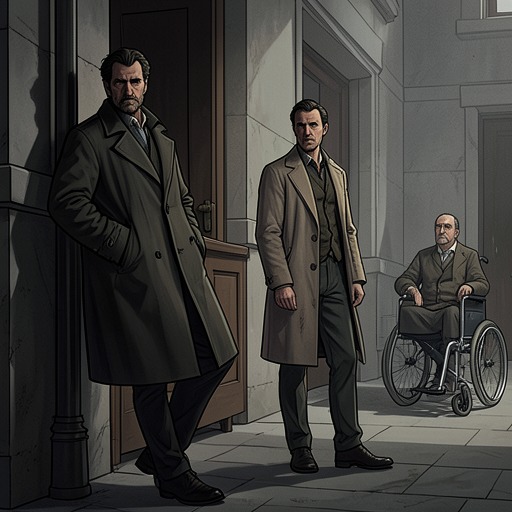
When Lee English returns, Henry appears markedly worse than before: unshaven, with his white hair flattened and untidy, his shoulders dusted with dandruff, and watery eyes. She measures the change against the six days since she arrived, though the interval feels much longer. His appearance suggests a body losing ground, not a sudden crisis with a clear boundary.
At night, the wheelchair-to-bed transfer has become a difficult undertaking. A handrail gives him something to grip, but he must haul himself across while his legs trail behind. He has managed it for five nights, yet knows a fall could leave him on the floor until morning. He refuses Lee's help, preferring to attempt the transfer alone even as that choice makes his vulnerability more apparent.
The effort continues after he reaches the bed. Undressing can take roughly forty-five minutes as he plans each small movement and tries to keep one leg from slipping back while he shifts the other. He considers sleeping in the wheelchair but recognizes that this is not a workable solution. He has not bathed since Isaac left, and suspects Lee can see the change in him. These are not incidental inconveniences: they show how Isaac's absence has removed practical assistance Henry had come to depend on.
Illness, treatment, and cost
Henry experiences his body as failing across several systems. He thinks of his kidneys, liver, and pancreas as giving out, and knows that his diet has been restricted: no alcohol, fats, or salt. The narrative does not establish a diagnosis for each organ, but it makes clear that food and illness govern his daily choices. After eating a lunch Lee prepared, he spends much of the day dealing with the consequences of the dairy and cheese; he later pretends to be tired rather than explain why he cannot go to the movies with her.
Medical appointments bring their own strain. Bills from the hospital accumulate, and Henry resents being scheduled for separate visits that he believes cost twenty-five dollars each. He distrusts the local hospital and its doctors, whom he regards as insufficiently capable, and has arranged to see a specialist in the city. The specialist, Ramesh, had examined a lump on Henry's prostate that was no longer present; Henry suspects it may never have been there. The examination briefly relieved his fear, but the experience leaves him unsure about returning to the specialist. His distrust and uncertainty complicate care at the very moment his health is worsening.
Henry also remembers the limits of endurance. He once admired stories of people surviving extreme hardship, seeing persistence as a triumph of the human spirit. Now he recognizes that such an outlook does not alter bodily reality. His imagined comparison is stark: determination may help someone continue, but it cannot restore the strength required to manage his own clothes or make a failing body well again.
Dependence and concealment
Isaac had usually helped Henry into bed. With his son gone, Henry can no longer treat that assistance as incidental; he is forced to confront how much worse off he is than he had admitted. He worries that Lee will discover the extent of his condition and respond practically by placing him in a care home. In his private assessment, Isaac would never have considered that possibility, while Lee might. The contrast reflects Henry's fear of losing control as well as his different expectations of his children.
He tries to preserve privacy even when it costs him. He does not tell Lee why he has to stay home after her invitation, and he keeps his bathing needs from her as long as he can. His resistance to help is not proof that he remains capable of managing alone; rather, each concealed difficulty makes the gap between independence and actual capacity harder to ignore. The wheelchair, the handrail, the bed, and the delayed bath register a narrowing field of choices.
Henry's concern for Isaac is tangled with regret and blame. He recalls leaving money where Isaac could find it and thinks that he should have secured it. He also recognizes that Isaac stayed with him rather than leaving earlier, and thinks of that care as a sacrifice Henry should have made for his children instead. His thoughts about Isaac's intelligence and childhood experiences do not resolve that guilt: Henry remembers a test score of 167 that he never told his son, and remembers Isaac shrugging after a painful loss in a junior-league baseball game. In Henry's view, his son could be gifted and still seem to take things the wrong way. The recollections make their relationship more complicated than simple dependence: affection, frustration, and a sense of responsibility coexist.
Mortality and the family home
The bed itself connects Henry's failing health to the household's past. It is older than either of his children and was the bed he shared with Mary English. Though its springs trouble him, he will not replace it; it remains Mary's last bed and, in his mind, will be his too. At night he sometimes feels her presence. The object is both a physical obstacle to his weakened body and a link to a marriage and family life that have ended.
Henry thinks of himself as close to death, imagining the slow failure of his body as an old pine weakened at its roots. He has a nine-millimeter pistol in a drawer and recognizes it as an option for a time when he might become too tired to continue, but the thought has remained unacted upon for thirteen years. The passage presents this not as a decision but as part of his private reckoning with bodily decline and the possibility of death.
His illness thus alters the meaning of independence inside the family home. He wants to spare Lee the truth, needs the help Isaac once provided, and resents the medical and financial systems on which he must rely. The ordinary work of getting into bed or accepting a meal becomes a measure of what has changed. His declining health is not only a condition of the body; it is the pressure that makes dependence, family obligation, and mortality impossible for him to keep separate.