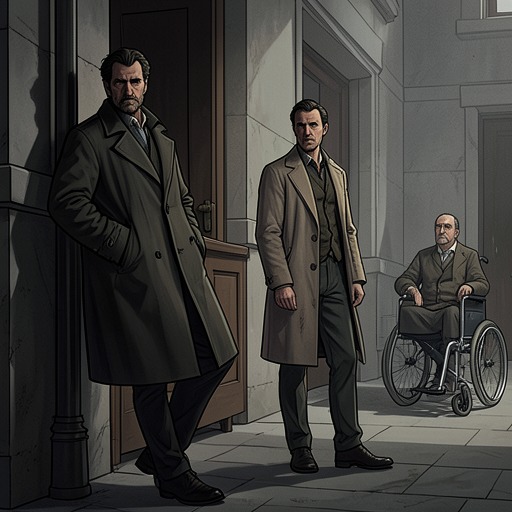
Henry English's disability
American RustHenry English’s disability is the lasting consequence of a dangerous steelworks accident: he uses a wheelchair, depends on accessible routes and assistance, and sometimes struggles to breathe while sleeping. The novel traces the condition through the contrast between Henry’s former working life and his restricted present, while connecting his altered body to unsafe industrial practice, family dependence, and a community whose economic choices have narrowed. His disability is neither an abstract symbol nor a story of simple recovery; it is an ongoing condition with practical consequences that remain bound up with loss, responsibility, and care.
The Accident and Its Industrial Context
Henry’s disability stems from an accident at Steelcor, where he had taken work that paid well but exposed workers to unsafe conditions. For three years, he commuted from Indiana and returned home only about once a month. The mill was trying to make money before its safety problems had been resolved. In Henry’s recollection, a hoisting drum lacked a safety brake, a gearbox failed, and the resulting fire forced him to jump from a tower. A young Black worker went back through the fire and dragged him out; Henry remembers that the rescuer escaped without injury.
The accident killed Chucky Cunningham and Wayne Davis. OSHA fined the company thirty thousand dollars, an amount Henry measures against the company’s earnings of the same sum every minute. That comparison places his disability within a broader conflict over who bears the cost of industrial production: workers suffered the physical consequences, while the fine seemed negligible beside the company’s profits. The injury is personal, but the circumstances that produced it are institutional.
Henry later broadens that judgment beyond the accident itself. He remembers that Penn Steel had failed to invest in its factories for fifteen years and that many American mills were left with outdated processes, while German and Japanese producers invested in their plants. He had once accepted arguments that unions made labor costs excessive, but came to see that the neglect of infrastructure had helped guarantee the mills’ decline. The accident and the region’s industrial collapse therefore belong to the same history of decisions made in the name of economy, with workers and families left to live with the consequences.
Daily Life and Physical Limits
In the present, Henry uses a wheelchair. When he and Lee English travel to Pittsburgh to consult a lawyer, she wheels him into the elevator at the old Koppers Building. Henry notices the expense of the law firm and feels uneasy about the prospect of Lee’s new husband helping the family financially. The scene makes assistance concrete: Lee’s help enables him to make the journey, but relying on her also sharpens his awareness of how much his life and family’s finances depend on others.
His physical limits also shape ordinary nights at home. Henry sometimes wakes after sleeping without getting enough oxygen and has to take deep breaths. In one episode, a creak in the house wakes him and he struggles to breathe. The narration turns from that immediate difficulty to his sense of how small his life has become, linking a bodily vulnerability to his uncertainty about the choices that brought him to this point. The text does not name a medical diagnosis for the breathing problem; it presents it as one more real constraint in his daily experience.
The wheelchair is also part of the geography of his home. During a later crisis, Henry rolls down the ramp and across the backyard in his chair. The ramp makes movement possible, but it does not erase the effort involved: the wheels sink into the soft ground, slowing him as he tries to reach the place he has chosen. The scene registers disability through the practical negotiation of space rather than through an abstract description of impairment.
Work, Memory, and Lost Capacity
Henry’s memories preserve a self organized around work. He dreams of being back at Penn Steel, tired at the end of a shift, dirty, and glad to return home to Mary English. In that remembered life, the workday gave shape to time and a sense of belonging; waking from the dream brings him back to a present in which his body and circumstances no longer permit that routine. The contrast does not suggest that his earlier life was free from hardship. It shows how much the accident and its aftermath changed the conditions through which he understood himself.
His recollection of the Steelcor accident is also colored by survivor guilt. He remembers that two coworkers died and imagines that he should have made a different choice. That counterfactual thought sits alongside his recognition that the machinery was unsafe and the company had prioritized production over adequate safeguards. The result is a tension between personal blame and responsibility at the level of the workplace: Henry turns the accident into a judgment on himself even as his memories identify failures beyond his control.
Family Dependence and Despair
Disability alters Henry’s relationships with his children. Lee helps him navigate the lawyer’s office, but her independence and new family connections make him feel that she now belongs to a world outside his own. He worries about her leaving and about losing Isaac English as well. His dependence does not simply produce gratitude or closeness; it is entangled with fear of abandonment and the difficulty of accepting assistance, especially when that help may come from Lee’s husband.
Henry’s distress also appears in his thoughts about Mary’s death and Isaac’s troubles. He wonders whether he could have acted differently, recognizes that the boy’s actions are not his responsibility alone, and nevertheless takes blame upon himself. His wheelchair-bound life forms part of this wider crisis, but the narrative does not reduce his despair to disability: bereavement, guilt, fear of losing his children, and the consequences of the accident converge. In the scene that ends with him moving into the backyard, he remains physically dependent on his chair while confronting a suicidal crisis. The supplied account does not establish what happens afterward.
Narrative Significance
Henry’s disability connects an intimate family story to the history of the Mon Valley. The accident leaves him with lasting mobility and breathing difficulties; the same industrial world that once organized his working life also failed to protect its workers and, over time, failed to sustain the region’s factories. His experience is specific—an elevator journey, a ramp, a difficult night’s breathing—while its causes reach beyond the household to workplace safety and investment.
The novel also resists treating disability as a single explanation for Henry’s character or choices. His limits affect how he moves, works, and depends on Lee, but his memories, loyalties, guilt, and judgments remain part of the portrait. By keeping physical access and family support alongside industrial accountability, the narrative shows both the material demands of his condition and the larger history that helped shape the life he now has to inhabit.