Incarceration
American RustBilly Poe’s incarceration is more than the legal consequence of the death at the machine plant: it becomes a second arena in which he must decide whether to protect Isaac English or disclose who killed Otto Carson. The prison imposes official confinement, but its daily risks are also governed by racial divisions, gang influence, isolation, and the threat that Poe will be forced to choose between a lawyer and physical danger. His silence preserves his loyalty for a time, while making his own confinement increasingly precarious.
Entry into confinement and the case
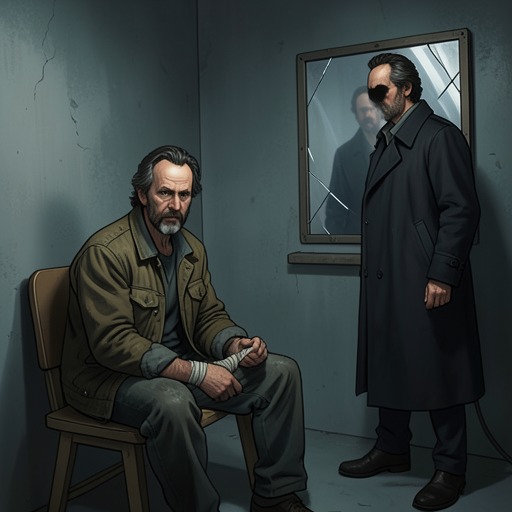
The case reaches incarceration after Poe and Isaac flee the plant rather than call the police. Earlier, they discuss reaching a Sheetz station to find a phone and call 911 for an injured man; the plan does not prevent their flight. The tension between seeking help and avoiding the authorities shadows the later legal consequences. At the police station, Bud Harris urges Poe to explain what happened and identify who else was in the plant, presenting a self-defense account as the way to give a jury a fuller understanding than the bare fact that Poe killed a man and fled.
Harris’s own decisions complicate that process. The jacket associated with the incident remains hidden, and Harris is nervous in part because it belongs to Poe. He weighs his duty to arrest Poe against an informal local understanding that people may sometimes be let go, and recognizes that defending Poe is not the same as simply concealing evidence. Rather than act immediately, he waits to see what happens. The episode makes the route from investigation to incarceration contingent not only on the alleged act but also on the judgments of people who know the accused.
Poe’s confinement also changes the situation for those outside prison. When he tells Lee English that he had nearly frozen in the yard because he could not face his mother after what had happened, she understands that the case may require lawyers and that Isaac and Poe are no longer on the same side legally. Her thoughts turn to the cost of care and legal help, including the checkbook she has brought home. Incarceration therefore reaches into a family’s practical decisions as well as its loyalties.
The prison’s spaces and informal order
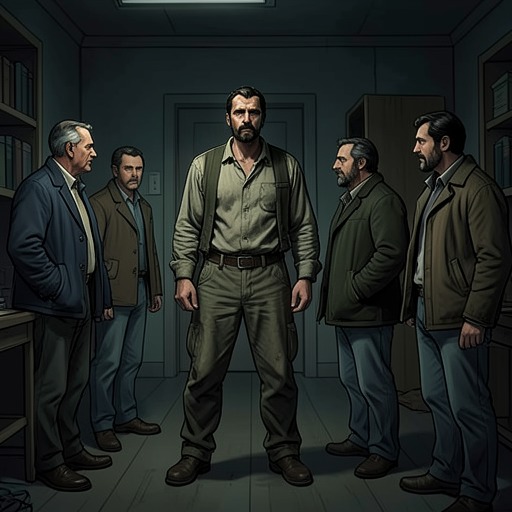
Poe encounters prison as a managed but crowded social environment. In the main corridor, traffic backs up as inmates move between cellblocks; he keeps his eyes on the fluorescent lights and polished floor rather than meet the looks around him. The dining room is divided by race. Black inmates and Hispanic inmates occupy separate areas, while the white inmates are a visible minority, quieter and apparently older. Long tables have benches attached, an institutional arrangement that also limits their use as weapons. The scene presents the prison not as a neutral enclosure but as a place where movement, seating, and social exposure are already structured.
Formal custody does not eliminate informal authority. Black Larry tells Poe that he will need to keep his head down until matters are worked out with the DCs, indicating that his safety and standing depend partly on negotiations beyond the ordinary routines of confinement. The distinction between official rules and prison alliances matters: Poe is housed and moved by the institution, yet he must also reckon with the expectations of inmates who can determine whether he is protected or targeted.
Isolation narrows his choices further. On his third day in the hole, a guard returns and orders him to cuff up. After the guard leaves, Poe listens to other inmates calling out, including one who has been shouting for help for two days. The episode makes isolation a condition not simply of separation but of limited access to support and uncertainty about what will happen next. Poe believes he has resisted a second opportunity to give in, but doubts he can refuse again.
Silence, loyalty, and legal jeopardy
Poe understands the central dilemma in stark terms: it is either him or Isaac. If a lawyer learns who actually killed Otto Carson, the information could reach the district attorney, and Isaac could take Poe’s place in the position Poe now occupies. Yet Poe also considers whether Isaac might cope with prison better than he can. The calculation does not resolve his loyalty; it shows how confinement turns loyalty into a judgment about another person’s capacity to endure the punishment.
The threat is not only legal. Poe expects Clovis and others to be waiting when he leaves isolation, and he imagines a choice between a shank and a lawyer: disclose the truth through legal channels, or risk violence for refusing to do so. His fear is part of the decision rather than an incidental reaction. He recognizes that remaining scared may determine what he chooses, but recognition does not make either option safe.
A later return to the cellblock repeats the pressure in a new form. Instead of having dinner slid under his cell door, Poe is told to cuff up. Once alone, he sharpens the plastic handle of a toothbrush against the cement and searches for metal that could be made into a weapon. He considers demanding protective custody, but sees that this would return him to the same position. The improvised point offers a possible defense, not an escape from the dilemma.
The cafeteria and the cost of refusal
Poe leaves his cell saying to himself that he only needs a quick dinner and to save his strength. In the cafeteria, Clovis is seated with younger lieutenants; Dwayne is there too, looking down and pretending not to see Poe. Clovis stands as though he has expected him. Poe’s legs shake. He turns away and moves through the corridor without a clear destination, changing direction because he fears being trapped in his cellblock and eventually heading toward the recreation yard.
The route ends at locked doors. When the men close in, Poe tries to break past them, but they catch him and beat him. He is left bloodied on the floor. The assault makes the cost of his refusal immediate without resolving the underlying choice: the evidence does not show him identifying Isaac at this point. Instead, incarceration has brought Poe to a threshold where silence, legal disclosure, and physical survival press against one another, and where neither prison procedure nor the informal promise of protection supplies an uncomplicated way out.