Inherited Violence
American RustInherited Violence is the novel’s account of harm repeating through family behavior, learned expectations, and the stories people tell about their own conduct. Poe sees his aggression as part of a family legacy, while Grace recognizes that Virgil’s influence and her own decisions helped shape the circumstances in which Billy grew up. The pattern is forceful but not absolute: the characters invoke inheritance to explain how they arrived at a crisis, yet the consequences still belong to the living.
Family Patterns and Early Lessons
Poe’s fear that violence runs in his family takes shape through memories of three generations. His grandfather, Hiram Poe, was known as the Valley’s biggest poacher and died by suicide; Poe had heard his father describe him as unstable, while also reassuring Poe that he was not like him. As a child, Poe had already experienced the grandfather’s anger directly. During Poe’s first hunting trip, he accidentally startled deer, including a large twelve-point buck, and Hiram was angry with him. Poe recalls that Hiram struck him once when Virgil was not present, while Virgil had also knocked him around. Poe’s later thought that the fault lay somewhere further back in the family turns those memories into a theory of inherited violence: each generation seems to receive a pattern whose original source cannot be located.
That explanation does not make the family history simple. Poe initially had not considered himself like Hiram, and the resemblance becomes frightening to him only after his own violence has escalated. The family story thus works both as a warning and as a possible evasion: if aggression is treated as something carried in the blood, it can seem inevitable, but it can also obscure the choices through which it is repeated.
Poe’s Escalating Violence
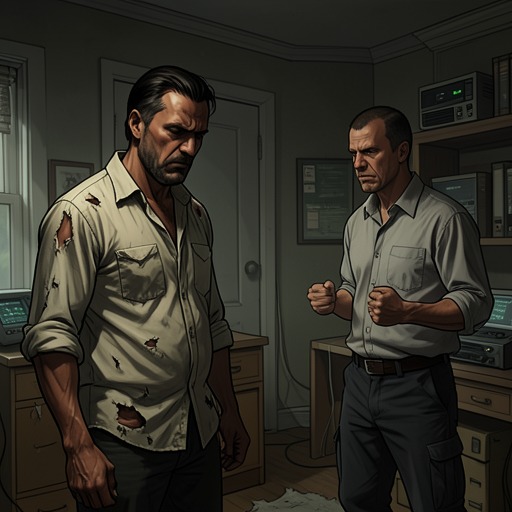
The pattern becomes visible in Poe’s movement from a fight with a boy from Donora to the fatal confrontation at the machine shop. Poe had struck the Donora boy with a bat, hitting him again after he had fallen while still holding a bayonet. The second blow led to the assault charge. Poe later learns that the boy was left unable to manage the numbers at a cash register, a consequence that makes the incident more than a moment of competitive anger. Poe recognizes that he had been testing how far he could push a situation, and that this habit helped bring him to the later crisis.
At the machine shop, Poe again remains in a confrontation after he could have withdrawn. He understands that he has won and does not want to lose, while the crowd’s presence helps turn the standoff into a contest. Isaac’s intervention results in Otto the Swede’s death, and Poe is left confronting the gravity of what his inability to step away has helped set in motion. He anticipates that the next escalation could involve someone he loves, naming his mother and Lee as possibilities. The sequence links a repeated impulse to a widening circle of danger, rather than presenting violence as a single, isolated lapse.
Poe’s reflections also show how he experiences his own capacity for action. In sports, he could read the movement of other players and the spaces opening between them, and he felt most at ease when absorbed in the game. Outside that setting, he describes himself as prone either to a surge of action or to freezing while he considers a decision from every angle. He connects his failure to leave for Colgate with the events that followed, although he also regards that failure as somehow inevitable. The contrast helps explain, without excusing, how a person who can act decisively in competition may fail to stop an escalating confrontation.
Virgil’s Influence and Harris’s Warning
Poe’s father, Virgil Poe, provides a living model of behavior that is not limited to physical aggression. Poe sees him as someone who could maneuver out of consequences, including after a barge full of coal drifted away during his towboat work. Virgil later collected disability payments while, in Poe’s view, his back was not permanently impaired. Poe also resents his father’s irregular presence and his disregard for the family. This portrait makes inheritance social as well as physical: children observe not only violence, but also the ways adults evade obligation and present self-interest as acceptable.
Bud Harris makes that connection explicit when he tells Grace that he has spent years trying to keep Billy safe and accuses Billy of having too much of Virgil in him. Harris’s history with the family complicates his judgment. Years earlier, he had seen Virgil drive through a stoplight with Billy in the car and stolen copper wire in the truck bed. Harris later tells Grace that he did not arrest Virgil then, and wonders whether Billy might have been better off if his father had been taken into custody in front of him. Instead, Harris had tried to find Grace a job elsewhere, including an offer in Philadelphia, as a chance for her and Billy to leave. His recollection shows that the adults around Billy recognized risks, but their interventions did not break the family’s course.
Grace’s Account of What Is Passed On
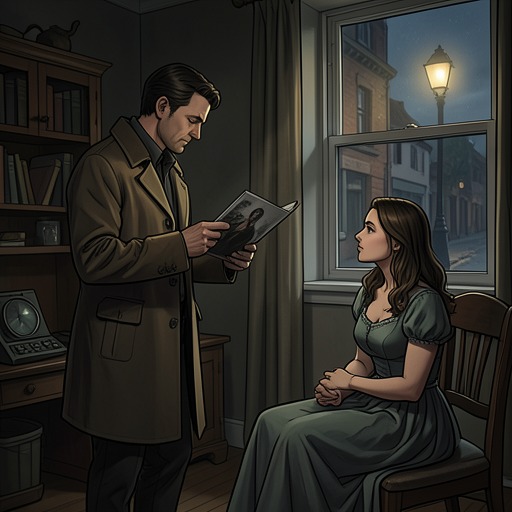
After Harris arrests Billy, Grace returns to a dark trailer and faces the possibility that her son may not come home. She interprets her own history as part of what brought them there. At twenty-two, with a young child and the Valley in a depression, she had completed three semesters of college. She gave up further education and took work she disliked while Virgil resented her schooling and asked when it would pay off. In retrospect, she sees his influence as gradual: he persuaded her to abandon opportunities, lied about looking for work, and sometimes kept his pay rather than bringing it home. She had not understood how much of the family’s money failed to reach the household.
Grace does not transfer all blame to Virgil. She holds herself responsible for failing to recognize his manipulation and for remaining with him rather than moving away. Her account describes the transmission of harm through constrained choices and unequal responsibility, not simply through blows. She believes her decision to stay with Virgil contributed to Billy remaining in Buell and to the course of his life, while acknowledging that she had made those decisions under difficult conditions. The river image she uses for the process conveys how influence can wear away a person’s independence gradually, without a single decisive break.
Inheritance and Responsibility
The novel places Poe’s belief in a family legacy beside Grace’s retrospective self-reproach and Harris’s warning. Together, these perspectives show inherited violence as a pattern made from remembered punishment, modeled aggression, neglected responsibility, and repeated failures to interrupt harm. Poe’s grandfather and father help explain what he has learned to expect; Virgil’s conduct shapes the household Billy grows up in; and Harris’s missed opportunity to act becomes part of the history he later recounts.
Yet the novel does not present family inheritance as a verdict. Poe’s recognition that he has repeatedly tested the limits of violence, and Grace’s recognition of how her choices were shaped, both make responsibility central to the concept. The past narrows the characters’ sense of what is possible, but naming that pressure also reveals the points at which adults could have acted differently. Inherited violence is therefore both a history of repetition and a question about whether recognizing the pattern can prevent its next consequence.