Isaac English
American RustIsaac English is a gifted but isolated twenty-year-old whose westward escape from Buell is overtaken by the consequences of Otto the Swede’s death. He moves between careful attention to the natural world and an elaborate self-mythology in which he casts himself as the Kid, an enduring figure able to pass through danger alone. The tension between that imagined independence and his obligations to other people drives his journey: he leaves to begin again, yet his loyalty to Billy Poe and his sense of responsibility eventually draw him back.
Identity and Background
At the outset, Isaac lives alone with an older man in the family house. His mother has been dead for five years, and he still thinks about her. Small for his age and easily mistaken for a boy, he sets out carrying a backpack after taking four thousand dollars from the older man’s desk. He corrects his own description of the act as theft, revealing the self-scrutiny that accompanies his decision to flee.
Isaac is intellectually accomplished. He and his older sister, Lee, were regarded as the two smartest children in Buell and perhaps the Valley; Lee went to Yale, while Isaac had tutored Poe in mathematics at school. He had hoped her success might help lift him too. Her life has since moved elsewhere: she has a husband in Connecticut whom Isaac and their father have not met. Isaac imagines studying astrophysics in California, gaining residency, and applying to school, with Lawrence Livermore, Keck Observatory, and the Very Large Array among the possibilities. Even as he plans this future, he questions whether it still makes sense.
The woods offer both pleasure and a way to direct his restless thinking. Isaac knows local trails closely and keeps notebooks filled mostly with drawings of birds and other animals; the notebooks make up half his pack’s weight. He names plants and trees as he walks, using observation to occupy a mind he compares to a train that needs a track. His attention ranges from the forests and river to the sky and its astronomical scale. This habit of looking outward coexists with persistent grief and uncertainty about what his life should become.
Departure and the Kid’s Story
Isaac has planned his departure for a month. From Buell he intends to reach Pittsburgh by following the railroad along the river, board a coal train, and continue west to California. He hopes for warmer winters and a chance to pursue his education. The route passes through a landscape marked by industrial decline: Buell’s mill, once like a small city, closed in 1987 and was partly dismantled ten years later. Nature has grown over its ruins, while the town’s boarded buildings and abandoned blocks record a different kind of change.
As Isaac travels, he narrates himself as the Kid: a figure who can belong anywhere, accept company across social divisions, and turn hardship into a test. At a river bend he encounters Daryl Foster, a former schoolmate now associated with Stormfront. Isaac tells him he is escaping; Daryl promises not to report him. Isaac regards even men he distrusts as possible allies, and reflects on the Valley’s hostility toward informers. His account also registers the danger of treating white supremacists as harmless simply because their targets have not been harmed in his presence.
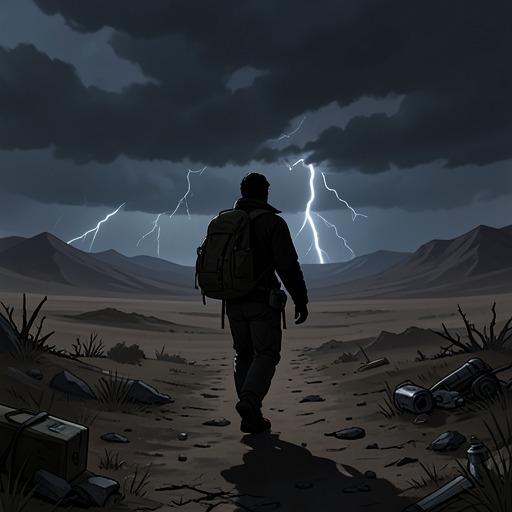
The Kid’s bravado does not erase ordinary limits. Isaac walks the tracks, calculates his pace, and rests after prolonged exhaustion, sleeping in brush beside the river before continuing into Fayette City. He moves through hunger and isolation by turning his attention to the stars and to the persistence of life. Yet his grand claims of self-sufficiency repeatedly meet doubts about whether his plans are sound and whether anyone, especially Lee or Poe, might still be part of the future he wants.
Otto’s Death and the Weight of Responsibility
Isaac’s flight is bound to the killing at the machine shop. When Otto the Swede returns to the building, Isaac throws a heavy industrial ball bearing at him to protect Poe. The blow brings Otto down; Isaac remains frozen for a moment while Poe runs outside. Jesús kneels beside Otto, and Isaac understands from the weight of the bearing and the force of his throw that the man has been fatally struck.
Afterward, the two young men face the consequences of leaving the scene. Poe worries that his letter jacket, bearing his name and player number, remains in the shop beside the dead man, and fears that the authorities will pursue him because of his reputation. He thinks they will have to return for it and considers moving the body to the river. Isaac’s later thoughts show that the death has not become an abstraction: he distinguishes Otto’s killing from the earlier death of a homeless man who froze, and understands that this is the death people will not let go. The landscape’s sheltering hills cannot protect him from that fact.
Isaac’s reflection turns from concealment toward moral obligation. He thinks of the dead as people who belonged to someone and returns to the principle that the dead should not be left without anyone asking why. The thought contrasts human responsibility with the unreflective way animals pass a dead animal. His loyalty to Poe remains powerful, but it does not settle the question of what he owes the person who died or to those still alive.
The Road West and Its Reversals
Isaac continues his journey despite the unresolved killing. When he wakes behind a warehouse with dirt and dried blood on his face and pain that makes standing difficult, he tells himself to get up and resume walking. He returns to the warehouse associated with local delinquents, framing the visit as an attempt to repay a debt connected to Otto’s death. The episode shows how the Kid’s story converts danger into a private ritual of redemption, even as Isaac recognizes that the debt remains unpaid.
At another point he rests in the sun and admits that he cannot think about what will happen over the Swede. He plans to reach Berkeley first, reasoning that at least he will have done that much before the truth catches up with him. He assumes Poe will eventually talk, but still regards him as the best of the people around him. Thoughts of Lee interrupt the performance of self-reliance: Isaac imagines going with her if she happened to appear, remembering her graduation and how her academic future once made his own seem clear. Their mother’s death and Lee’s departure changed that imagined future, though Isaac does not blame her for leaving.
Isaac accepts help from a man who introduces himself as Winston, known as the Baron. He gives the Baron his real name, reasoning that he needs assistance and can leave if necessary. The Baron points him toward a freight train headed for a place near Detroit, where Isaac hopes to find another ride. The train makes progress an uncertain, physically demanding process: it waits for hours on secondary tracks, and its sudden stops and movements force Isaac to stay alert. At night, he watches the stars from the coal car and thinks about how astronomical knowledge, like human lives, depends on records that can be lost.
When police pursue the Baron, Isaac guesses that they have caught him and returns toward the canal to retrieve his backpack. Hearing more sirens and seeing a cruiser approach, he abandons the pack rather than risk being caught. Later, after a Walmart shoplifting escape, he slips away from the young employees by continuing into the woods. His own review of earlier decisions links mistakes to hesitation and misplaced trust, including his choice to let go of his knife when the Baron robbed him. He keeps walking west, though the destination has begun to matter less than continuing to move.
Return and Change
After walking from Little Washington to Speers, nearly twenty miles in a day, Isaac reaches the bridge over the Mon River. Teenagers under the highway fall quiet as he passes, apparently noticing his hunting knife. Once out of sight, he unfastens it and throws it into the river. The gesture is quiet but decisive: Isaac frames it as renouncing old ways and choosing, through the simple act of putting one foot before the other, to remain among the living.
Isaac later wakes in a hospital, alive and restrained to the bed. After returning to Buell, he goes to the police station and asks to speak with Chief Harris. In the conversation that follows, he says he is going to leave and may live with Lee in Connecticut. The idea surprises him, but feels right; Harris agrees that it is a good idea. Isaac also asks what will happen to Billy, keeping his friend’s fate in view even as he imagines leaving town.
When Isaac walks out, he realizes that he has decided to trust Harris and the others and to see how that trust turns out. He goes to the riverbank, puts his hand in the water, and watches the light on Buell’s buildings as birds head toward open water. The ending does not resolve every danger surrounding Poe or the killing. Instead, it changes the terms of Isaac’s movement: he has returned, relinquished the knife, and made a choice that is neither solitary escape nor a claim of innocence, but a willingness to rely on other people while continuing to live.