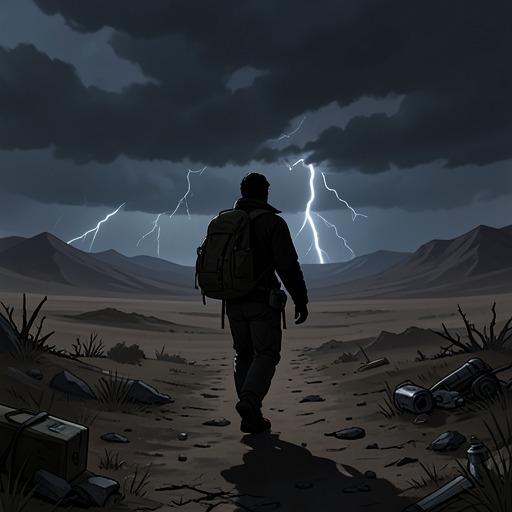
Isaac English leaves Buell and travels west
American RustIsaac English leaves Buell by slipping out with stolen money and following the railroad west, trying to make distance from his injured father, his sister Lee, and a killing that may yet implicate Billy Poe. His departure is both practical escape and uncertain self-reinvention: he has a destination, California, but no dependable itinerary, and the tracks carry him into a journey whose next steps depend on strangers, freight trains, and what may happen to the people he has left behind.
Reasons for Leaving
Isaac is twenty, slight enough to be mistaken for a boy, and living alone with Henry English, his father. Isaac’s mother has been dead for five years, but remains present in his thoughts. He has taken four thousand dollars from Henry’s desk. He corrects himself from the softer idea of taking it to the harder recognition that he has stolen it, and understands that being seen could bring Silas and the dogs after him. The money gives his escape a concrete means, but also marks it as a betrayal within the household he is leaving.
The plan has been forming for a month. Isaac intends to reach Pittsburgh by following the railroad along the river, board a coal train, and continue west until he can catch another train to California. He has considered whether Billy Poe will come with him, but doubts it. The question gives the journey a second purpose: Isaac is not simply fleeing alone from Buell; he is measuring the distance between his own departure and the loyalty he feels toward the friend he expects to remain behind.
Leaving Buell
From an overlook, Isaac sees Buell set among rolling hills, forest, and a muddy, winding river. The town’s steel mill, once like a small city, had closed in 1987 and was partly dismantled ten years later. Vines and trees cover its remaining structures, while deer and coyote tracks cross the grounds; people appear there only occasionally as squatters. Buell’s decline is not a distant backdrop to Isaac’s departure. The abandoned industrial landscape is part of the place he is trying to leave, and the rail line that once served its industry becomes his route out.
The town still bears traces of prosperity: rows of white houses, church steeples, an Orthodox cathedral, and historic stone buildings downtown. But many storefronts and blocks have been boarded up or abandoned. Isaac walks the tracks to avoid being seen, although few people are out. He remembers the shift change at the billet mill, when men coated in steel dust emerged into the light and his tall father reached down to lift him. That memory belongs to a time before the accident changed Henry into the diminished figure Isaac now calls the old man. The route away from town thus passes through a landscape of industrial loss and through Isaac’s own altered memory of home.
At night he moves through the grounds of the closed mill, past its long empty buildings, rusted blast furnaces, powerhouses, slag cars, and stacks of structural steel left behind when dismantling funds ran out. He then follows the tracks past his old school and the road to Billy Poe’s home. Buell falls out of sight behind him. The departure acquires its force through these familiar landmarks: Isaac does not leave by an abstract road west, but by passing the places that have defined his life and the friend he has not persuaded to join him.
A Journey Without a Fixed Route
Isaac’s intention to reach California is firmer than his knowledge of how to get there. Later, when asked for his destination, he answers California, but admits he has no idea how he will reach it. The answer reveals his vulnerability to the man asking: Isaac realizes too late that the question was meant to discover whether he needs help. He has the destination; the practical route remains open to whoever can provide passage.
That dependence leads him to the Baron. The Baron directs him toward a large freight train with four units, bound for a place near Detroit, where Isaac expects he will be able to find another way onward. When the train starts, its headlights sweep across the men. They run beside it over loose gravel; the Baron throws his backpack onto a platform and climbs aboard between cars, while Isaac tosses his own pack onto the rear platform of a different hopper and pulls himself up its ladder. The immediate achievement is modest but decisive: after so much walking, Isaac is moving without having to lift a foot. The train carries him away from Buell, but not yet to his announced destination.
The journey also changes in Isaac’s thoughts. At a secluded spot on a sunny riverbank, he tells himself to appreciate the day rather than keep moving; he imagines reaching Berkeley and postponing thoughts about what may happen with Otto the Swede. He believes the truth about what he has done will eventually come out and expects Billy Poe to talk, yet still regards Poe as the best of them. His confidence in escape therefore remains entangled with fear of discovery and affection for the person he may have exposed to danger.
Those Left Behind
Lee becomes certain that Isaac is not coming back when Henry brushes aside the money Isaac took and says that Isaac will return soon enough. She interprets Henry’s calm as evidence of the opposite. When she tells Billy Poe that Isaac left the previous morning, a few hours after Billy had left, and that he had a bag packed, she watches Billy’s expression change from confusion to fear and then become unreadable. The departure is not wholly secret: Lee makes it known to Billy, turning Isaac’s private flight into news that changes what Billy must understand about his friend’s absence.
Isaac’s own thoughts return to Lee. He imagines that if she happened to drive past, he would go with her, and recalls her graduation, when her academic distinction and admission to Yale, Stanford, Cornell, and Duke made his own future seem momentarily visible to him. Their mother’s death and Lee’s departure for a new life broke that imagined parallel. He does not blame her for leaving, but her success sharpens the difference between her departure and his: she had a clear next stage, while he is traveling toward California without knowing how he will get there.
Significance
The movement west is driven by escape, but the novel presents no clean break between leaving and belonging. Isaac takes money from Henry, passes his old school and Billy Poe’s road, and boards a train whose destination is only a step toward California. His progress is real, yet provisional. The closed mill and the unused remnants of its dismantling mirror the instability of the route: both town and traveler are moving out of an earlier life without a settled account of what comes next.
Isaac also leaves with a moral burden rather than putting it behind him. He anticipates that what he did will be discovered, worries that Billy may speak, and nevertheless holds to his loyalty and admiration for him. The journey’s central tension is therefore not simply between Buell and the West. It is between flight and responsibility: Isaac can put miles between himself and home, but his thoughts continue to circle the people, memories, and possible consequences that make escape incomplete.