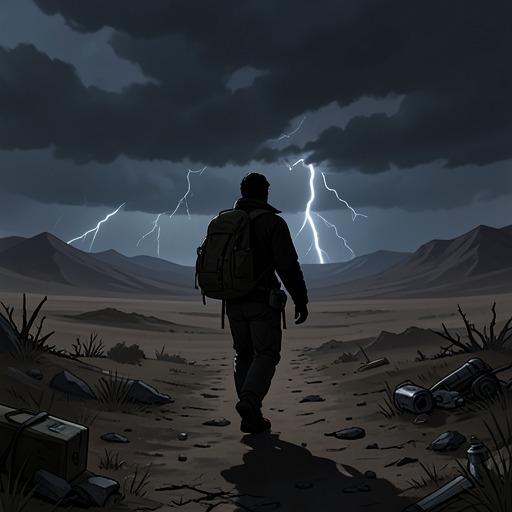
Isaac’s knife
American RustIsaac’s knife accompanies Isaac through episodes in which survival depends not only on having a weapon, but on deciding whether to use it. Its recurring presence makes the boundary between defense and violence tangible: he reaches for it when danger appears, keeps it close at night, and ultimately leaves it behind rather than turn a confrontation into a killing.
Use, Restraint, and Care
When a group of high-schoolers bursts into the room where Isaac is sleeping, he begins to disentangle himself from his sleeping bag and puts a hand on the knife. Seeing that the intruders are young, he lets go of it. They attack him, punching and kicking him until the light is in his face and the assault stops. Afterward, Isaac packs his belongings, carries a rubber welcome mat outside, and moves through the brush toward the river to sleep somewhere less exposed. He takes the knife out and sets it beside his head. The placement offers a measure of readiness, but comes only after he has consciously chosen not to draw it against the teenagers; he remains awake until his racing heart slows.
The knife also appears as an object Isaac tends to amid the dirt and exhaustion of life on the road. After washing himself in a diner restroom, he carefully soaps down the blade, rinses and dries it, then wipes the floor and sink before returning to the dining room. Cleaning it is part of the same deliberate effort to remove the traces of his muddy, bloodied condition. The blade is not merely an instrument kept ready for danger: it has to be maintained, and its presence links bodily vulnerability to the practical routines of staying alive.
While travelling toward the coke plant with another man, Isaac adjusts the knife and its sheath, then checks his own suspicion as the man stops on the tracks. Later, unable to fix the broken zipper on his sleeping bag in the dark, Isaac keeps his boots on, wraps the bag around himself, and finds a position that leaves his hand near the knife. He moves partly under a fallen tree and takes the knife out before sleeping. In these scenes, the object becomes part of his night-time vigilance: he does not use it, but arranges his body and shelter around the possibility that he might need it.
The Chase and the Lost Blade
When Isaac wakes in the clearing, The Baron is beside him, removing the envelope of money from his cargo pants. Isaac has kept the knife in his hand all night and tightens his grip, ready to use it; then he lets it go and grabs The Baron’s coat instead. The Baron breaks free and runs. Isaac pursues him through the trees, past a trailer park, and onto a four-lane road, carrying the knife as the white envelope flashes in The Baron’s hand. Even as he closes the distance, Isaac recognizes that catching him may mean having to use the blade, and cannot accept that outcome.
A police car makes a U-turn and cuts across traffic ahead of them. Isaac hears the officer order them to stop and realizes the knife makes him look dangerous. He leaps over a chain-link fence; the knife flies off into the dirt as he lands on his hands and knees. While the officer turns his attention toward The Baron, Isaac runs on. He later understands that he could have used the knife when he first woke, but chose to seize The Baron’s coat instead; during the chase, he also chose not to use it to catch him. The knife’s loss is therefore more than an accident of flight: it marks a decision, made under pressure, not to turn pursuit into a stabbing. With police cars converging, Isaac abandons his backpack as well and moves away from the road, leaving the blade behind.
The Blade and the Burden of Choice
During the chase, the knife changes hands as Isaac runs after The Baron, and his inner reasoning turns on the difference between catching a thief and being willing to stab him: if he tackles The Baron, he tells himself, he should drop the blade rather than cut himself. Later, hiding from the police, Isaac rejects the idea that grabbing The Baron’s coat instead of using the knife was simply foolishness; he recognizes it as a choice. The knife thus gives physical form to a recurring tension in his flight: it may offer protection, but carrying it also makes violence possible and makes him appear dangerous to the police. Its loss leaves Isaac without that immediate instrument of force, while his later reflection preserves responsibility for the decision that sent it flying.
An Object That Makes Choice Visible
Isaac’s knife gives physical shape to a distinction that otherwise remains internal: being prepared to defend oneself is not the same as choosing to injure someone. Across these episodes, the blade is alternately within reach, deliberately maintained, and finally lost, but its significance lies less in what it can do than in Isaac’s changing relation to that possibility. Its movement from hand to ground makes restraint visible without making it effortless: danger still governs his posture and attention, even when he refuses to let the knife decide what happens next.