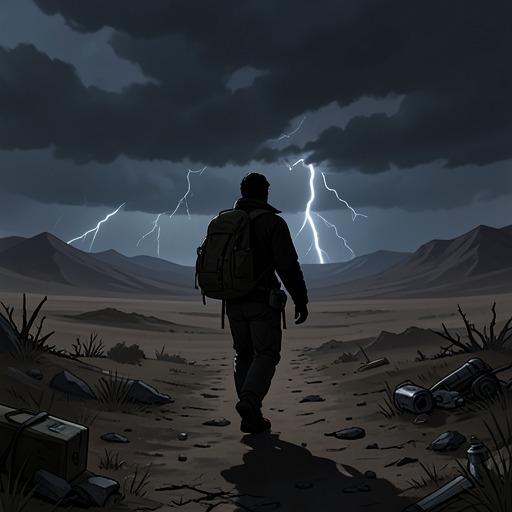
Isaac’s military-surplus backpack
American RustIsaac’s military-surplus backpack is more than luggage: it holds the money, notebooks, and preparations on which his attempted departure from Buell depends. Its repeated concealment and recovery track the gap between a carefully planned escape and the dangerous, improvised circumstances in which Isaac has to carry it out.
Identity and Use
The backpack is identified as an Alice pack and, later, as a larger army-surplus pack. Isaac has assembled the possessions he expects to need if he starts over in California, including notebooks and school transcripts. The pack makes those plans portable, but it also concentrates his limited resources in one object: losing it could mean losing the practical basis for beginning again.
The money inside gives that vulnerability a concrete scale. Isaac counts a sum just under four thousand dollars and recognizes that, although it feels enormous to him, it is not enough to make his future secure. He has prepared on paper, but even while carrying the pack he questions whether the plan still makes sense. The belongings signify preparation without certainty; they can be organized and carried, but they cannot settle whether leaving is possible or what it will cost.
The Pack at the Machine Shop
At the machine shop, Isaac’s attention shifts between Billy Poe and the pack. When Poe remains inside with the other men, Isaac picks up the backpack and leaves alone, worried about losing what is in it but unsure how to persuade Poe to come with him. The moment makes the object a practical counterweight to his loyalty: Isaac can protect his belongings by leaving, yet he does not simply abandon Poe to the situation.
After hearing shouting inside, Isaac hides the pack beneath a piece of sheet metal in the field. Before going back into the building, he takes the money from his pocket and puts it deep inside the bag. The choice preserves his resources while he approaches the danger without carrying them openly. But concealment also creates a new problem: his possessions are now separated from him, in a place he may have to return to, and the field is not guaranteed to remain undisturbed.
Loss of Access and Recovery
When Bud Harris drives Isaac away from the area, the money and notebooks are still in the meadow. Isaac knows that the things he needs are not in the machine shop, where the attention of others is concentrated, but his own cache remains exposed to the possibility that someone will find it. The pack’s physical distance from him turns an earlier precaution into an immediate uncertainty.
Isaac later decides that retrieving it is his first priority. He dresses for the journey, takes his fishing knife, and approaches the train-car plant from the rear rather than repeating the earlier route through the field. Moving through woods and along a stream, he reaches the clearing and finds that the truck is gone. He continues to the meadow and discovers the pack where he left it. The notebooks and money are still inside, though the contents are slightly damp.
The recovered food offers a modest but consequential immediate resource: a sandwich bag of raisins and peanuts. Isaac realizes he has not eaten in two days and finishes the food while consolidating what he needs into the larger army-surplus pack. He leaves a smaller schoolbag behind in the field and heads back toward the tracks. The episode changes the pack from a hidden cache into carried equipment again, restoring some of his ability to continue while showing how little separates his preparations from deprivation.
Material and Narrative Significance
The pack’s changing status—carried, hidden, left behind, and recovered—gives physical form to the instability of Isaac’s departure. It is a useful object when it contains his money and notebooks, but once buried under scrap metal it becomes a source of uncertainty; even after he finds it, dampness has reached its contents. Its usefulness is never absolute, and Isaac’s plans depend on attention to the actual conditions around it: where it is stored, whether anyone has searched, and whether he can return safely.
That dependence also sharpens the contrast between preparation and control. Isaac has collected papers and money for a new beginning, yet the route to those belongings runs through a landscape of abandoned industrial equipment and a crime scene. The backpack cannot make the escape orderly. It can only gather what Isaac has managed to save and let him carry it onward. In this way, the object links his imagined future in California to the immediate, precarious work of staying alive and keeping hold of what he owns.