Isaac's ethic of appreciating life
American RustIsaac English’s ethic of appreciating life turns awareness of human smallness into a practical obligation: to make the best of being alive and notice the pleasures still available. Formed during his flight through the Mon Valley, it sets the immensity of the universe against immediate bodily need, private grief against continued existence, and damaged industrial surroundings against the value of a sunny day.
A Rule Against Despair
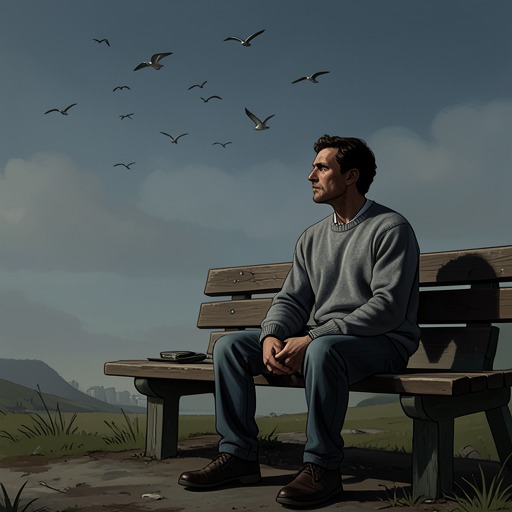
While hungry beside the river at night, Isaac considers the stars and the distances that make human life seem nearly insignificant. Proxima Centauri is twenty-five trillion miles away; stars and galaxies persist beyond the span of human beings. But he rejects the conclusion that this scale makes life meaningless. His reasoning turns from cosmic perspective toward obligation: “Your only duty—make the best of it. The only true sin—not appreciating life.” The maxim does not deny death or hardship; it insists that awareness of them is no reason to stop valuing what is present.
The thought is bound to his grief for Mary English. Near Lock Four, Isaac remembers that her body was found in the lock channel after she had been missing for two weeks. The autopsy established drowning, while the stones in her coat pockets—eleven pounds, by his estimate—recall the possibility that she had deliberately made herself sink. He imagines her collecting the stones and humming, and recognizes that she had carried an inward pain. Against that memory, appreciating life is not a breezy slogan: it is a judgment Isaac tries to hold alongside the knowledge that suffering can be profound and difficult to see.
Attention to Ordinary Pleasures
The ethic becomes most tangible in small physical comforts. After eating, Isaac rests on a grassy riverbank, removes his shirt and shoes, and feels the sun. He recognizes the temptation to keep moving, but also allows that he might be dead by night and that a pleasant moment should be enjoyed while it is available. The scene makes his principle an action rather than an abstraction: he pauses, accepts warmth, and attends to the simple pleasure of a sunny day.
Food and water carry the same weight during his journey. Watching the river, he sees a bluegill leap in the shallows and knows that people eat fish from water contaminated with mercury and PCBs. Later, the quart of milk he drinks gives him strength after he has spent money and walked many miles. Hunger makes nourishment immediate and concrete; his attention to comfort does not mean that deprivation has ended, only that relief matters when it arrives.
The Valley as Both Damage and Refuge
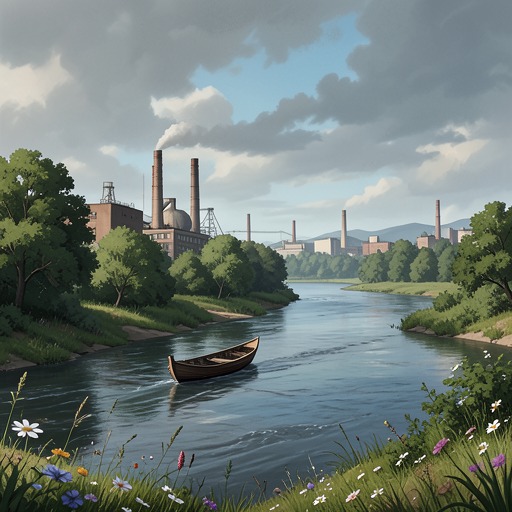
Isaac’s reflections take place in a landscape shaped by coal, industry, and environmental harm. He follows the river past barges and towboats, power stations, mine workings, coal tipples, and long lines of railcars. The steam from the Elrama power plant looks clean and white against the night sky, but Isaac recognizes that the plant burns coal. At the Clairton coke works, he watches coal being unloaded and thinks of the carbon drawn from darkness and of ancestors being burned. The valley’s industrial scale is inseparable from its costs; his ethic does not ask him to mistake pollution for beauty or hardship for contentment.
Yet the riverbanks and woods also give him quiet and room to direct his restless thoughts. Away from people, he can follow familiar trails, observe animals, and keep his attention occupied. The contrast is not a simple opposition between corrupt industry and untouched nature: the water itself is polluted, while industrial power stations continue to dominate the river. Instead, the landscape offers Isaac moments of stillness within a damaged place, making attention a way to remain present without pretending the damage is absent.
Choice, Responsibility, and Continuance
The maxim’s force lies in the choices it does not settle for him. Isaac is trying to reach California and eventually Berkeley, but he wonders whether his plans still make sense and whether he can think about what may happen with Otto the Swede. He anticipates that Billy Poe may talk about what Isaac has done, yet still regards Billy as the best of them. Hope, fear, loyalty, and uncertainty persist together; the ethic does not promise that he can control their outcomes.
At moments when despair threatens to turn perspective into self-erasure, Isaac treats continued life as something requiring active attention. He slaps his face to bring himself back to the present, and elsewhere checks his impulse to move on long enough to feel the sun. These gestures do not erase grief or resolve the consequences awaiting him. They show the ethic’s narrow, demanding scope: not a guarantee of happiness, but a refusal to let suffering or cosmic insignificance cancel the duty to value life that remains.