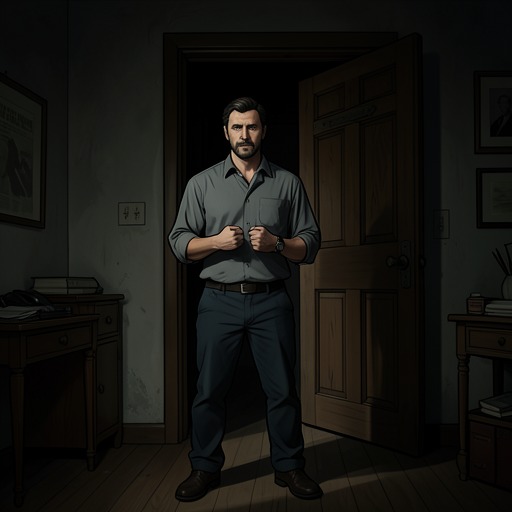
Jacket connected to the Carson case
American RustThe Jacket connected to the Carson case is both a potential link between Billy Poe and the scene of Otto Carson’s death and the object through which Bud Harris’s conflict over enforcing the law becomes visible. Harris hides it before a state trooper arrives, then must decide whether protecting Poe is compatible with his duty to investigate. The jacket remains unnoticed at the scene, but its concealment shapes Harris’s choices even as the case develops in other directions.
Recognition and Concealment
Harris is first at the crime scene after an anonymous tip. Seeing the body, he initially takes relief in the thought that the dead man is a transient, someone whose death will not bring painful calls or visits from people he cares about. Then he recognizes a familiar jacket. When he hears the state trooper approaching along the access road, he scoops it up and hides it behind a workbench. The trooper arrives moments later and does not notice what Harris has done.
People come and go through the day, but the jacket stays where Harris put it, unseen. Its significance is personal as well as evidentiary: Harris is not simply hiding an unidentified object. Sitting in his truck with Steve Ho, he is troubled that it belongs to Billy Poe. He tells himself that giving someone a break can be part of doing right, as when police let a young person go rather than arresting him for every offense. But he also recognizes that this reasoning can excuse the concealment of a felony. The jacket makes the boundary between discretion and interference difficult for him to keep clear.
The Jacket and Harris’s Divided Judgment
Harris’s private argument takes the form of competing versions of himself. The voice he associates with Even Keel insists that he should get out of the truck, retrieve the jacket, and arrest Poe. Harris rejects that judgment as cowardly and decides to wait and see which part of him is right. The decision leaves the jacket hidden while he postpones a clear choice about what the law requires and what he believes he owes Poe.
That hesitation occurs amid a local culture in which Harris understands policing as more than mechanically applying the law. He thinks of an unspoken community agreement to do right, but admits that deciding what that means can lead officers to let people go even when they have committed serious offenses. The concealed jacket turns that abstract discretion into a physical fact: evidence connected to Poe is within Harris’s reach, and he has chosen not to expose it.
The Case Moves Beyond the Jacket
Before Harris’s concealment becomes an issue in conversation, Isaac English urges Poe to get to a phone and call for an ambulance for the injured man they have left behind. Poe argues that the police will follow the ambulance; Isaac suggests using a payphone at the Sheetz station, but Poe does not answer. Their exchange shows that the decision to avoid police attention predates Harris’s intervention. Later, when Harris sees Isaac and Poe, he says they look fine from where he is and suggests that they might promise to stay out of trouble and accept a ride home rather than be searched. His treatment of them reflects the same discretionary judgment that governs his handling of the jacket.
The case acquires a witness. Murray Clark, whom Poe had encountered on the road, is reported to have been present at the killing and to be able to identify a football player in a lineup. Harris checks Clark’s record and finds earlier arrests for driving under the influence and disorderly conduct, but no later offenses; he judges that this history would not be enough to discredit Clark on the witness stand. The emerging testimony changes the case’s direction, and Harris tells himself that his stunt with the jacket may not have mattered. He does not know whether it is still behind the workbench, but he regards it as no longer relevant to the investigation’s immediate course.
What the Jacket Leaves Exposed
When Harris questions Poe, he says he saw him returning to the crime scene and begins to refer to the jacket, then stops himself. Instead, he tells Poe that the only reason he did not take him in then was consideration for his mother, and argues that Poe should explain what happened so the killing can be presented as self-defense. Poe describes the threat he faced at the plant; Harris responds that this is good, then lets him go home for the night. He orders Poe to get rid of his Adidas sneakers and destroy any box or receipts, warning him not to run. Harris’s instructions show that his protection of Poe has moved beyond the jacket: he is actively advising him about what could become evidence and how to avoid flight.
The jacket’s narrative importance therefore lies less in any stated forensic conclusion than in what its concealment reveals about Harris. It is simultaneously a material trace of Poe’s connection to the scene, an object Harris can hide from other officers, and a measure of how far his idea of doing right diverges from ordinary procedure. The later witness does not erase that choice. Even when Harris decides the jacket may no longer matter to the case, its concealment has already exposed the cost of his divided loyalty.