Mid-Mon Valley
American RustThe Mid-Mon Valley is a landscape formed by the rise and retreat of steelmaking, where industrial ruins and struggling towns register an economic transformation that reaches into family life, public services, and the characters’ prospects. Its riverside routes connect places such as Buell, Pennsylvania, and Brownsville, Pennsylvania, to Pittsburgh, but the possibility of leaving is not the same as the means to do so. The Valley is neither merely a scenic background nor a community reduced to decline: its working history, damaged infrastructure, local attachments, and returning wildlife remain present together.
Landscape and Regional Setting
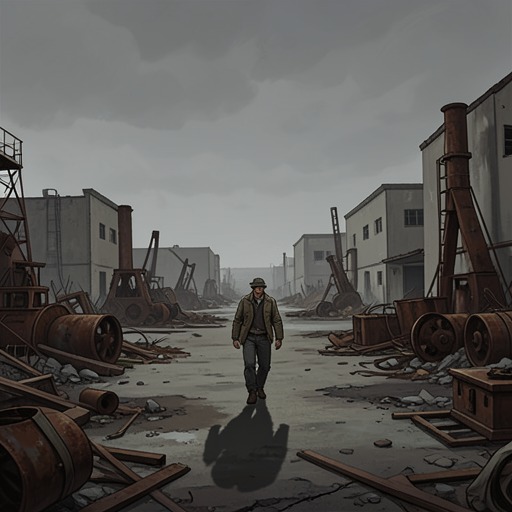
The Valley’s geography is defined by wooded hills, a winding river, rail corridors, and towns built around industry. From an overlook above Buell, Isaac English sees forested slopes broken by the town and the steel mill. The mill, once almost a city in itself, had closed in 1987 and was partly dismantled about ten years later. Its remaining buildings have been overtaken by vegetation; deer and coyotes cross the grounds, while human visitors are largely occasional squatters. The contrast is physical as well as historical: the plant’s scale persists, but its intended work and the dense human activity around it have receded.
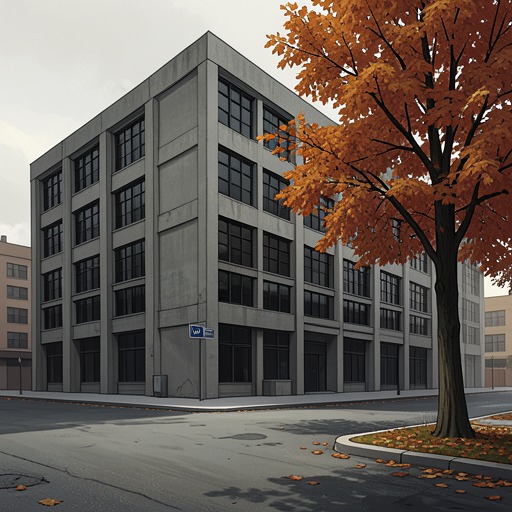
The towns carry a similar mixture of inheritance and vacancy. Buell’s hillside rows of white houses, church steeples, Orthodox cathedral, cobbled streets, and historic stone buildings recall a place that had been prosperous. By the time Isaac walks through it, much of downtown is boarded up, some blocks are neglected, and others have been abandoned. Brownsville, Pennsylvania, offers another view of the same regional contraction: its once-promising downtown contains empty office buildings and hotels, while its narrow streets and older architecture retain a distinct urban character. These are not interchangeable ruins; each place keeps the form of a community whose economic purpose has diminished without erasing its built past.
Steelmaking and Economic Collapse
For a century, the Valley had been a center of steel production in the United States and, in a broader sense, the world. Steel depended on coal and on a network of supporting industries, including tool-and-die work, specialty coating, and mining equipment. When the mills closed, the effect spread beyond the steelworkers themselves: the interconnected industrial system that supported and depended on the mills contracted with them. Since Isaac English and Billy Poe were born, the Valley had lost 150,000 jobs. Many towns could no longer afford basic services, and some lacked a police force.
The narrative connects this regional collapse to decisions about investment as well as to the disappearance of work. Henry English reflects that Penn Steel had spent years failing to modernize its factories, while steelmakers in Germany and Japan continued investing in their plants and infrastructure. In his account, the weakness of American mills was not simply an unavoidable feature of industrial change; underinvestment helped guarantee their decline. The comparison makes the abandoned works evidence of choices made over time, not just the aftermath of a sudden closure.
The physical landscape preserves that history. Isaac and Billy Poe travel north along the river past old plants and smokestacks, remnants of the industries that had grown up around steel. Isaac wonders how long it will take for the structures to rust away and for the Valley to return to a more primitive state; in his image, stone alone may outlast the industrial order. Elsewhere, the remaining blast furnaces, powerhouses, slag cars, and stacks of structural steel show how dismantling stopped when the money ran out and no buyer wanted the liability of an old mill. The scale of what remains makes the absence of its former workforce more legible.
Work, Home, and the Cost of Staying
The industrial past is carried into household decisions. Grace Poe remembers the shift whistle and streets crowded with workers, their families, and other mill employees. As a teenager she expected to leave the Valley. Instead, after high school, her father presented her with a car and pay stubs and told her she would start at Penn Steel the following Monday. She worked on the rolling line, where she met Virgil; later, after layoffs, her college plans stalled while she raised a young child and searched for work. Virgil survived several rounds of cuts before losing his mill job, despite his pride in it and his efforts to retrain for robotics and then work at a barge-making plant. Those replacement opportunities also failed to last.
The Valley’s declining prospects do not make migration a simple solution. Grace considers the possibility that keeping the family trailer may have prevented a fresh start elsewhere, but leaving required money, and people who moved away often returned. Workers went to places such as Houston, New Jersey, and Virginia, sometimes sharing motel rooms and sending money home; many ultimately came back. For families without relatives elsewhere, remaining poor among familiar people could seem more manageable than attempting an uncertain move. The region’s geography thus includes not only roads and railways out, but the economic limits and personal attachments that make departure difficult.
Housing became a site of collective resistance as well as private anxiety. When Grace’s trailer faced foreclosure, local residents began picketing sheriff’s sales, and a protest escalated into the destruction of a banker’s car. A judge imposed a foreclosure moratorium to prevent further escalation, and the measure eventually became law. Grace’s household kept the trailer and relied on food-bank supplies and deer hunted by Virgil. The episode shows how the loss of industrial wages could reach into basic shelter, while local action and a change in policy could interrupt, without reversing, that loss.
Public Life, Environment, and Narrative Meaning
The Valley’s decline is also visible in its strained public institutions. Its population begins to grow again even as incomes continue falling, municipal budgets shrink, and infrastructure goes without investment for decades. Towns face problems on a larger scale than their resources can address. Bud Harris sees the police being blamed for conditions that policing cannot repair: unstable employment, poverty, and a shrinking field of opportunity. The novel’s account resists treating those pressures as individual failures or as problems that a more aggressive department could solve.
Industrial damage remains part of the environment, even as nature returns to abandoned sites. The river is slow and muddy; a bluegill jumps near the bank, but its fish are known to contain mercury and PCBs. At the mill, plant growth spreads among the ruins, and deer, coyotes, and bears appear in places shaped by industry and abandonment. That return is not a simple restoration: wildlife can flourish while contaminated water and human hardship persist. The landscape’s beauty and its residue coexist.
For Isaac English, the rail lines running along the river are both a route toward Pittsburgh and a possible beginning of a journey west. The tracks connect the Valley to a wider world, yet they also run past his old school, the mill, and the town he is trying to leave. The same regional history shapes Billy Poe’s and Grace Poe’s choices, Henry English’s memories of work, and Bud Harris’s view of the town’s institutions. Through those intersecting lives, the Mid-Mon Valley becomes more than the setting of individual hardship: it is a social landscape where lost industry alters what people can earn, where they can live, and whether leaving or staying feels possible.