Mon Valley deindustrialization
American RustMon Valley deindustrialization is more than the disappearance of steelmaking: it is the unraveling of an interconnected regional economy and the institutions that depended on it. The novel follows that process from neglected mills and mass layoffs into homes, public budgets, and empty streets, showing how economic decisions made across generations narrow the choices available to workers and their families.
A steel economy unravels
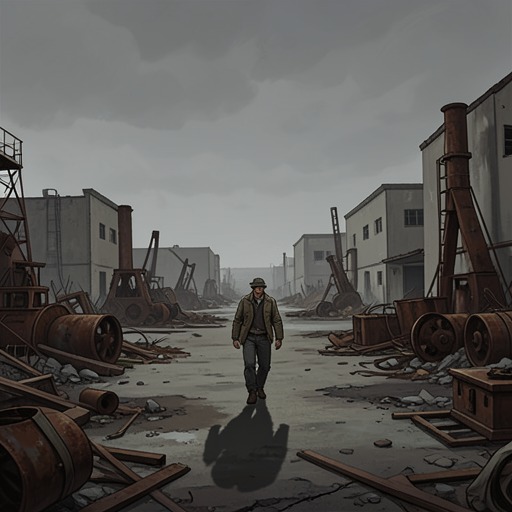
For a century, the Valley had been a center of steel production on a national and global scale. Steelmaking had also sustained a broader industrial system, including tool-and-die work, specialty coating, mining equipment, and other businesses tied to the mills. When the plants shut down, the loss therefore reached beyond the mill gates: the industries that supported steel were also weakened, and the Valley’s economic foundation collapsed with them.
By the time Isaac English and Billy Poe were born, the area had lost 150,000 jobs. The novel links this contraction to a stark reduction in local capacity: many towns could no longer afford basic services, and some no longer had a police force. A line Isaac overhears about people relying on welfare or returning to hunting and gathering is acknowledged as an exaggeration, but one that captures how drastically the region’s prospects had changed. The scale of the loss makes the decline structural, not a series of isolated misfortunes.
Henry English’s recollection of steelwork gives that history an industrial cause. He remembers first accepting the argument that labor costs and unions were responsible for the industry’s troubles. His later understanding is different: Penn Steel had failed to invest in its factories for fifteen years, while many other large American mills had also allowed their equipment and facilities to deteriorate. Some American plants were still using a single process when they closed, while German and Japanese producers had adopted basic-oxygen steelmaking decades earlier and continued investing in infrastructure. The comparison undercuts the simple claim that the industry’s fate was caused by labor costs alone; the mills’ owners had also neglected the productive capacity on which their future depended.
Work and family choices
The decline enters Grace Poe’s life through work, education, and family obligation. At eighteen, after graduating from high school, she found that her father had already arranged her future: a new Pinto in the driveway and a book of pay stubs meant that she was to start at Penn Steel on Monday. She spent a year on the rolling line, where she met Virgil. They married after she became pregnant, and she began attending school while pregnant and then while caring for a baby. She was close to finishing an associate degree when the layoffs came; with a young child and no jobs to be found, she could not continue.
Virgil survived six rounds of layoffs before his turn came. Keeping a mill job increasingly required long seniority, and he had only five years. He had been proud of the work partly because it set him apart from a family with a history of insecure employment. The mill’s contraction thus disrupted not only household income but also the status and self-understanding that Virgil had attached to holding a steady job. Grace reflects that decisions about her life had often been made by men, while the economic crisis further reduced the choices available to her.
For a time, the family waited for the mills to reopen, but layoffs continued across the Valley and plants kept closing. The novel presents this uncertainty as a force that could interrupt education, damage plans, and make relocation difficult rather than straightforward. Some workers left for places such as Houston, New Jersey, and Virginia, sometimes living several to a room and sending money home; others eventually returned. For Grace, remaining poor among familiar people could seem preferable to starting over elsewhere, even as she wondered whether keeping the family’s trailer had prolonged their hardship.
Household survival and public strain
The family’s trailer went into foreclosure during the worst years of the downturn. Residents responded to sheriff’s sales with pickets, sometimes arriving with deer rifles in their cars. When a banker came to press for action, protesters overturned and burned his Cadillac. A judge imposed a moratorium on foreclosures to prevent the confrontation from escalating into shootings, and the measure eventually became law. The family kept the trailer, but survival depended on food-bank supplies and the deer Virgil poached. Venison became so constant a part of their diet that Grace could no longer stand its taste.
The same contraction appears in local government. Buell’s police department faced repeated budget crises and the prospect of being merged into a regional force. In one earlier crisis, after the city ran out of money late in November, city employees took loans from the bank in place of their paychecks; the city paid off the loans at the beginning of the new year. The episode shows how precarious municipal finances had become, even for workers responsible for public services.
The wider Valley faced falling incomes, shrinking budgets, and decades without infrastructure investment, despite a population that was growing again. Ho describes the region as approaching a tipping point, while many towns already seemed beyond recovery. The novel connects those conditions to the scarcity of attainable work: office jobs required college, were too few to absorb everyone, and were themselves moving overseas. Police could respond to crimes, but could not create stable employment or reverse social collapse. The contrast between communities’ demand for tougher policing and their limited economic prospects exposes the limits of treating public safety as a problem that law enforcement alone can solve.
Industrial risk and the altered landscape
The costs of industrial decline are not confined to closure. Henry recalls working at Steelcor while commuting from Indiana and recognizes, in retrospect, that the mill was unsafe and that its owners were trying to extract value before addressing problems in the plant. During a furnace operation, the safety brake on the hoisting drum was supposed to prevent a catastrophic failure, but a component in the gearbox sheared. The recollection makes neglected investment tangible: machinery and safety systems were part of the same industrial infrastructure that management had failed to maintain. The company’s OSHA fine was thirty thousand dollars, an amount the mill made in a minute, a comparison that emphasizes the gulf between the penalty and the company’s earning power.
The landscape offers a quieter measure of what remains. In a nearly deserted neighborhood, Isaac sits in an abandoned house while watching another house; tall grass fills the yards, and deer walk down the paved street and browse on bushes. The scene does not restore the lost industrial economy. Instead, it sets vacant housing and diminished human presence beside wildlife moving through the built environment, making the region’s transformation visible without treating it as a simple return to an untouched natural state.