Nature reclaiming industrial ruins
American RustNature reclaiming industrial ruins is a defining visual and thematic pattern in the Valley: plants, animals, and streams take possession of abandoned industrial sites, but their return does not undo the human and environmental consequences of the steel economy. The overgrown factories are neither simply dead monuments nor restored wilderness. They are places where industrial remnants, nonhuman life, pollution, and the aftermath of lost work remain entangled.
The ruin as a living landscape
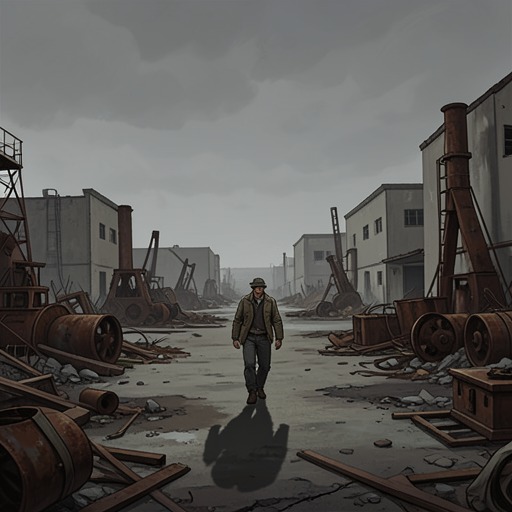
The former steel mill near Buell, Pennsylvania, once operated like a small city. It closed in 1987, and parts of it were dismantled about ten years later; when Isaac English looks across the site, its buildings have become an ancient-looking ruin, covered in bittersweet vine, devil’s tear thumb, and tree of heaven. Deer and coyote tracks cross the grounds, while human presence has dwindled to the occasional squatter. The contrast registers a change in who uses the land: machinery and industrial labor have receded, while vegetation and wildlife move through the spaces they left behind.
The return of nature is described in specific, visible processes rather than as an abstract promise of recovery. At the Standard Steel Car factory, a half-collapsed structure, bricks and beams lie across old forges and hydraulic presses; moss and vines grow among the wreckage. The factory remains vast and open despite its damage. Its scale survives even as its working purpose has disappeared, and plant growth occupies rather than conceals the industrial remains. The landscape therefore holds two times at once: the age of machines and production, and the slower present in which living growth threads through their remains.
Industrial history and regional decline
The abandoned sites make sense within an interconnected industrial region, not as isolated ruins. Coal supplied the steel industry, and smaller businesses such as tool-and-die shops, specialty coaters, and mining-equipment makers supported the mills in turn. When the mills shut down, this interdependent system collapsed. For a century, the Valley had been a center of steel production; during Isaac English and Billy Poe’s lifetimes, the region lost 150,000 jobs. Many towns could no longer afford basic services, and some lacked police. The spread of vines across factory grounds is thus set against the loss of work and public capacity beyond the factory walls.
The book also connects the region’s decline to decisions about investment and industrial change. Henry English recalls that Penn Steel had failed to invest in its factories for fifteen years, while German and Japanese producers had continued to modernize their plants. He sees this neglect as a cause of the American mills’ eventual failure, not as evidence that industrial decline was an unavoidable consequence of labor costs alone. From this perspective, a factory returned to plants and moss is not just an image of nature outlasting industry: it is the material remainder of choices that helped make the site idle.
Routes through abandoned places
The ruins remain part of the characters’ working geography. Isaac English travels through the mill grounds after dark, passing long empty buildings, four remaining blast furnaces, their powerhouses, slag cars, an ore crane, and stacks of structural steel left behind when dismantling ran out of money. The enormous equipment still structures his path, although the site no longer functions as a workplace. Its abandoned rail lines and open grounds connect the town to a landscape that is both familiar and unsettled.
The Standard Steel Car factory also offers a possible place to wait out bad weather. Isaac English remembers being inside it before and knows its exposed, partly collapsed interior; the prospect of shelter is immediately undercut by the fact that the building has no roof. The factory’s openness, a consequence of ruin, makes it accessible but not reliably protective. Its past also persists through an object removed from the site: Isaac English had pried a nameplate from a large hammer forge, polished and oiled it, and given it to Lee English for her desk. That small act preserves a piece of industrial workmanship beyond the factory, while the building itself continues to deteriorate.
Later, Bud Harris and Steve Ho observe the machine shop and the remains of the larger factory from a ridge. The meadow, old boxcars, and vine-covered structures appear peaceful; Harris associates the scene with abandoned temples he saw in Vietnam. The comparison makes the ruins seem at once local and monumental. Nature’s occupation can soften the visible scene, but the site’s history of production and its place in the present investigation remain close beneath that calm appearance.
Regrowth without restoration
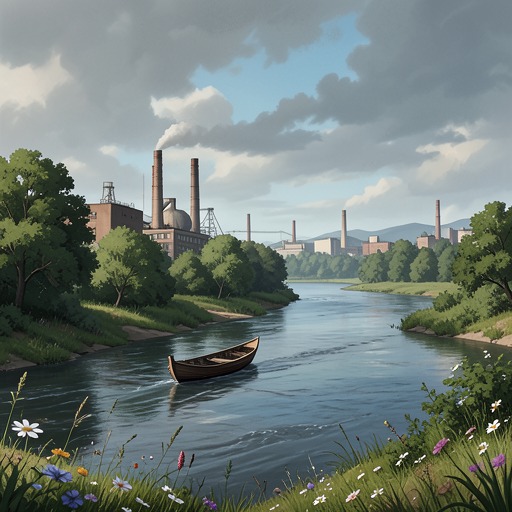
The book resists treating nature’s return as proof that the region has healed. Along the river, barges still push coal, and the water remains muddy; a bluegill jumps in the shallows, but Isaac English recalls that the fish are not supposed to be eaten because the water contains mercury and PCBs. Elsewhere, coal plants send smoke and steam into the night above barges and coal piles. Industrial use has not vanished from the Valley; abandoned factories exist beside active energy infrastructure and the lasting contamination of waterways.
This contrast gives the landscape an environmental as well as economic history. Visible growth—moss, vines, trees, and animal tracks—coexists with damage that is less easily seen or reversed. Nature may cover machinery and make a former worksite habitable to wildlife, but that surface change does not remove pollutants, restore lost jobs, or repair struggling municipal infrastructure. The ruins’ apparent quiet can therefore mislead: the Valley is not simply returning to a pristine state, and its residents continue to live among the consequences of industrial production and withdrawal.
The meaning of persistence
The recurring image of nature reclaiming industry holds endurance and loss together. The factories’ material structures remain long after the system of work that gave them purpose has contracted, while living things find routes through the altered ground. Isaac English wonders how long it will take for the remains to rust away and for the Valley to return to a primitive state, but the book does not present that imagined future as a completed transformation. Stone may outlast the machinery, and plants may cover the ruins, yet the river, coal infrastructure, and economic pressures keep the industrial past active in the present.
Nature’s presence is consequently neither a decorative backdrop nor a simple promise of renewal. It changes how the abandoned sites look and how characters move through them, while exposing the limits of visual recovery. A vine-covered factory can seem peaceful from a distance and still testify to lost work, neglected investment, and an environment not cleansed by abandonment. The landscape endures, but its endurance does not absolve the choices and systems that shaped it.