Nature’s Endurance and Regeneration
American RustNature’s Endurance and Regeneration is the novel’s recurring contrast between an industrial landscape that has been polluted and economically depleted and a natural world that persists beyond human works. Forests push through abandoned and working industrial ground; the river carries both the evidence of contamination and a scale of time larger than any one life. This endurance offers Isaac English and Bud Harris moments of perspective, but it does not erase the costs of industrial decline or make environmental damage harmless.
Landscape and Industrial Inheritance
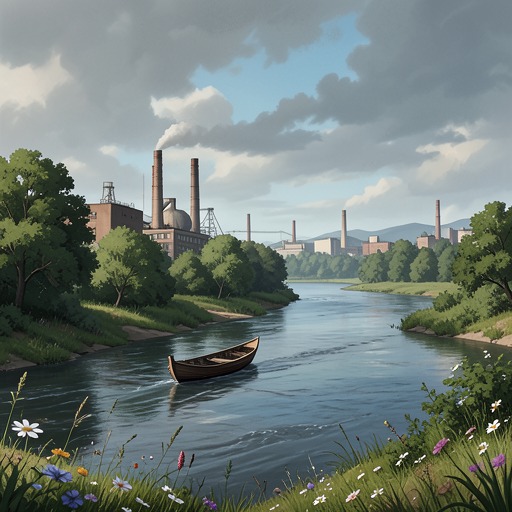
The river landscape is never simply pristine wilderness. Early in Isaac English’s journey, barges and a towboat move coal along the water, while a bluegill jumps in the shallows. The fish are not supposed to be eaten because the river contains mercury and PCBs, yet people eat them anyway. The scene places the beauty and continuity of the water beside a danger that ordinary life has absorbed: pollution is both known and difficult to avoid.
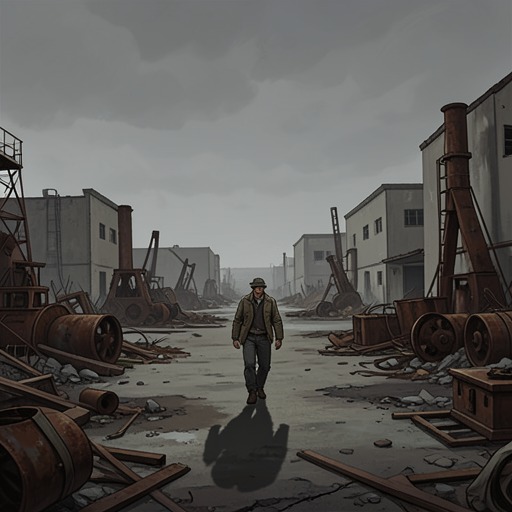
Industry shapes the land beyond the river itself. The road south of Buell passes vacant hamlets, abandoned service stations, a depleted coal mine, and a broad field of gray tailings where even weeds do not grow. Elsewhere, the West Penn Power and Elrama plants loom across the river, their stacks and plumes visible above the coal piles, barges, and rail yards. From a ridge, Isaac sees the Elrama plant dominate the green valley. The view resists a clean opposition between industry and nature: trees cover much of the surrounding land, but the industrial structures remain conspicuous, and coal continues to be moved and burned.
This inheritance includes damage to public infrastructure as well as the industrial landscape. Buell’s sewer system spills sewage into the Mon during heavy storms, and the city is under orders to repair it even as its police budget is sharply reduced. The river’s condition is therefore connected to the same scarcity that shapes local government and daily life. Natural persistence does not remove the need for costly maintenance, nor does it distribute the consequences of pollution evenly: residents remain in a region where damaged infrastructure and shrinking public resources meet.
Regrowth Among the Ruins
The novel gives the landscape a force that is not confined to serving as a backdrop for human feeling. During his travels, Isaac sees greenery spreading around towboat piers, storage tanks, and abandoned industrial ground. In the brush he notices a pale legbone, which he understands as part of a cycle in which old remains can contribute to new growth. His perception turns industrial passage into a scene of ecological succession: human traces remain, but vegetation is also advancing around them.
The image does not establish that every damaged site recovers. The mine tailings outside Buell are barren, and the polluted river remains unsafe for eating fish. Instead, the book places signs of persistence beside lasting damage. Some ground is overtaken by brush; some remains sterile; some harm is carried invisibly in water people still use. Regeneration is real, but uneven, and it does not restore the region to an untouched state.
The River as Perspective
For Isaac, the river and surrounding woods provide both physical terrain and a way to steady his attention. He follows the railroad and river corridor westward, then uses trails and forest routes. His notebooks of animal drawings occupy much of his pack, and he knows the local woods well. Naming birds, trees, and other plants gives his restless mind things to attend to; the natural setting is not merely scenery during his flight, but a place in which he can direct his attention and continue moving.
The river also holds his thoughts about what lies beneath the visible surface. Its muddy water suggests buried layers—old machinery, remnants, and things not readily seen. That perception links the physical landscape to the past without making the river a transparent record: what it contains cannot simply be recovered by looking. At another point on the journey, Isaac lies in the sun and attends to the pleasure of its warmth. The moment is modest rather than triumphant, a brief recognition of an ordinary good while the uncertainty of his situation remains.
Human Time and Natural Endurance
Bud Harris finds a different kind of perspective in watching the river. Amid paperwork and decisions about Billy Poe, he pauses to watch the water and the changing sky. His reflections place the river, mountains, trees, and stones on a timescale far beyond human cruelty. In his view, forests and trees can recover after people cut them down or pollute the land, while stone survives human lives. The thought helps him resist taking the ugliness of human conduct as permanent or all-encompassing.
That perspective is not identical to the book’s account of environmental damage. Harris’s faith in eventual healing is a way of managing human despair; it does not settle the question of what local people must live with in the present. Isaac’s polluted fishing water, the sterile tailings, and Buell’s sewage problem keep the costs concrete. Nature’s endurance can outlast an industrial order, but it does not make the loss of jobs, failing services, or exposure to contamination inconsequential.
Deindustrialization and Uneven Renewal
The ecological imagery belongs to a wider account of the Mon Valley’s decline. The region had been a global center of steel production, but it lost 150,000 jobs during Isaac and Billy Poe’s lifetimes, leaving many towns unable to afford basic services. Grace Poe’s history connects this collapse to household choices: layoffs ended her education, work became scarce, and the family relied on food-bank provisions and deer Virgil Poe poached to keep their home. The land’s abundance could help sustain people, but that dependence was also a consequence of lost wages and limited options.
The novel likewise presents industrial decline as a result of decisions about investment, not simply as the natural fading of an old economy. Henry English recalls that Penn Steel had neglected its plants for years while steelmakers in Germany and Japan invested in new infrastructure. Against that history, nature’s return to industrial ground is neither a simple promise of restoration nor an excuse to forget who benefited from production and who remains amid its residue. The enduring river and encroaching forest offer continuity, but the novel keeps that continuity in tension with pollution, poverty, and the human work still required to live in the Valley.