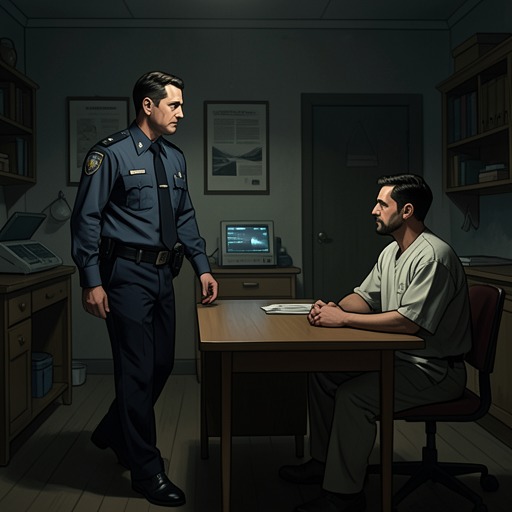
Pennsylvania State Police
American RustThe Pennsylvania State Police are an external law-enforcement presence in the criminal case surrounding Otto Carson’s death and Billy Poe’s arrest. Their demands for evidence and expected involvement in taking Poe into custody place pressure on Bud Harris, whose attempt to protect Poe coexists with his insistence that Poe prepare for prosecution. The novel presents the agency through these concrete points of contact rather than through a broader account of its structure or operations.
Role in the Investigation
The agency enters the case as the investigation widens beyond local police. When Bud Harris explains the circumstances to Poe, he identifies Carson and reports that the state police want Poe’s shoes confiscated. The shoes matter as evidence, while the reference to a woman found dead in a dumpster and the lack of clues frames the case as a serious investigation being taken to the district attorney in Uniontown, Pennsylvania.
Harris’s account makes the agency’s presence consequential even before its officers appear directly in the supplied scenes. Its interest in the shoes signals that investigators are seeking physical evidence, and its anticipated action creates an immediate risk for Poe. Harris tells him that he must explain what happened and identify anyone else at the plant so the killing can be presented as self-defense at trial. The advice reflects Harris’s effort to shape Poe’s response to an investigation he cannot simply keep within his own control.
Custody and the Threat of Prosecution
Harris tells Poe that he is allowing him to go home for the night, but plans to pick him up the next day before the state police do. He warns Poe not to run and tells him to destroy the shoes and any box or receipts associated with them. The episode links the agency to an impending transfer from Harris’s discretionary handling of the case toward formal custody and investigation. It also exposes the conflict in Harris’s conduct: he offers Poe practical protection while instructing him to destroy potentially relevant evidence.
Harris later emphasizes the severity of Poe’s legal exposure. He tells Poe that a witness may remove him from the lineup, but warns that the district attorney is pursuing a capital case and may seek the death penalty. In this account, the state police belong to the wider machinery of investigation and arrest, while the district attorney drives the prosecution strategy. The agency’s role is therefore distinct from the prosecutor’s, even as both contribute to the pressure surrounding Poe’s case.
Institutional Context and Limits of the Portrayal
The novel sets this outside investigative pressure against the precarious condition of the Buell Police Department. Its budget has been cut from $785,000 to $541,000, forcing reductions in training, continued use of aging vehicles, and the prospect of laying off three full-time officers. The contrast establishes the local department’s limited capacity in a town facing a major criminal case, but the evidence does not specify how the state police are staffed, organized, or formally assigned the investigation.
References to the state police also register how quickly a local crisis can become a matter of broader legal attention. Harris anticipates their arrival as a practical deadline; Poe’s father has already been asked whether Isaac English was involved and is reported to have said that Isaac left two days earlier. These details place the agency within an expanding inquiry, while leaving the precise scope of its investigative work unstated. Its narrative importance lies chiefly in this pressure: the prospect of state-police action narrows Harris’s room to maneuver and makes Poe’s choices about evidence, cooperation, and flight more urgent.