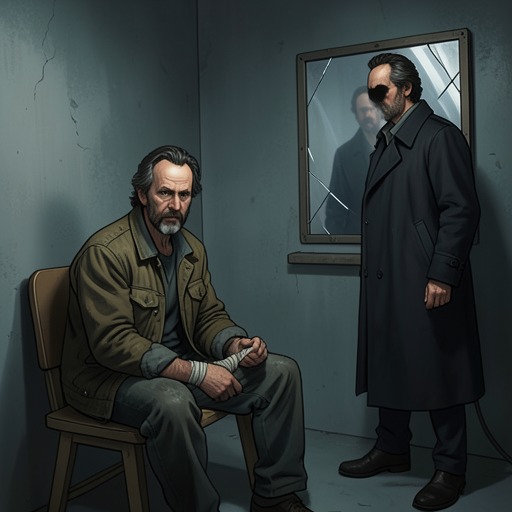
Poe fights back against “Little Man” in the prison cafeteria and gains protection from white inmates
American RustBilly Poe’s fight in the prison cafeteria is a turning point in his effort to navigate an institution where safety depends not only on official rules but also on the judgments of inmates with power. When a larger inmate singles him out and challenges him over his food, Poe acts despite recognizing the danger of crossing racial lines. The fight earns him protection from the white inmates who control their area, but that protection is conditional, and the confrontation makes visible the alliances and risks that govern daily life inside the prison.
Setting and Prison Order
The cafeteria is part of a prison organized by both its official architecture and an informal social hierarchy. Poe comes down from the second-floor cellblock into a crowded corridor, then enters a room full of noise and movement. Long institutional tables have attached benches, designed so they cannot readily be used as weapons. No guards are present in the cafeteria, leaving inmates to manage the room’s immediate conflicts themselves.
The diners sit in areas divided by race. Black inmates occupy one section, Hispanics another, while white inmates are a visible minority, described as quieter and apparently older. At one end of the white section sit three large, tattooed men who appear to run things. The arrangement makes Poe’s position precarious: an argument that begins between individuals can draw in the groups around them. The room’s organization does not merely form a backdrop to the confrontation; it helps determine what choices Poe believes are available and what consequences may follow from them.
Poe is physically imposing and has a football background, but neither fact gives him a straightforward place in this new social order. Before prison, his expected future had included college and continuing to play ball; instead, he is incarcerated after a fight with a teenager from Donora, for which he remains on probation. In the cafeteria, physical size and a history of fighting do not guarantee security. Poe must read unfamiliar signals and decide whether silence will protect him or make him an easier target.
The Cafeteria Confrontation
The encounter begins when a large, tattooed Black inmate approaches Poe and addresses him with a taunt. He asks for one of Poe’s sausages. Poe moves his tray out of reach, and when the man reaches for it, Poe slides it farther away. The man then leans into Poe’s space and raises his voice, making the exchange public as other diners begin to watch. A demand over food becomes a deliberate challenge before an audience.
Poe understands the racial danger of responding. He expects that the other Black inmates may join against him, and he does not want to fight; he feels frightened and knows that this is a situation in which a simple refusal could have wider consequences. Yet the man continues to touch his arm and imply that he will take care of him, prompting laughter around the room. Poe acts suddenly, taking the man down and striking him. The choice is not presented as an easy display of confidence: it follows his recognition that he is already being made into a spectacle and may have no safe way to withdraw.
The crowd reacts to the fight rather than intervening to protect either participant. A white inmate tells Poe to get up, and a white leader characterizes the encounter as a fair fight. Someone from the Black side objects that Poe had used a sucker punch. The dispute over how the fight began matters because the inmates’ response is also a judgment about whether Poe has violated the room’s unwritten rules. For a moment, the two groups’ interpretations leave his standing uncertain.
Protection and Its Limits
After the confrontation, the white inmates’ leader gives a slight nod toward Poe. Poe understands that he is expected to follow the group. A man with a shaved head offers a friendly wink and says they had thought Poe might be turned out; the leader adds that Poe took a long time to decide. The remarks make clear that the fight has been watched as a test. Poe’s response has not simply won approval for winning; it has shown the group how he behaves under pressure and allowed them to claim him within their own circle.
The men lead Poe through the corridor, past the metal detector and metal doors, and out into the recreation yard. A hand signal brings the guards at the Plexiglas station to open the doors. Once outside, the group stops near the weight area. The move from the crowded cafeteria to the open yard marks Poe’s immediate passage from isolation into an alliance: after days of uncertainty, he receives a friendly gesture and is allowed to stand with the inmates who hold influence among the whites.
That protection is not an unconditional guarantee of safety. Later, Black Larry says Poe needs to keep his head down for a while, at least until an arrangement with the DCs can be worked out. The advice shows that even an accepted position leaves Poe dependent on negotiations and continuing restraint. His place in the group has to be maintained within a larger prison order, not secured once and for all by a single victory.
Significance in Poe’s Arc
The scene places Poe’s familiar capacity for physical action inside a setting where violence has a different cost. Before prison, he had already been unable to resist a fight and was still dealing with the consequences. Here, he is reluctant and afraid, yet chooses to act when a public provocation threatens to define his position. The episode therefore presents both the force of an old pattern and the pressure of circumstances: Poe fights, but he does so while calculating a danger that extends beyond his opponent.
The cafeteria’s informal authority fills a vacuum left by the absence of guards in the room. The white inmates can decide whether Poe will be treated as an outsider, and their decision opens a route to provisional safety. At the same time, the racial division of the room and the objection to the way the fight began expose how quickly an individual act becomes a group matter. Poe’s acceptance is real, but it rests on an unstable balance of recognition, force, and alliance. The fight marks the beginning of protection while revealing why protection in prison remains conditional.