Poe's prison stabbing
American RustBilly Poe’s prison stabbing turns his loyalty to Isaac English into an immediate physical danger inside a prison governed not only by guards but also by inmate factions and their informal rules. After Poe refuses to identify Isaac, he is left to face the consequences of that choice within the general population.
Prison Conditions and the Threat
The prison’s routines offer little sense of safety. In the cafeteria, inmates gather at long tables in areas divided by race, while Clovis and other influential men occupy a visible position among the white prisoners. Earlier, Black Larry had warned that Poe would need to keep his head down until a matter involving the DCs was settled. The advice establishes that Poe’s safety depends on factional arrangements as much as on official custody; his refusal to follow an intimidating group back to a cell also makes clear that he will not accept protection without understanding its terms.
After asking for protective custody, Poe is moved again, but he doubts that the transfer will keep him safe. He considers a weapon and weighs escape against returning to the general population, while telling himself that protecting Isaac is the reason he is in prison. When he hears guards approaching, he briefly expects to be taken somewhere secure; they pass his cell instead. Poe then leaves to get food, but at the cafeteria he sees Clovis with Dwayne and the younger men. Clovis rises, and Poe turns away, moving through the corridors toward the rec-yard doors. The doors are locked. Clovis and several associates catch up with him there, closing off the route he had hoped might lead out.
The Attack and Its Immediate Aftermath
Clovis and his companions overtake Poe at the locked doors. One of the group has a long-bladed knife, and when Poe tries to break past them, they bring him down and stab him. The attack ends his attempt to escape the confrontation, but not his effort to protect Isaac: Poe has already understood the choice as one between himself and his friend, and he has resolved to endure the consequences rather than betray him.
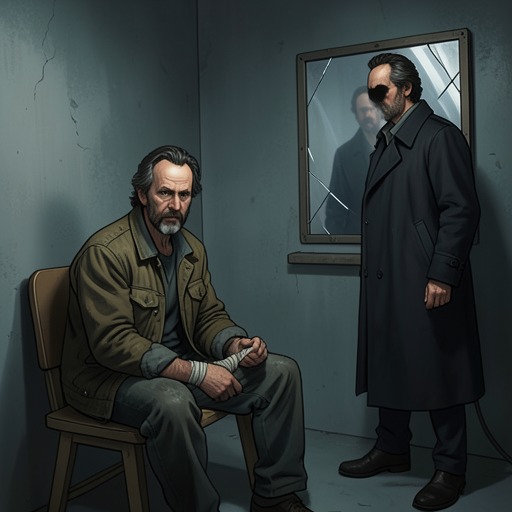
Poe survives, though his first moments afterward are confused and frightening. He drifts in and out of awareness as rescuers treat him, then comes to in a hospital bed with his head bandaged, an intravenous line beside him, and a handcuff securing him to the bedrail. Pain limits his movement, but the recognition that he is alive marks a decisive turn from the apparent finality of the attack. The danger has not erased his commitment to Isaac; it has made the cost of that commitment unmistakable.
Secrecy After the Attack
After Isaac visits the police station, Harris watches him leave without telling him that Billy Poe has been stabbed and nearly died. Poe had also refused to see his lawyer for several days. Grace has not yet been told either, leaving both people closest to Poe outside the immediate truth of his condition. Harris, meanwhile, must prepare an account of where he was the previous night while coping with his own injuries. Ho had stayed on duty through the night, sensing that something was happening. Harris’s silence makes the stabbing part of a wider pattern of concealed knowledge, even as he recognizes that both young men are worth saving.
Earlier Violence and the Cost of Survival
The prison attack followed an earlier assault at the machine shop, where Billy Poe had been threatened and injured while Isaac English killed Otto to protect him. In the immediate aftermath, Poe walked home without his jacket in freezing weather, fixated on the violence and blaming himself for having started the confrontation. He also worried that he had failed to prepare firewood for his mother, whose arthritis kept her from chopping it herself. Fear, anger, guilt, and concern for her thus converged before his imprisonment began; surviving one violent encounter did not leave him untouched by it.
At home, Poe’s mother found him cold and emotionally distant. She put him in a bath, warmed him, and cleaned his wounds, recognizing that she had misjudged how much support he needed after losing his hardware-store job. He let her remove his shirt but would not let her take off his jeans. The scene establishes a boundary he could still assert amid shock and dependence. In prison, the later stabbing again leaves his body subject to other people’s decisions, while his recovery is rendered through intermittent awareness and confinement to a hospital bed. His survival is therefore not a simple return to safety: it follows two successive episodes of violence, with care offered at home and medical treatment after the prison attack providing distinct, limited forms of protection.