Prison retaliation code
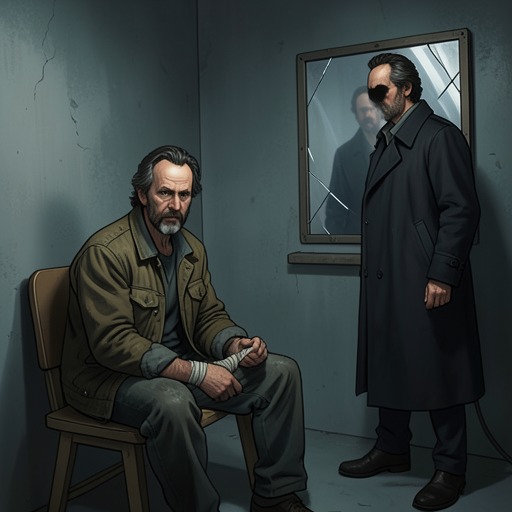
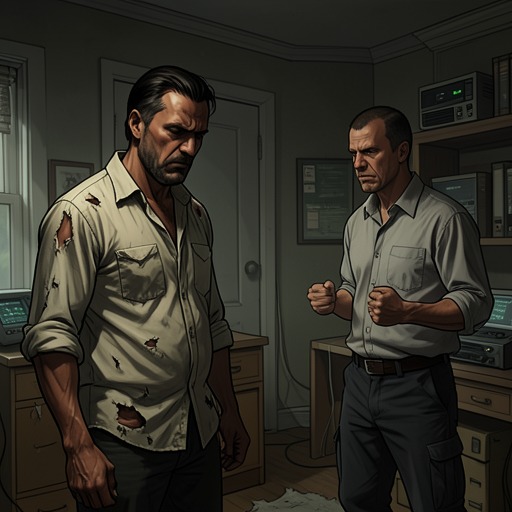
American RustThe Prison retaliation code is an informal system of escalating payback that governs risk, protection, and allegiance inside Fayette prison. Billy Poe learns that retaliation is not considered settled by absorbing an equivalent injury: a response is expected to exceed the original offense. The code turns a fight into an expanding obligation, binding individuals to prison factions and making refusal dangerous even when the demanded act conflicts with a prisoner’s own judgment.
Setting and Operation
Prison life gives this rule force through crowded, divided spaces and group authority rather than through any formal regulation described in the novel. On his first trip to the cafeteria, Billy Poe finds a loud, crowded room divided by race. White prisoners are visibly a minority, and three large, tattooed men sit apart at the end of a table as apparent leaders. The room’s organization makes affiliations legible: where a person sits and which group stands behind him can carry consequences beyond the immediate encounter.
The pressure is not only a matter of individual revenge. The cafeteria has no guard present in the scene, while inmates manage the room’s ordinary movement and conflict. Later, when Billy Poe considers whether to follow Black Larry and Dwayne, he resists going with them to a cell. Their laughter and reassurance do not remove the power imbalance; the moment shows how the group can present a demand as both an offer of belonging and a test of submission.
Escalation and Protection
The code becomes explicit after Billy Poe has choked out a senior Black prisoner, a captain. He knows that the response is likely to exceed a beating: in prison, payback must be escalated, and the next person must be made to suffer more than the last. His earlier success in the fight has therefore not secured safety. It has created a new exposure, because the man he embarrassed has standing, and others may seek favor by retaliating against Poe.
Black Larry and Dwayne explain the consequences in factional terms. Billy Poe’s action has embarrassed one of the Black group’s leaders and reopened tensions between that group and the DC Blacks, after efforts to settle them. The white prisoners’ protection of Billy Poe is presented as collective: Black Larry says that an attack on Poe would bring the white group into a full fight. But this protection is not a free refuge. Black Larry also makes clear that Poe has been fast-tracked into the group’s orbit, and that there is a place for him with them or a place exposed to the men across the yard. The code thus couples safety with an obligation to answer for the group.
The Demand and Billy Poe’s Choice
The immediate test is an order to assault Fisher. Dwayne says Fisher’s name will be on the shirt and insists that Billy Poe act alone. Black Larry frames the grievance as a debt: Fisher allegedly took items the prisoners had paid him to obtain, then claimed they had been confiscated. He characterizes Fisher as a drug dealer who steals from his business partners, while Billy Poe points out that he is still awaiting trial and does not want to hit a guard. The competing descriptions do not change the demand; they make it easier for the group to present the attack as repayment rather than arbitrary violence.
Billy Poe asks why he should do it and says he needs time to think. Black Larry’s explanation links the demand directly to the retaliation code: Poe’s earlier fight has made the group vulnerable to further conflict, and the proposed assault is meant to answer that danger. Black Larry tells him that people outside the prison already dislike him and that prison may be his home for a long time. The threat narrows Poe’s apparent choices. He looks toward the many Black prisoners gathered across the yard, then tells Dwayne he is in, recognizing in his own thoughts that agreement may become action rather than merely a way to gain time.
His cellmate Tucker reinforces the same coercive logic from another position. Tucker warns that the prisoners demanding the assault are dangerous, offers to keep lookout, but says Billy Poe must do the hitting. He also warns that backing out could make Tucker a target as the person associated with Poe. The rule therefore spreads risk through association: refusing an order can endanger not only the person who refuses but also anyone perceived as connected to him.
Limits and Consequences
Billy Poe’s agreement does not resolve the conflict. When he later enters the cafeteria, Clovis is sitting with younger lieutenants, and Dwayne avoids looking at him. Clovis stands with an expectant grin. Billy Poe’s legs shake; he turns around and leaves, moving through the corridors toward locked doors before Clovis and several younger men catch up behind him. The scene records an interruption, not a settled escape or a confirmed attack on Fisher. The demand remains active, and the danger of refusing it is immediate.
The code’s significance lies in this absence of a clean choice. Group protection can keep Billy Poe from being isolated after his fight, yet it makes him answerable to a new hierarchy and a new act of violence. Retaliation is represented as a mechanism that reproduces conflict: an insult invites a stronger response, that response creates new enemies, and the next refusal threatens the security bought by allegiance. Billy Poe’s hesitation exposes the human cost of a system in which safety is offered conditionally and the price is participation.