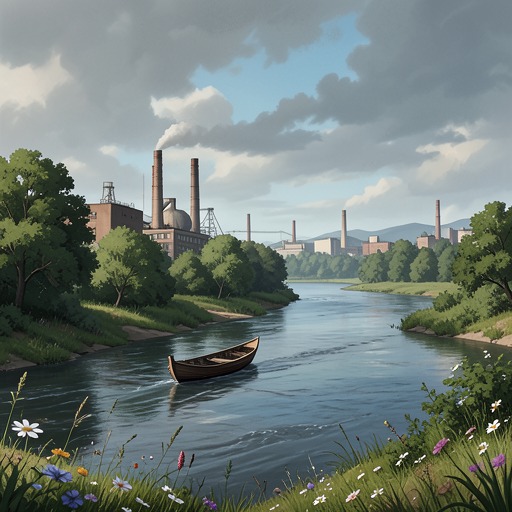
Spring
American RustSpring gives the novel a landscape that seems to renew itself even as its people remain caught among the consequences of industrial decline, poverty, and loss. Its green fields, returning wildlife, and signs of growth offer genuine beauty, but not a restoration of the prosperity Buell once knew. Across scenes of travel, hardship, and hunting, the season becomes a measure of change: nature comes back in forms the characters can see, while human recovery remains partial and uncertain.
A season of travel and industrial remains
In the first weeks of spring, Billy Poe and Isaac English walk down a narrow dirt road toward the river, through woods and meadows described as green and beautiful. The landscape is already marked by what lies beneath it: an old house has tipped face-first into a sinkhole because the Mid-Mon Valley is riddled with coal mines, some stabilized and some not. Isaac knocks a ventstack from the roof with a stone, an irreverent gesture in a landscape where industrial traces and unstable ground are part of the same inheritance.
Their route also takes them past the ruined Standard Steel Car factory, a vast, half-collapsed structure where bricks and beams cover old forges and hydraulic presses. Moss and vines grow through the wreckage. Isaac remembers taking a nameplate from a hammer forge, polishing and oiling it, and giving it to Lee English; she placed it over her desk. The small object carries a piece of the factory into a different setting, turning salvage into a modest act of preservation. Yet the men’s immediate circumstances are less elegiac: rain arrives as they travel, and the roofless factory offers little shelter from a cold, wet start to their trip.
Spring interrupted by snow
The season does not arrive as steady warmth. In another scene, a spring snowfall covers the trees, grass, and an empty neighboring house, while green remains visible beneath the white. Grace Poe steps onto the porch and sees Billy sitting under a tree at the edge of the yard, snow in his hair and no coat on. She calls him inside, but he does not move. The beautiful, peaceful appearance of the scene sharpens rather than resolves the sign that something is wrong.
The cold is also bound to the material conditions of Grace’s life. Inside the trailer, she sits in a gray sweatsuit, wrapped in blankets because the electric baseboard heaters cost too much to run. The family is out of firewood, and replacing the trailer’s inadequate heating with a furnace feels to her like investing in a home she has long hoped to leave. The snowfall therefore unsettles the usual promise of spring: the landscape can look newly made while the household remains cold, constrained, and uncertain of its future.
Wildlife returns to a changing valley
Elsewhere, spring is marked by animals appearing in places where industrial and human life have receded. On a road between Brownsville and Buell, a large black bear watches from a ridge, its spring coat glossy. The narrator observes that bears are returning, as are coyotes and deer, and that wildlife seems to be among the few things doing well. The contrast is striking: ecological recovery is visible, but it does not mean that the valley’s former human prosperity has returned.
The distinction also appears in Isaac English’s view from a hunting blind. In spring, the field is full of growth: fresh grass, new oak buds, pine needles, hemlocks, and a stream below the slope. He notices that green is not one color but many, and imagines a vocabulary that could distinguish them. Woods have grown over patches he remembers as fields, while goldenrod is taking over an unmowed stretch near his home. He knows that the land will not remain a field without care, and plans to mow it the next day. Renewal here is not passive prettiness; growth changes the land, and maintaining a human use for it takes work.
Renewal without restoration
Isaac’s spring reflections hold two accounts of the valley together. He recognizes that the region was once far wealthier, with steelworkers earning thirty dollars an hour, and that no return to that economy is likely. Minimum-wage work has become ordinary. At the same time, he sees the woods reclaiming ground and believes the valley is recovering in different ways. Because he grew up after much of the decline, he can recognize the beauty that remains without mistaking it for a return to the past.
Spring also frames a more immediate sense of continuation. While hunting, Isaac carries a fifty-year-old Winchester Model 94 and puts three cartridges in his pocket; he intends to take a deer, part of a family habit of poaching. The deer are numerous, and extended hunting seasons have not brought the population under control. As he sits in the blind, the smell of damp soil and new growth leads him to think of life as a cycle that will continue after he is gone. That thought joins the season’s ecological renewal to the novel’s larger concern with mortality and persistence, without making renewal a cure for hardship. Spring brings green growth, returning animals, and a day Isaac recognizes as good; it does not undo the damaged economy or the losses carried by the people who live there.