Suicidal ideation
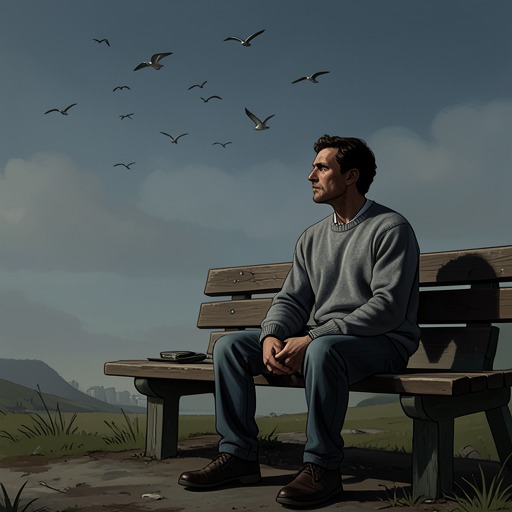
American RustSuicidal ideation in the novel is presented not as a settled wish for death but as a crisis in which guilt, dependence, and fear narrow a character’s sense of choice. Its clearest enacted instance belongs to Henry English: he prepares to die, then interrupts that course when he recognizes that his family would be pulled down with him. Other scenes offer important contrasts—characters face danger, punishment, or sacrifice without the text making those experiences equivalent to a wish to die.## Henry English’s crisisHenry English’s suicidal crisis grows from accumulated losses and his fear of further separation. Alone in the house, he revisits the deaths of Chucky Cunningham and Wayne Davis, whose families received compensation after the furnace accident, and contrasts their outcome with his own sense of failure. His thoughts then turn to Mary English and Lee English, both of whom he fears losing, and to Isaac English, who, Henry thinks, should have been able to leave rather than remain at home. His distress is therefore bound up with family history and dependence, not presented as an isolated impulse.Henry’s physical circumstances sharpen the crisis without explaining it away. He moves in his wheelchair through the house and out to the porch, carrying a blanket and a bottle of whiskey. He also retrieves an old supply of OxyContin that he had stopped using a year earlier. The actions show preparation and a degree of determination, but his thoughts remain unsettled: even after taking pills, he postpones a final decision and rolls into the yard to think further. The scene tracks the movement between intention and hesitation rather than treating the attempt as an accomplished death.The narration makes his self-accusation central. Henry tells himself that Isaac’s actions are not the cause of what has happened to the family; he is responsible for the situation and for having kept Isaac at home. He imagines that his children resent him and interprets their possible departure as another loss he cannot endure. The inward argument is not a clear accounting of blame so much as a mind turning every circumstance into proof that he has failed those closest to him.## The interruption of intentThe decisive change comes while Henry holds the pill container in the backyard. He recognizes that his death would not simply end his own suffering: it would leave his family with another loss and make them bear the consequences of his shame. He rejects the idea that they should go down with him and chooses, for the moment, to carry the burden himself. He returns the container to his pocket and reasons that the amount he has taken is not enough to kill him. That decision does not erase the crisis; it changes the immediate direction of his actions.The landscape gives the moment a wider frame. From the backyard, Henry can see the dark woods, the distant river, and the Valley. The land seems to open into a high ledge beneath a wall of stars, a view he has never seen in quite that way. He wraps the blanket around himself and begins to feel warm as he falls asleep. This ending is deliberately limited: the scene shows him relinquishing the immediate plan and sleeping, but does not establish what care or assistance follows. The view and the temporary return of warmth mark a pause, not a complete recovery.## Distinguishing despair from dangerOther characters encounter violence, confinement, and responsibility, but the novel keeps those experiences distinct from Henry’s suicidal intent. At the machine shop, Isaac English initially waits outside while Billy Poe is in danger. When Poe does not emerge after shouting and banging stop, Isaac decides he must go back in. He hides his money and pack, takes an industrial ball bearing, and intervenes. The scene shows fear and a choice to enter danger on another person’s behalf; it does not identify that risk-taking as a wish to die. Isaac’s action is directed toward rescuing Poe.The same distinction matters in Poe’s later reflections in prison. He considers telling a lawyer that Isaac killed the man in the machine shop, which might help him, but weighs that possibility against his promise and his belief that Isaac is one of the good ones. Poe says he will accept the consequences of his own choices and remains aware that a lawyer will likely ask who killed the man. His willingness to remain accountable and his refusal to volunteer the truth create a conflict between self-preservation and loyalty, not an explicit suicidal plan. Likewise, Bud Harris’s thought that he is trading himself for Billy Poe describes a dangerous protective choice, not a stated intention to end his life.## Relationships, responsibility, and possible futuresHenry’s crisis is shaped by the people he fears leaving and the relationships he believes he has damaged. He thinks of Mary and Lee as losses clustered within the same year and imagines losing Isaac as well. His conclusion that his family would be better off without him gives suicidal thinking the form of a distorted sacrifice: he treats his absence as a way to spare them, then recognizes that it would instead add to their burden. The scene’s turn depends on that recognition, not on any assurance that his family’s difficulties have been resolved.The novel also places moments of connection and future possibility elsewhere in its social world. Lee invites Joelle and Christy to visit her in New York, and Joelle and Christy respond positively. Joelle describes the security of living in a place where someone familiar will soon pass by if a car breaks down, a modest form of mutual support set against the fear of having nowhere to fall. These exchanges do not explain or cure Henry’s crisis, and the text does not connect them directly to his decision. They do, however, provide a contrast in the novel’s treatment of vulnerability: endurance can depend on other people and on imagined plans, even when neither guarantees escape from hardship.## Narrative significanceThe portrayal gains force from the way the scene moves between practical acts and self-judgment. Henry handles ordinary objects—the old bottle, the whiskey, the blanket—and makes a sequence of choices that repeatedly approaches and retreats from finality. His thoughts shift from blaming himself to imagining the effect on his children, and the movement from the house to the yard opens a brief interval in which he can reconsider. The narrative does not present a sudden cure or a neatly settled moral lesson. It records a decision to stop, grounded in his refusal to make his family carry his burden.The episode also complicates responsibility across the novel. Isaac’s intervention at the machine shop, Poe’s prison decision, and Harris’s willingness to endanger himself for Billy show different forms of loyalty and consequence; they should not be collapsed into Henry’s despair. Henry’s choice is significant because it is both personal and relational: he remains alive in the moment not because guilt has disappeared, but because he sees that his proposed escape would impose further suffering on those he loves. The scene leaves that fragile choice, and its uncertain aftermath, open.