The Fall
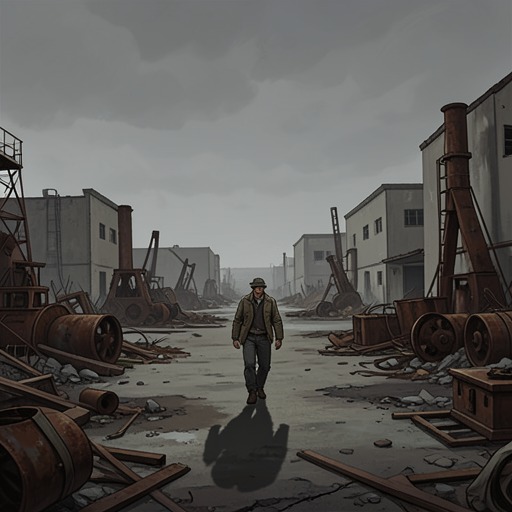
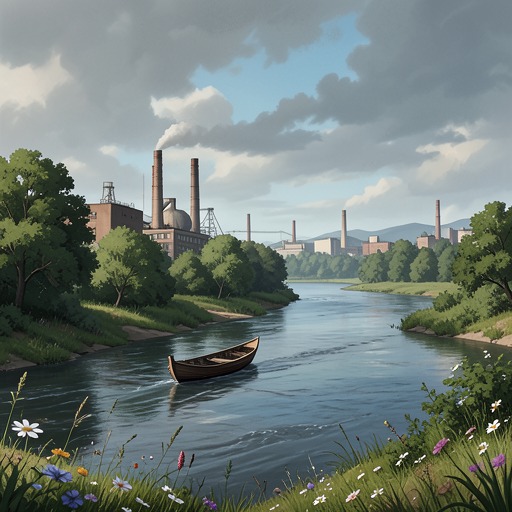
American RustThe Fall names the Mon Valley’s prolonged industrial and civic decline after the steel mills began closing. Once the center of steel production in the country and, technically, the world, the region lost 150,000 jobs during the lifetimes of Billy Poe and Isaac English. The damage reached beyond the mills: supporting industries and local services weakened with them, households lost security, and people faced fewer routes to work or a future. The Fall is therefore not a single shutdown but a chain of consequences that reshapes work, family life, migration, and local institutions.
Industrial collapse and the lost transition
For generations, steel had anchored an interconnected industrial system. Coal supplied the mills, while tool-and-die shops, specialty coaters, mining-equipment makers, and other businesses depended on them and supported their production. When the mills shut, this network contracted with its center; the region’s decline was not simply the replacement of one employer by another.
Henry English’s retrospective account complicates the idea that the collapse was inevitable or caused only by labor costs. He had initially accepted arguments against union costs, but later recognized that Penn Steel had failed to invest in its factories for fifteen years. Many American mills remained in disrepair and continued using single-process production as they approached closure, while German and Japanese producers had adopted basic-oxygen methods decades earlier and kept investing in infrastructure. The contrast makes the Fall a story of decisions about industrial maintenance and adaptation as well as a sudden loss of work.
Efforts to replace steel employment did not restore the old stability. Virgil Poe completed two years of robotics training, but the anticipated jobs never appeared; he later worked at a barge-making plant that also closed, as ship and barge production shifted overseas. The region’s experience thus joined mass layoffs to a failed transition: training and new workplaces offered no dependable substitute for the industries that had disappeared.
Work, family, and the choices left behind
The contraction altered Grace Poe’s life before and after she became a parent. At eighteen, after graduating from high school, she found a new car and a book of pay stubs waiting for her; her father had arranged for her to begin at Penn Steel. She worked on the rolling line, where she met Virgil. She began college while pregnant and continued with a baby in tow, nearly completing an associate degree before the layoffs ended her schooling. With work scarce and a young child to support, continuing her education ceased to be a practical option.
Virgil’s layoff also carried a particular weight. He had survived several rounds of reductions, but the mill’s seniority threshold rose beyond his five years of service. He had taken pride in having a steady job and in doing better than his coal-patch family; losing the job weakened both his livelihood and that sense of distinction. The Fall therefore reaches into identity: employment had represented not only wages but a claim to a different life from the one a worker had inherited.
For Grace and Virgil, the crisis became a daily struggle to keep their home. Their trailer entered foreclosure, but local protests against sheriff’s sales helped prompt a judge to impose a moratorium that eventually became law. They kept the trailer and survived on food-bank supplies and venison from Virgil’s poaching; for two years, venison was a staple. The episode shows how collective resistance and informal subsistence filled gaps left by a damaged economy, without undoing the poverty that made those measures necessary.
The choice to leave the Valley was no simple remedy. Workers went to places including Houston, New Jersey, and Virginia, sometimes sharing motel rooms and sending money home, but many returned. Bud Harris later recalled people heading to Texas in search of oil-rig work that was scarce, leaving some more broke and isolated than before. Staying could mean enduring hardship; leaving could mean losing the support of familiar people without finding secure work elsewhere.
Public life and diminishing prospects
The Fall also appears in the condition of local government and public safety. Towns that had once been sustained by industrial payrolls could no longer afford basic services, and some had no police. In Buell, the police department faced repeated budget crises; during one, city employees borrowed from a bank in lieu of paychecks until the city could repay them. Harris expected further cuts and the eventual merger of the department with a regional force.
The broader strain was visible even where population began to grow again: incomes continued to fall, budgets shrank, and infrastructure had gone without investment for decades. Harris described Valley towns as carrying big-city problems on small-town budgets and saw neighboring communities nearing a point from which they might not recover. He also connected economic insecurity to shrinking prospects for young people. Office work increasingly required college, while the number of such jobs was limited and some were moving overseas, repeating the displacement that had already struck steel.
Harris’s perspective is shaped by the change in his own work. He remembered the 1970s, when the police department could buy new cruisers with powerful engines every few years; after the job losses of the 1980s, he felt that residents had lost not only employment but opportunities to become skilled and take pride in what they did. He had moved to the area expecting the relative ease of small-town policing, but the work became more forceful as the mills fell. His account links the loss of industrial livelihoods to the pressure placed on the institutions expected to manage its consequences, while recognizing that police could not repair the underlying lack of stable jobs.
Meaning in the novel
The Fall gives the characters’ decisions a material history. Grace’s interrupted education, Virgil’s repeated loss of work, Harris’s strained department, and the uncertain migrations of laid-off workers all belong to the same regional contraction. The novel does not reduce these outcomes to individual shortcomings: it sets personal choices against vanished jobs, inadequate investment, diminished public resources, and the poor prospects of moving elsewhere.
Its scale is at once economic and intimate. The mills’ closure dismantles an industrial system, but its effects are measured in a home kept from foreclosure, years of dependence on food assistance and hunted deer, work reduced from steel wages to grocery-bagging, and young people unable to see a viable path ahead. The Fall names the accumulating distance between the region’s former industrial strength and the narrowed possibilities of its present.