The river as a threshold between death and renewal
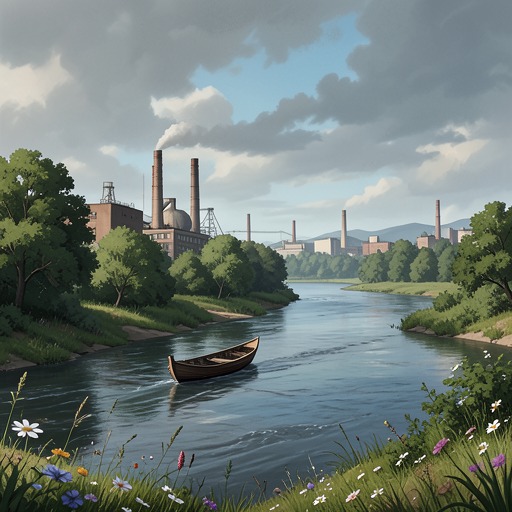
American RustThe river as a threshold between death and renewal gives physical shape to the novel’s movement between despair and a choice to continue. For Isaac English, the Mon River is bound to the loss of Mary English and to his own crisis, but it is also a place where he can set aside his knife, consider what he owes the living, and decide to return to Buell. The river does not erase grief or guarantee safety. Its significance lies in the possibility of passage: death remains present, while life continues beyond any one person’s control.
River, place, and consequence
The river belongs to the material circumstances of Buell as much as to Isaac’s private reflections. In Bud Harris’s thoughts, the Mon River is affected by the city’s failing infrastructure: during heavy storms, sewage spills into it. The river thus bears the consequences of local government decisions and economic decline, rather than existing as an untouched refuge. Its movement through the region offers no simple escape from the social conditions shaping the characters’ lives.
The river also serves as a setting for matters that remain unresolved on land. On a boat in the wooded southern Mon Valley, Harris hears that a reporter from the Valley Independent is asking about warrants and sealed orders connected to Billy Poe’s murder case. The quiet river setting contrasts with the continuing pressure of investigation and possible exposure. In this strand of the motif, the river does not itself cleanse or settle anything; the people aboard it still carry the consequences of their choices.
Grief and the overpass crisis
The river’s association with death is most intimate in Isaac’s recollection of his mother. On an overpass during his flight, his thoughts turn to Mary’s death by suicide, the family’s uncertainty and grief, and Henry English’s refusal to leave her burial place. Isaac remembers that he and Lee had to persuade their father to move. He understands both his father’s self-blame and his own divided feelings toward him. The memory makes his present isolation inseparable from an earlier loss: Isaac fears that what happened to Mary has left a coldness in him, and that his life may be shaped by what he cannot fully face.
This crisis takes place above a highway, not at the riverbank, but it belongs to the same threshold pattern. Isaac calculates the force of the traffic below and thinks through the prospect of his own death. The scene places a possible ending against a continuing world of movement, while his recollections pull him back toward family bonds and obligations. His survival is not presented as a sudden cure for grief. Rather, the passage exposes the weight of the past that he must carry if he is to choose what happens next.
The knife and the choice to continue
When Isaac finally returns toward Buell, he walks nearly twenty miles from Little Washington to Speers, then stands on the I-70 bridge looking toward the Mon River. After passing teenagers beneath the highway, he realizes they have noticed his hunting knife. Once out of their sight, he unfastens it and throws it into the river without ceremony. The action gives the motif a concrete turn: the knife, associated with the danger and violence surrounding his flight, is no longer something he will keep carrying.
Isaac’s thoughts frame this act as a decision to remain among the living, not as proof that his difficulties have disappeared. He reflects that choosing can be difficult, yet even placing one foot before the other is an act of continuing. He connects this attention to life with the ordinary example of Lee’s cat knocking pencils from a desk, an action that suggests the value of being able to act while one still can. The river receives the knife, but it does not absolve Isaac of responsibility or make the past vanish.
The river as continuity and return
That night Isaac stops beside the river and rests. He resists going straight home because he expects his family might persuade him away from the course he has chosen. Instead, he acknowledges that Henry tried, and decides that the right thing is to tell Harris what he did. The riverbank becomes a place for a practical resolution: the next step is not escape into an imagined new life but a return to Buell and an attempt at honesty.
As he looks at the stars, Isaac imagines life and matter moving through transformations: stars become earth, and his mother becomes river, ocean, and rain. This image gives Mary’s death a place in a continuity larger than the family’s grief, without suggesting that the loss itself is repaired. Isaac feels as if something is leaving him, like stepping out of a skin. The change is inward and provisional; he still expects to face the consequences of his actions the following day.
After speaking with Harris, Isaac leaves the office and recognizes that he has decided to trust him and the others. He crosses the old railroad and stands among the reeds at the riverbank. His mind is quiet; he kneels and puts a hand in the water, watching the ripples spread. Terns head toward open water as Isaac imagines himself leaving too, but this possible departure now follows confession and renewed trust rather than the earlier impulse to disappear. The ending keeps the future open: the river offers neither a verdict nor a guarantee, only a continuing world in which Isaac can choose what to do next.