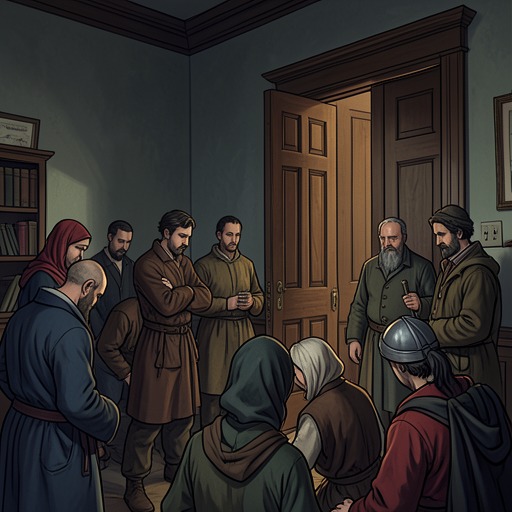
Broadcast of the comrades’ eulogy tape
American WomanThe broadcast of The cadre’s eulogy tape transforms mourning into a public act of political communication. Recorded by Juan, Yvonne, and Pauline after the Los Angeles shootout and fire, it carries both an account of the group’s losses and a declaration that three members survived. Its airing brings the fugitives’ voices to a broad radio audience, but also helps redirect official attention toward Boulder and sharpens the conflict over whether Pauline has chosen her new allegiance or been made to accept it.
Background and Preparation
The tape follows a sequence of events that had already altered how the public saw The cadre. In four months, the group had kidnapped the daughter of San Francisco’s most prominent family, won her to its cause, robbed a bank, and been cornered in Los Angeles. The shootout and ensuing fire killed members of the group; the spectacle of their deaths, widely seen on television, seemed to eclipse public judgment of their actions. At a memorial rally, Sandy—previously too shy to shout slogans at an antiwar demonstration—delivered a forceful speech and was cheered. Afterward, a surviving member approached her and asked for help. Sandy called Rob Frazer, becoming an unexpected intermediary between the survivors and the outside world.
The eulogy was first described as something meant to help the survivors mourn and move on. Jenny understood it that way, but Juan and the others intended to send it to a radio station so the public would know that their comrades had been avenged. When Jenny objected to a direct visit, Juan explained that they would mail the package to someone who could mail it onward. The recording was wrapped in layers of note paper and many differently colored rubber bands. Juan used his work shirt as a covering when he picked it up, taking care not to leave fingerprints on the tape. The contrast between the eulogy’s intimate purpose and its deliberate, cautious distribution defines the event: remembrance is also a means of reaching an audience and making a threat of continued resistance.
The Broadcast
Before the eulogy aired, the survivors prepared to hear how the station would present them. Yvonne sat with a notepad, intent on recording both the news update and its tone; Juan placed a recorder beside the radio, whose sound became distorted. The group’s expectation turned into an uneasy vigil. By midmorning, they moved away from the radio and back toward it, unable to settle into other tasks while waiting to learn whether the tape would be played.
The broadcast interrupted regular programming and joined a station in Boulder. Yvonne’s section arranged its account through particulars: times and dates, weapons and police activity, injured bystanders, deaths, and public cost. Juan then shifted from reported facts to a sweeping political indictment, connecting the Los Angeles siege to state violence and the war in Vietnam. He represented the three escapees as having survived by living rough and accepting the same deprivation imposed on the poor. The tape also claimed that the authorities had believed all twelve comrades dead, and declared that three had escaped. In this way, the recording did not merely commemorate the dead: it revised the public account of the group’s fate and announced that the campaign had not ended with the fire.
Pauline’s Eulogy and the Survivors’ Response
After Juan’s denunciation, Pauline’s section turned from political argument to personal remembrance. She addressed the dead through particulars of their lives: a scarf given by a father, a comrade’s persistence in learning to use a rifle, and another’s anger when the group failed to take its work seriously. The details make the dead individuals rather than anonymous members of a cause. Pauline also described one comrade as a brother she had never had, linking that attachment to their shared experience of growing up in privileged, closely watched lives. Her tribute gives voice to grief inside a recording otherwise shaped by public defiance.
The tape’s account of chosen family echoes Pauline’s earlier declaration, broadcast on April 3, 1974, that she would remain with the comrades because she considered their battle just. In that earlier recording she contrasted her old family, which she said had not cared for her or for the poor, with the family she had found among The cadre. That statement had already prompted news commentators to speculate that she was brainwashed. Jenny challenged the certainty of that explanation, asking how anyone could know Pauline did not agree with the group. The eulogy does not resolve the question, but its personal recollections make Pauline’s participation more than a simple public slogan: she speaks as a mourner and as someone who understands the dead through intimate bonds.
Reception and Aftermath
When the tape ended, a news update reported that three members remained at large and that investigators were shifting their focus to Boulder. Jenny immediately thought of Dana, but the others were absorbed in their own responses: Yvonne fell into Juan’s arms, while Pauline remained apart in the bathroom. The broadcast therefore has a consequence beyond its rhetoric. By stating that survivors escaped and by airing from a station associated with Boulder, it supplies information that intensifies the search, even as the group has used radio to challenge the authorities’ account.
The broadcast also exposes the limits of speaking publicly on one’s own terms. The radio gives Yvonne, Juan, and Pauline a platform, yet their words enter a news cycle already inclined to interpret Pauline’s choice as evidence of coercion. Later, Jenny and Pauline encounter a crisp portrait of Pauline displayed above a bar, its fixed, composed image sharply unlike her altered appearance beside it. The contrast suggests how a person can become a public image distinct from the life that image claims to represent. In a later reflection, Anne considers Pauline the figure who will remain at the center of the story while the dead and surviving members of The cadre risk being forgotten, and imagines that Pauline’s coming trial will be expected to explain everything. The eulogy briefly resists that narrowing: it gives the comrades individual histories and lets the survivors speak. But its national broadcast cannot guarantee that their motives, losses, or political aims will be remembered on their own terms.