Dolly’s car
American WomanDolly’s car is a long-garaged, nearly unused vehicle that Jenny acquires during an urgent return to the farmhouse. After she and Pauline leave in it, its journey west is shaped by the car’s age: it stalls in a Missouri rainstorm, overheats across the Great Plains, loses its radiator cap, and fails again as they try to cross the Rocky Mountains. The car gives the fugitives a way forward, but never lets escape become effortless or secure.
The car at the farmhouse
When Jenny returns to the farmhouse late at night, she has already told herself that she might exchange The Bug for Dolly’s car and leave. She has practical reasons to think the plan could work. Dolly has not driven for years, and Jenny believes that she might not notice one car’s disappearance and another’s arrival for some time. Dolly also keeps a long-standing distance from local government: she does not pay taxes and treats the police condescendingly, making Jenny think she is unlikely to report the swap. Yet, even as Jenny drives back toward the farmhouse, she knows that she cannot simply take the car and go. The plan she has rehearsed does not make the decision easier.
The car waits in the stables, where Jenny can reach it without waking Dolly. The old wooden doors groan, but their metal hardware moves smoothly; Jenny had repaired it about a year earlier. Inside, the car seems almost untouched by time. It still carries the smell of a 1961 showroom, its odometer has not yet reached five thousand miles, and its ashtrays remain pristine. Jenny suspects the keys have not been moved since she left the farmhouse with Frazer three months earlier. When she turns them, the lights come on dimly, but the engine only coughs. The car is available, but it is not ready to carry anyone away: it will need a jump-start.
Jenny’s purchase from Dolly
Rather than take the car without permission, Jenny wakes Dolly and asks to buy it. At a quarter past four in the morning, Dolly doubts that Jenny has come to make an ordinary purchase, especially since Jenny has arrived in another car. Jenny explains that she would leave The Bug in the stable. It might serve as a runabout for a new employee, she says, but it is not suitable for distance; she needs a car to get home to her family in an emergency.
Dolly’s objections are bound up with Jenny’s earlier departure. She points to the unpaid wages and to Jenny’s failure to give notice or say goodbye, while Jenny remembers that Dolly may herself have struggled to pay her wages. Their conversation is a negotiation, but also a reckoning with the abruptness of Jenny’s leaving and the household arrangement they shared. Jenny first offers three hundred dollars, then raises the amount to three hundred fifty, saying she cannot do better and could look at classified advertisements if Dolly refuses. Jenny believes Dolly sees through this bluff, just as she sees Dolly weighing the money as a sum already within reach. Dolly finally agrees, calling the sale a favor and admitting she was sorry Jenny left. Jenny says she was sorry too, and means it in some sense. The purchase thus gives her a usable vehicle while briefly reopening a relationship she had broken off by leaving.
A difficult passage west
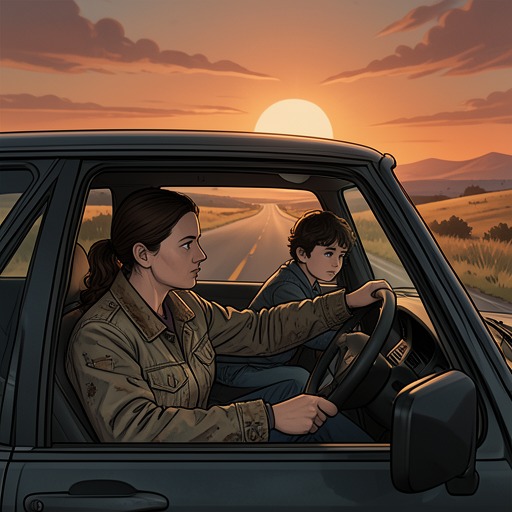
Once the car is running, Jenny and Pauline set out in it. Their travel is neither smooth nor direct. At dawn in Indiana, after a night at a motel, Jenny loads a file and duffel into the trunk and waits until the engine has warmed before Pauline joins her. They drive away from the weatherworn buildings as travelers resuming their journey, but the car’s apparent readiness is provisional. In a desolate stretch of Missouri, it dies after they pull onto the shoulder to consult their atlas. It will not restart, and the women sit with the hazard lights on as rain accumulates on the road. A passing truck throws water against their car so forcefully that they fear most of all for its ability to remain watertight and protective. The episode makes the car both their shelter and the fragile thing on which that shelter depends.
Farther west, the car repeatedly overheats. Jenny knows that it has to cool down, and the two women wait beside it while the engine ticks in the wind. Their pauses become part of the journey: they see sandhill cranes rising from a field and, on another day somewhere in Colorado or Wyoming, pelicans circling above the landlocked expanse. Later, the radiator cap bursts off in a billow of white steam. At a junkyard on a boulder-strewn slope, Jenny walks between wrecks with a taciturn man who searches for a replacement, gathering several caps he thinks may fit. The car’s problems keep the fugitives dependent on roadside help and on improvised repairs, even as the emptiness of the landscape makes the trip feel remote from ordinary life.
As they attempt to cross the Rocky Mountains, the dashboard’s orange warning light signals another bout of overheating. Jenny and Pauline crawl at twenty miles an hour, trailing steam, until they reach a gas station and roadhouse at dusk. The car gives out there. Its failure brings them to a halt at what Jenny recognizes not as a town but as a meeting point between isolated habitations. The evidence follows the car as far as this breakdown, without establishing what repair follows or how the travelers proceed from that particular stop.
The car as an instrument of flight
In retrospect, Jenny cannot settle the trip into a clean itinerary. It may have lasted almost two weeks; she remembers that they wandered north and south, following uncertain instincts about where they might be safe, while struggling west overall. The car’s condition contributes to this uneven passage. A vehicle bought from someone who had kept it garaged since 1961 might seem a dependable refuge, but its repeated failures make distance something the women must negotiate one delay at a time.
The car therefore occupies an unstable place between object and obstacle. At the farmhouse, it is a possibility Jenny cannot bring herself to seize without asking; after Dolly sells it, it becomes the means by which she and Pauline can continue their escape. On the road, however, its stalled engine, overheating, and lost radiator cap interrupt that forward motion and expose their reliance on a machine neither woman can simply command. The car carries them west, but its age gives the journey its stops, risks, and improvised encounters. It is not a seamless vehicle for escape; it is the material condition that makes escape possible and precarious at once.