Ego reconstruction
American WomanEgo reconstruction is a structured exercise practiced by The cadre, combining timed personal disclosure with a larger group ritual. It is presented as a way to test the self and build trust, but its effects are not simply reassuring: it can create intimacy, provoke conflict, and leave participants uncertain whether honesty will be welcomed or used against them. The term first reaches Jenny as a guarded piece of cadre practice; its meaning becomes clearer only through what she hears, what Pauline later explains, and the contrast between the group’s stated purpose and its power over members.
Purpose and Introduction
At Wildmoor, Juan schedules ego reconstruction for the half hour before lunch, placing it between field training and the rest of the day’s routine. When Jenny asks what it is, Juan says it is cadre business that he cannot discuss. His refusal gives the exercise an air of organizational secrecy before she knows its rules. The schedule itself makes it part of a disciplined program, alongside physical readiness, combat strategy, and weapons training, rather than an informal conversation.
Pauline later gives Jenny a more direct explanation: ego reconstruction is a game, but a serious one, and it builds trust. That description holds together two features the novel keeps in tension. The exercise is a game because it has turns, signals, a clock, and rules; it is serious because it asks participants to expose what they think and feel before comrades who may judge them. Its declared purpose is relational, but its formal structure also makes candor an obligation that can be observed and evaluated.
The Group Ritual
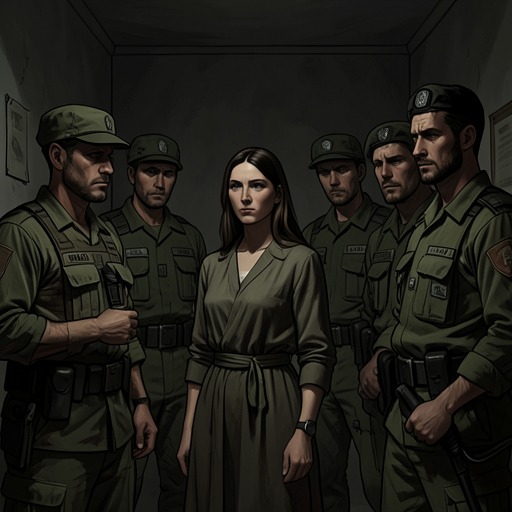
In its larger form, ego reconstruction is a collective practice rather than a private exchange. A participant takes the central position in a circle formed by the others. The person whose turn came most recently serves as the clock, watching the second hand of the cadre’s alarm clock. At a signal, the speaker begins addressing a person selected at random from the circle. The group proceeds clockwise, and the exercise includes a rule against interruption. These procedures give a highly personal disclosure a public audience and a defined duration.
The sessions do not follow a single emotional course. They are sporadic and vary in length; some end peacefully according to a prearranged schedule, while others break into shouting and disorder. Who should take a turn can itself be disputed. The rules therefore do not eliminate conflict. They channel it into a ritual that can make disagreement part of the group’s shared experience, while leaving room for alliances, resentment, and shifts in who supports whom.
Pauline’s retrospective account emphasizes how the group size shapes the experience. Two people can make the exercise feel like a fight, and three can remain awkward; larger groups work better because they absorb the impact of individual disclosures while also making each person feel small within the collective. For a group of eleven, a turn may not come every session, or even every week. The ritual’s scale, irregular schedule, and formal turn-taking combine to make each occasion both conspicuous and uncertain.
Pauline’s Exposure to the Practice
Pauline first encounters ego reconstruction from outside the group. During her captivity, she hears The cadre members speaking and reading through the door, though she does not yet understand the exercise they are doing. Their accounts of personal histories and political commitment reach her before she can take part in their collective life. The narration later distinguishes her early, incomplete awareness from the knowledge she gains after joining them: she had heard the ritual’s voices and emotional force without yet seeing its arrangement or understanding its rules.
Her eventual admission to The cadre follows a vote. When the leader raises whether she should be invited to join, the group has eleven members, including the leader. Nine vote in favor; Juan and Yvonne vote against. The group’s interest in reaching twelve is bound both to combat organization, since twelve can be divided into four groups of three, and to the appeal of symmetry. Pauline’s membership thus places her inside the collective whose rituals she had previously heard from confinement, but it does not erase conflict within that collective. The opposing votes and the strained loyalties among members show that trust is negotiated within an organization already divided by personal attachments and disputes about authority.
Pauline’s account of her own experience exposes the exercise’s less secure side. She recalls being asked what she really thought of Juan’s leadership, answering honestly, and then being accused of insubordination. In her angry recollection, the invitation to speak freely had been a trap. The episode does not establish that every session is deliberately deceptive; it does establish that the language of openness cannot guarantee safety for a speaker. In a group where leadership and discipline matter, an honest opinion can be reclassified as disloyalty after it has been voiced.
A Two-Person Version
Later, Pauline explains the rules to Jenny in a quieter setting. For two participants, each times the other. One person signals the start, and the speaker says what comes to mind about the other without holding back until the minute ends; then the timer calls a stop. They also consider a shorter alternative: each person says the one thought that comes to mind when time is called. This version preserves the basic demand for unfiltered speech while adapting the exercise to a pair rather than a circle.
Jenny questions whether a minute is useful, observing that it can feel long, and responds to Pauline’s explanation with sarcasm about trust. Yet the exchange becomes an instance of the practice rather than a discussion of rules alone. Jenny asks for the truth, and Pauline checks whether that is all she wants. Their brief exchange gives the exercise a more intimate scale: instead of a rotating group ritual, the stakes are concentrated in what one person is willing to say to another. It also leaves the question of trust alive. Jenny’s request is simple, but the exercise cannot make truthfulness automatic; it can only create a situation in which a truthful response is asked for and tested.
Meaning and Limits
The novel presents ego reconstruction as both a method of collective formation and a source of pressure. The group’s account of the practice links self-knowledge to a shared discipline: participants confront one another, endure emotional shocks, and may experience greater closeness even amid discord. In this sense, the exercise gives form to The cadre’s ambition to become more than a collection of individuals. Its circle, turn-taking, and recurring schedule make mutual exposure part of organizational life.
But the same structure complicates the promise of trust. A participant speaks under rules established by the group, before people whose responses carry social and political weight. Pauline’s memory of being punished for an answer solicited as honest shows how disclosure can be converted into evidence against the speaker. The two-person version between Jenny and Pauline narrows the audience but does not abolish that vulnerability. Ego reconstruction therefore names neither pure intimacy nor simple manipulation. It is a practice whose ideals and risks coexist: it asks people to lower their defenses in order to strengthen their bonds, while revealing how difficult it is to separate genuine openness from the discipline of belonging.