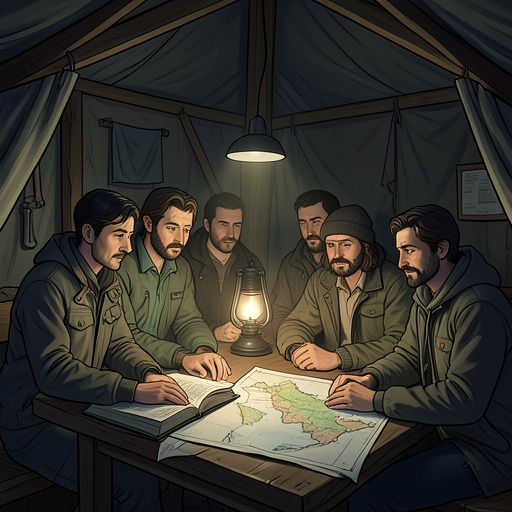
Frazer's no-guns-on-the-journey condition
American WomanFrazer’s no-guns-on-the-journey condition is a temporary security rule that shapes how he will help the fugitives travel across the country. He asks them to leave their weapons behind while on the road, presenting the restriction as a practical safeguard rather than a demand that they give up armed self-defense. The distinction is nearly lost in a volatile misunderstanding, then becomes the basis for a workable arrangement: the fugitives travel without their current guns, which are stored through Frazer’s connections, while he offers to obtain replacements for them at their destination.
Purpose and Terms
Frazer introduces the gun rule as the second of two conditions for his support. First, while traveling, the fugitives must do what he tells them; the journey will be dangerous, he says, and argument could waste time. He makes their compliance a condition of his continued assistance, warning that he will withdraw his support if they will not trust him with their lives. The no-guns rule follows from this broader demand for cooperation: their safety during transit depends, in his view, on accepting his judgment about how to travel.
The specific instruction is that they leave their weapons behind and take no guns on the road. Frazer’s explanation is concrete. If they are stopped, disguises may conceal who they are, but cannot conceal a gun; he believes they cannot drive across the country carrying weapons. His restriction is therefore limited to the journey. It does not require the fugitives to surrender their guns permanently or abandon the expectation of being armed once they reach their destination.
Misunderstanding and Negotiation
The condition initially sounds to Juan like a demand to give up the group’s weapons altogether. He springs to his feet gripping the gun that had been resting on his lap, while Frazer’s palms become wet with fear. Yvonne cries out Juan’s name. The near-confrontation makes visible how much is at stake in a rule that Frazer regards as logistical: Juan hears a threat to the group’s security and autonomy, not merely a restriction on what can travel in the car.
Frazer tries to clarify that a gun would be conspicuous during a traffic stop, even if the travelers were disguised. Juan’s question about how they will get their guns to the other side shows that he understands the proposal as separation from the weapons, not necessarily as a ban on owning them. Frazer answers that they do not need to transport these guns because he will get them new ones. The promise resolves the central misunderstanding: he is not telling them they should be unarmed in general, but that the existing weapons cannot accompany them on the drive.
Juan then laughs, and Frazer responds with a weak grin. The exchange releases the immediate tension, but the afternoon’s discussion remains close to a breaking point. The participants work through the complicated arrangements without another flare-up. The rule is accepted not because the danger of traveling armed has become an abstract principle, but because Frazer’s clarification gives the group a way to preserve its future access to weapons while complying with his transit condition.
Arrangements and Implementation
Over the following days, the travel plan proceeds through a series of car shuttles: Pauline goes first, Yvonne next, and Juan last. The staggered transfers put the no-guns condition into practice as part of a larger relocation operation rather than leaving it as an unresolved argument. Carol rents a new safe house, an old farm about an hour’s drive from Manhattan, providing a destination for the group’s move.
The guns are entrusted to Frazer’s old friends until their owners can someday reclaim them. Frazer assigns Tom responsibility for storing them; Tom appears to regard the task as an improvement over having to store the fugitives themselves. The weapons’ temporary absence from the travelers’ hands is thus managed through a separate chain of custody, while Frazer’s offer of replacements addresses their needs at the far end of the journey. The account later treats the existing guns’ location as uncertain: they are presumably scattered throughout the San Francisco Bay Area, rather than gathered in one known cache.
Significance
The rule balances two forms of trust that the scene briefly sets against each other. Frazer asks the fugitives to obey him because he is taking responsibility for the journey; Juan’s reaction shows that accepting his help does not mean accepting every restriction without suspicion. The group’s ability to proceed depends on clarifying the actual terms. Once the rule is understood as temporary and compatible with later access to new guns, the argument can give way to coordinated movement and storage.
The condition also marks the practical limits of Frazer’s support. He is willing to help finance the group’s travel by doing the book and to arrange the transfer, safe house, and weapons storage, but he insists on controlling how the dangerous road journey is conducted. Its outcome is neither a lasting disarmament nor a simple assertion of authority: the fugitives travel without their existing weapons, and the guns are left with Frazer’s acquaintances for possible future recovery. The compromise preserves the group’s armed identity while accepting a temporary constraint intended to make the crossing possible.