Great Plains
American WomanThe Great Plains appears as a place Jenny and Pauline cross while fleeing west, not as a destination where their journey settles. Its immense open space unsettles Pauline’s sense of what she has seen before, while its migrating birds make the landlocked interior seem briefly magical. For Jenny, the same landscape also prompts an uneasy projection of an older American past onto Pauline, linking the apparent openness of the Plains to histories of conquest, inheritance, and privilege.
A Passage on an Unsettled Route
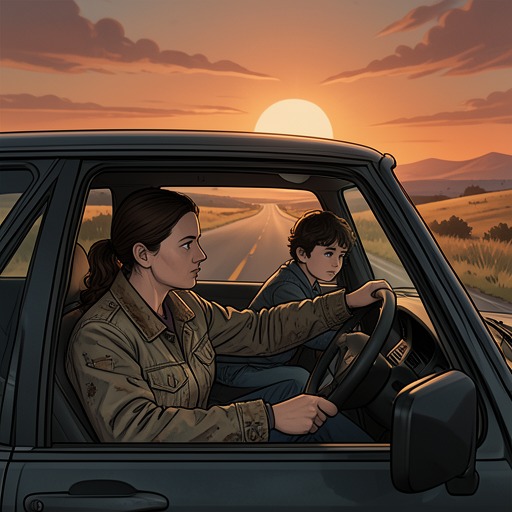
Jenny and Pauline cross the Great Plains during a journey whose route and duration resist ordinary measurement. They do not follow the most efficient road or keep to comfortable driving hours; they zigzag north and south, guided by shifting impressions of where they might be safe or vulnerable. Looking back, Jenny can say they were struggling west, but the trip does not resolve into a smooth, orderly line. The Plains is therefore experienced from the road, as part of a prolonged flight rather than a fixed home or destination. The journey brings practical strain into this expansive setting. Somewhere west of the Mississippi, Dolly’s car overheats, and Jenny knows they must wait for it to cool. They stop while the engine ticks and the wind moves around them. On another day the radiator cap bursts off, sending up white steam. These interruptions make the car’s vulnerability palpable against the scale of the country: the travelers can keep moving only by attending to the failing machine that carries them.
Space, Birds, and Shared Wonder
For Pauline, the Plains’ defining impression is its sheer extent. Gazing from the window, she says, “I can’t believe all this space. It’s so huge. God, I’ve never seen anything like this.” Jenny knows Pauline has crossed this country before, but sees her present amazement as sincere. The scene joins the physical view to the difference between what Pauline has experienced and what she can feel anew in the moment. The landscape also offers encounters that neither woman expects. They see four-foot-tall sandhill cranes rise from a field, and, somewhere in Colorado or Wyoming, pelicans circle overhead. Pauline wonders what ocean birds are doing so far inland. For now, the birds are simply magic: their presence makes the two women strangely happy amid the vast, landlocked country. While the car cools, the scene narrows to its light ticking and the wind, a pause in which the Plains is not merely distance to be crossed but a source of attention and companionship.
Jenny’s Imagined History of the Land
Pauline’s wonder prompts Jenny to imagine a different kind of prior passage across the Plains. She pictures Pauline as a girl in a calico dress, whose parents’ farmstead is attacked by the Crow, who kill them and burn the house; Pauline is abducted, then, in Jenny’s invention, grows up among the people who took her. The imagined past is not presented as Pauline’s actual history. It is Jenny’s way of reading the land through a frontier story, and of imagining Pauline as both victim and survivor within it. That projection shifts into a question about wealth. Jenny wonders where Pauline’s money came from and concludes that her family’s wealth belonged to people who arrived early, endured, killed, and took enough. The Plains thus becomes more than a scenic interval: in Jenny’s thought, its vastness carries the possibility of appropriation and inheritance. Her reflection challenges the idea that privilege is detached from the past, even as the specific story she invents for Pauline remains explicitly imagined.
The Landscape in Memory
The Plains returns in Jenny’s later recollection through the pelicans. She eventually comes across the information that white pelicans migrate from the far North to the Mexican coast through the Great Plains corridor. The fact startles her and makes her heart hurt before she understands why. During the crossing, the birds had seemed inexplicably out of place, and that very incongruity had made them beautiful to Jenny and Pauline. Later knowledge does not erase the moment; it gives the remembered sight a route and a pattern. This delayed recognition captures the way the journey survives in Jenny’s mind. Its episodes do not unroll in a clear sequence: particular images remain because something happened, or because nothing happened beyond a moment of coexistence. The pelicans preserve one such moment, joining the immense Plains, the stopped car, and the two women’s shared wonder to a later, private ache.