Hudson River
American WomanThe Hudson River is more than scenery in the novel: its banks, bridges, and currents shape how Frazer searches for Jenny and how Jenny arrives at a place to hide. It is at once a geographic obstacle, a route through the landscape, and a shifting presence that marks the distance between urban life and the secluded country around Rhinebeck.
Geography and Routes
Near Red Hook, the Hudson River lies about a ten-minute drive west of the town’s sparse center. Frazer studies a map while trying to locate Jenny, and the river becomes part of his practical reasoning: there are only four bridges along the 150-mile stretch between the city and Albany, and one lies west of Red Hook. He doubts Jenny would cross the river to collect her mail. A bridge concentrates traffic and offers no easy exit, conditions that seem inconsistent with her habits and her wish to remain concealed.
The river therefore gives Frazer a boundary with which to narrow his search. He marks Red Hook on the map and draws a circle around it, estimating a half-hour’s drive. His method reflects his conviction that people remain within familiar patterns and rarely stray far from their established realms. The Hudson is not simply an obstacle on the map; it helps him translate what he knows of Jenny into a geography of likely choices.
Rhinecliff and the River Crossing
Jenny’s connection to the Hudson begins with an earlier journey. She chooses Rhinecliff at random, deciding to go wherever one fourth of her money will take her. The train runs alongside the river for the trip from New York City, making the water a sustained companion to her departure rather than a destination she deliberately seeks. On the deserted Rhinecliff station platform, she looks out at the river and smells both rotting vegetation and brine. It is low tide, yet the ocean scent seems stronger, even though the ocean is now two hours farther away.
The river’s atmosphere registers the distance she has traveled without making her arrival feel secure. From Rhinecliff she must call a taxi and ask for the nearest motel; there is only one, miles inland near Rhinebeck. Its cost consumes another large part of her limited funds. The next day, an advertisement in the Rhinebeck Gazette leads to work at Wildmoor, where she accepts room and board as part of her pay. The Hudson thus marks a transition in her flight: the train carries her beside it, but survival requires her to move inland and find shelter.
The Station and Frazer’s Search
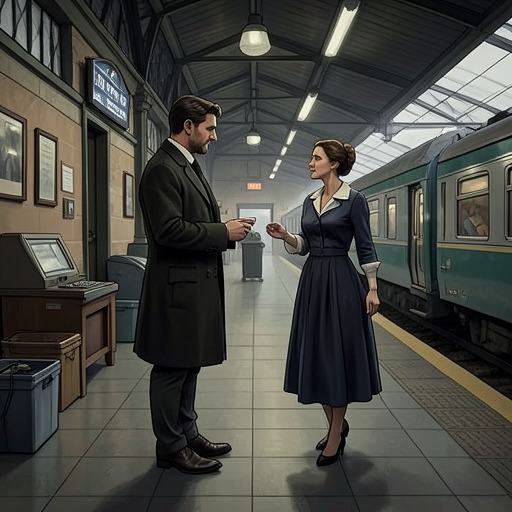
Later, Frazer encounters the river from a small stone railroad station set between the town and the water. The road descends steeply through trees to a tiny parking lot beside the tracks. The station occupies a narrow space between the bluff on which the town clings and the river, with little room for anything else. From a promenade above the platform, Frazer can watch both boats and trains without standing among the people on the platform. On this hot, still day, however, there are no crowds, and the ticket window is unattended.
Frazer rests his arms on the warm stone rail and looks toward the west bank, almost a mile away. The surface reveals deep currents pulling slowly against one another; upriver, an arched bridge forms a silver line. The river makes the setting feel both quiet and dynamic: its visible surface shifts while powerful movement continues beneath it. Frazer senses the distant train through a faint vibration underfoot before hearing its long hoot. When it arrives, it appears suddenly below him. Three people leave it and enter the station; the train pulls away without anyone waiting. One of the passengers is Jenny. The river-side station, first a place of still observation, becomes the point at which Frazer’s search reaches her.
Valley and Narrative Significance
The Hudson also defines the view from a field above the river valley. After Jenny drives to a lakeside lot and follows a trail uphill, she and Frazer reach a grassy field ending at a cliff. Below them lie the valley and the river, a thin silver line in the afternoon haze; farther off, mountains dissolve into a compounded blur of haze and smog. The farmland they have crossed appears miniaturized, its fields marked in green, yellow, and black. Jenny sits at the edge, while Frazer settles close beside her without touching her.
This elevated view places their strained reunion inside a landscape at once expansive and difficult to cross. The river links the scenes of Jenny’s arrival, Frazer’s search, and their meeting, but it does not resolve the distance between them. Its bridges are scarce, its currents pull in opposing directions, and its valley can be seen from above without being reduced to a simple route. The Hudson gives the novel a concrete geography for concealment and pursuit while making movement itself—the train’s passage, the crossing that Jenny avoids, the road inland—part of the story’s emotional structure.