Jenny
American WomanJenny is a resourceful fugitive whose ability to move between invented identities keeps her alive, yet whose life in hiding gradually unsettles the convictions that first bound her to political action. From the authoritative signs she paints to the aliases she adopts, she repeatedly makes herself legible on her own terms; from her years with Pauline to the unequal consequences of their convictions, the novel shows how difficult it is to control what a person’s actions will mean to others.
Identity, Skill, and Recognition
Jenny’s gift for lettering is one of the first things that allows others to recognize her. In Berkeley, when she was nineteen, she painted Mike Sorsa’s truck for his house-painting business and made a hundred-foot banner for Frazer’s planned disruption of a homecoming game. She worked quickly, using soft chalk fixed to a stick to lay out the letters without crawling across the muslin. The banner unfurled on cue, its system of weights her own idea; its scale and precision turned her quiet competence into a public declaration. Frazer remembered that work years later when he saw the weathered house-tour sign at Wildmoor. He could not identify the handwriting so much as its deliberate unrecognizability, and that recognition carried him back to the young woman who had ignored his mistaken assumption that her offer to paint his sign was flirtation.
At their reunion, Jenny has already passed through the station and is striding toward a car before Frazer catches up and touches her elbow. She turns with her mouth slightly open, breath caught, and eyes fixed on him. The encounter offers none of the grand, suspended moment he has imagined: by the time he is certain it is her, she has nearly disappeared from view, and he has to run after her. Her stillness at his touch becomes the brief, startling counterpoint to the speed with which she has been moving through life.
Hiding Behind Names
Jenny’s aliases are practical inventions, revised as her circumstances change. While living with Dick and Helen, Frazer presents her as a young woman who needs to lie low, leaving the reason deliberately unclear. The couple agree to a cover story: she is their old family friends’ daughter, Sally Chen, staying with them to establish residency before applying to a New York State school, with plans to become a doctor. Dick’s explanation of why acquaintances would accept the story exposes the casual racial assumptions that make the deception plausible.
After choosing Rhinecliff at random, Jenny takes a job at Wildmoor advertised in the Rhinebeck Gazette. She has little money, and the motel she finds has already consumed a substantial portion of it; taking room and board as part of her pay gives her a place to stay. For a post office box in Red Hook, she calls herself Iris Wong. She collects the Rhinebeck Gazette after the post office closes, then reads it in her car beside a neglected riverside park. First she scans the national news for any mention of herself; only after finding none does she settle into the local notices. The papers’ small world of church dinners and advice about Canada geese gives her a strangely welcome sense of confinement: for now, she can do little but learn the boundaries of her cell.
When a grocery-store boy asks whether she is from Vietnam, Jenny realizes she has forgotten to prepare a story and cannot continue as Iris Wong, Chinese, from San Francisco. She finally says she is from New York. Later, in Liberty, she quickly invents another identity for a post office box: Alice Chan, a landscape painter who travels through the area. The aliases do more than conceal her; each one is a temporary answer to the demand that she explain herself to strangers. When she meets the boy again, now identified as Thomas, he calls her by the names he has attached to her—Not-from-Nam and Alice. Jenny recognizes him, sees that his face has acquired a guardedness it lacked before, and knows she never returned to see him.
The Cadre and Its Costs
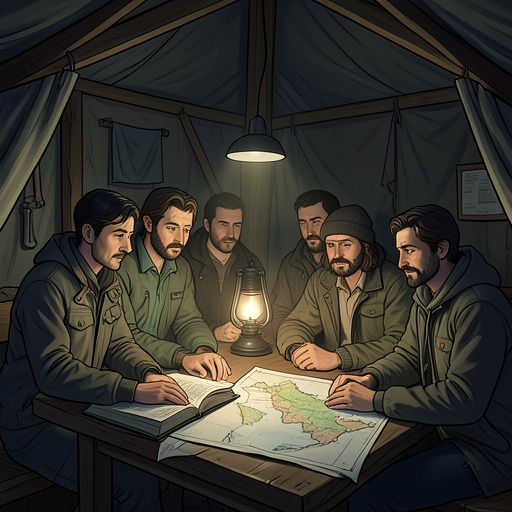
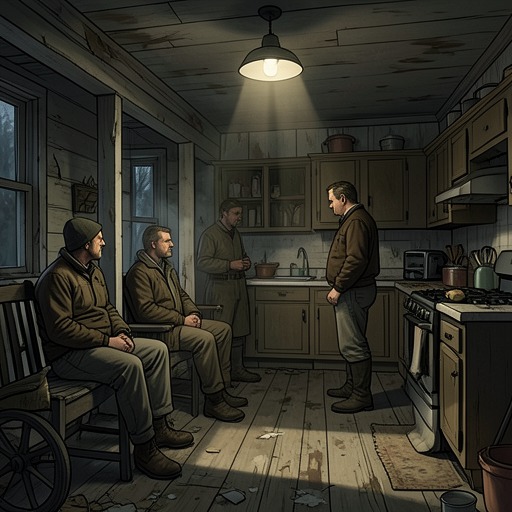
Jenny’s return to political life is marked by uncertainty rather than a simple recommitment. On the drive toward the rural safe house, she asks Frazer whether Pauline truly chose to join the cadre. Frazer says that he had doubts too, until he met the group, and insists that Pauline is now with them by choice. Their arrival comes near dawn, after more than an hour on small roads. The house sits near the top of a grassy slope, with a long view down the track; Carol is waiting outside. As the solitary ride ends, Frazer takes Jenny’s hand and then lets go. The gesture is brief, but it registers the intimacy and restraint between them as they enter a dangerous new situation.
At the house, Jenny offers to help with day-to-day needs. The losses surrounding the surviving group are not abstract to her: the previous day’s papers report that nine of Juan’s comrades were burned so completely their charred bones had to be picked from the ash, and that melted gas masks had fused to their skulls. She senses death in Juan’s stillness, while also feeling the uncomfortable return of hunger. The juxtaposition makes grief a physical problem as well as a political one: she has to reckon with the dead while continuing to live among the people left behind.
Her distrust of the group’s plans becomes explicit when Juan tells her that they intend to rob a bank by intercepting a store owner’s deposit. Jenny immediately refuses. Juan insists that the proposed robbery is carefully planned and that the store’s young employee, Thomas, will not be involved, but Jenny’s response makes clear that she does not accept the group’s reasoning simply because it is offered as a strategy. Later, when Juan turns off the engine and gives her the car keys, she goes inside to retrieve her letter to William and postal supplies so she can repack a tape. Once out of sight, she considers burying it where it will never be found, then decides she will not. As she drives away, she thinks about how the first year after William’s arrest left her unable to sleep through the night and about the impossibility of feeling grateful for his life as it is. She understands the need for mourning and for public eulogies, even as she is trying to grieve less than the surviving comrades.
Flight, Solidarity, and Political Revision
After Jenny and Pauline flee together, their westward journey is made from small acts of concealment and trust. They spend Jenny’s money, then use stolen bills one at a time, traveling by day and taking an irregular route rather than hurrying toward a fixed destination. In a motel in Winnemucca, Pauline tells Jenny she would never have informed on her if captured, but that Jenny had not been obliged to stay with her. Jenny refuses to betray her. As they near the coast, their uncertainty about where to settle gives way to recognition: on seeing San Pablo Bay, they shout, and understand they are going home. Jenny reaches Sandy’s North Berkeley porch in the guise of a teenage girl, with her hair in a ponytail, a churchgoing blouse and skirt, and a Bible under her arm. The performance is a disguise, but the Bible has also become part of their shared, sometimes playful life on the road; Pauline had taken one from a motel, and Jenny had joked about the consequences of carrying it across state lines.
The women’s work after their return changes Jenny’s relationship to both knowledge and political force. Pauline proposes teaching women about firearms—not to hurt or kill, but to understand weapons and the ways men use and misuse them. Their early sessions begin with parts, ballistics, and the purposes of different guns rather than shooting. Jenny joins Sandy, Sandy’s younger sister Joanne, and Joanne’s housemate Lena in dismantling a 12-gauge shotgun and cleaning it with pipe cleaners and household rags. She finds pleasure in asking questions, making lists, and learning without embarrassment. The experience helps the women name a habit they have acquired around men: presenting themselves as already knowledgeable, then privately trying to catch up. Jenny connects that performance to her relationship with William, in which she had felt the secret excitement of becoming the lover he desired. Among women, by contrast, she finds the pleasure of approaching something for the first time and admitting not to know.
That shift does not make Jenny a simple opponent of political action. The weapons group makes her feel braver and more capable, and she sees its effects on Sandy, Joanne, and especially Pauline. Yet when Mike Sorsa asks whether she wants to meet new comrades, she recoils inwardly. From outside, she can see the group as violent and courting destruction. Increasingly, revolution seems to her less like force gathered to topple the system than a fragile process of changing individual minds, or a rare chance to attempt such change.
Jenny and Pauline’s disagreements sharpen when they discuss women’s place in revolutionary movements. Pauline argues that women have followed men even in movements associated with famous women revolutionaries, who are often remembered as helpmeets to more celebrated men. She records the group’s resolution that women must assume leadership. She also describes her own abduction by former comrades as a typically masculine act of violence, and applies that criticism to William’s methods. Jenny resists turning this pattern into a claim that men are naturally doomed to act in one way; she compares it to saying that women do housework because it is their nature. Their exchange marks both an alliance and a limit: they share a feminist political awakening, but do not arrive at identical explanations of how gender shapes revolutionary conduct.
Imprisonment and Unequal Aftermath
Jenny and Pauline ultimately face different consequences, and the distinction cannot be explained by their charges or sentences alone. Pauline is convicted of bank robbery and receives less than two years before her sentence is commuted. Publicly, she is treated as a victim of her attorneys’ poor work; her prison term becomes another ordeal she has endured without being degraded. Her class privilege, the novel suggests, survives the apparent punishment and helps restore her standing.
Jenny receives the minimum sentence for participating in the selective-service recruitment-center bombings and is transferred to a work-release program after a year for good behavior. The relative leniency does not feel like uncomplicated mercy. She experiences a new shame: a pressure to scrape by gratefully, as if she were the fortunate recipient of unusual generosity rather than someone serving a sentence. In prison, she is assigned pleasant kitchen tasks and repeatedly praised for being good. She recognizes the racial logic of this treatment in the figure of the model minority, rewarded as an example to supposedly less worthy kin. Thomas returns to her mind: honest and loyal, he too might be praised for exceeding expectations so long as the world does not embitter him or make him a target of the stereotype attached to Black people.
The women are tried and punished only for acts committed before they met. Their time together, including the choices and risks they shared, is consequently left out of the legal record. Nor is anyone charged with Mr. Morton’s murder. For Jenny, the mismatch between crimes and punishments leaves an unseen remainder of confusion and pain, and makes it seem that her life can be revised indefinitely by other people’s accounts. The contrast between Pauline being punished severely yet emerging apparently restored, and Jenny being treated leniently yet made to feel grateful and diminished, gives Jenny’s ending its force: survival does not erase the unequal stories that race, class, and the law tell about who deserves suspicion, redemption, or praise.