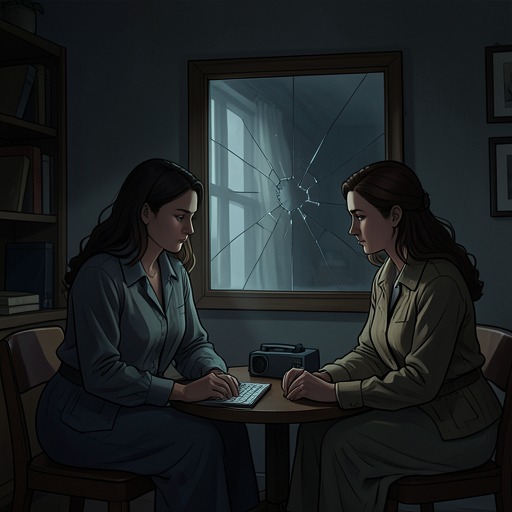
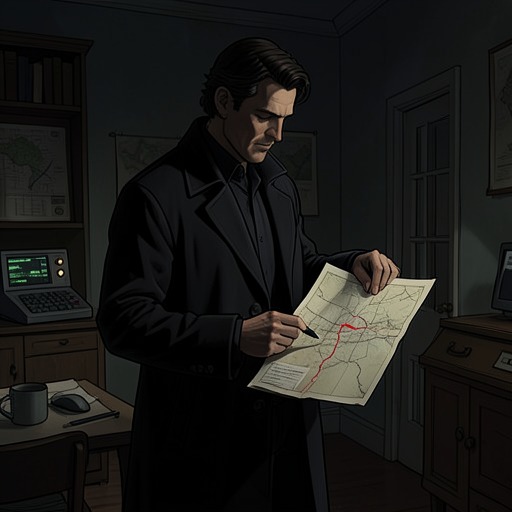
Jenny and Pauline’s fugitive status
American WomanJenny and Pauline’s fugitive status governs how they travel, communicate, and try to disappear, while exposing the limits of disappearance itself. Their movements are pursued by investigators and mediated by news coverage, but the record that survives is uneven: fingerprints and carefully routed messages can point toward them, while Jenny’s part in the story is repeatedly overlooked. Their flight ends in arrest, yet the legal and public accounts of what happened do not capture the time they spent together on the run or distribute its consequences equally.
Hiding and the traces left behind
During their time in hiding, Jenny and Pauline’s approach to concealment changed. An investigator later found a house empty and unusually clean. The contrast with the fugitives’ earlier habits was striking: at first, they had left notebooks, dirty clothes, spoiled food, cigarette butts, graffiti, and a bathtub of submerged evidence. After thirteen months, the house showed the effort of people who had learned to protect themselves by erasing signs of their presence. The painstaking cleanup did not make the place legible as empty by accident; its absence of ordinary debris became evidence in its own right.
The search nevertheless produced physical traces. Investigators found a clear partial fingerprint and, in a rotting mattress, a taped-in plug of newspaper dated June 12, 1974. Fingerprints preserved between layers of tape included several distinct impressions, giving the investigators a trail even though it was already cold. The passage makes their attempt at erasure feel precarious: the house’s contents could be removed, but traces left on an object or hidden inside it might outlast the people who made them.
Communication under pursuit
Jenny’s separation from William made secure communication both necessary and painful. Their letters traveled indirectly: Jenny sent hers to Dana in Boulder, who recopied and forwarded them to William; William’s replies went back through Dana to Jenny. The arrangement kept direct addresses out of their exchange, but it also placed an intermediary between the separated couple. Dana reported that Jenny seemed to be doing well, while also noting that she and William had corresponded independently about Jenny’s fate.
When William suggested that Jenny surrender, the proposal collided with a future she could barely imagine. She and William had made plans for what they would do if both were arrested, but never for the possibility that one would be caught while the other remained free. Their past actions had been carried out together, in tandem; after William’s arrest, Jenny had to continue alone. She understood that he meant the suggestion as a way forward, yet experienced it as a possible severing of their bond. Her decision-making as a fugitive was therefore not only a question of physical safety: surrender meant confronting separation, imprisonment, and a life without the shared movement on which their relationship had depended.
The same caution governed contact with Dana after Jenny mailed a tape. Jenny returned to a phone booth beside a boarded-up diner outside Liberty, using coins kept in a battered plastic bag. The calls followed a traditional, minimal routine: Jenny asked whether Dana had received something, and if not, they hung up. When Dana confirmed receipt and asked what the package contained, Jenny refused to explain over the phone. She instructed Dana to wear dishwashing gloves when opening it, avoid touching a second envelope, and deliver that inner package. The procedure turned an ordinary call and household object into parts of a controlled chain of transmission.
Movement, visibility, and the public story
More than a year after Pauline’s kidnapping, Jenny and Pauline impulsively borrowed Tom Milner’s car and drove to the house where Pauline had grown up. Jenny drove while Pauline navigated. The house had once been the center of an enormous media presence: television vans filled the street and driveway, crews occupied the lawn, and telephone booths were installed for reporters. By the time the two women returned, the lawn had been resodded and the portico swept, but the cleared setting still carried the imprint of that spectacle. Their visit brought them into a place associated with Pauline’s family and with the public pursuit that had accompanied her disappearance.
Investigators and journalists had struggled to distinguish reliable information from rumor. Rob Frazer, then using the name Joe Smith, told Anne Casey that the FBI had discovered a farmhouse where Pauline had hidden and had linked her to Jenny Shimada. The FBI had questioned him after he visited the farmhouse, but he claimed they could not hold him because he had done nothing wrong. Anne had previously treated Jenny as a known fugitive without pursuing her connection to Pauline. Later, even after learning that Rob’s account was true, Anne recognized how readily Jenny could be left out of the story. The phrase the lost year offered a ready-made label for the period, but also made it easier for public attention to pass over what Jenny had experienced.
Arrest and unequal consequences
After the flight, news accounts concentrated heavily on Pauline’s condition. Her lawyers, doctors, and brainwashing experts described malnutrition, hallucinations, flat speech, and her initial failure to recognize family members; they argued that deprivation and violence had made her an unwilling participant. The judge denied bail despite that presentation and the image of Pauline publicly proclaiming Venceremos. Jenny, meanwhile, received little attention in the coverage. The disparity continued a pattern in which Pauline’s experience was made visible through the family, lawyers, and medical explanations, while Jenny’s was harder to place in the public account.
The legal outcomes further separated the two women. Pauline was convicted of bank robbery and served less than two years before her sentence was commuted. The public could portray her as a victim of her attorneys and regard the experience as something she had endured without lasting degradation, reinforcing rather than undoing her class privilege. Jenny received the minimum sentence for participating in the selective-service recruitment-center bombings and, after a year, entered a work-release program for good behavior. She experienced the favorable treatment not simply as leniency, but as a new pressure to be grateful and accommodating. Praise for being a good prisoner made her feel like a token offered as an example of the model minority.
Jenny and Pauline were tried and sentenced only for acts they had committed before meeting one another. Their shared fugitive life was therefore left outside the formal record, as was the murder of Mr. Morton, for which no one was charged. Their arrest ended their movement together, but did not produce a coherent account in which crime, punishment, and experience aligned. Pauline’s public visibility and Jenny’s relative erasure continued into the aftermath, making the end of their flight another point at which their lives diverged.