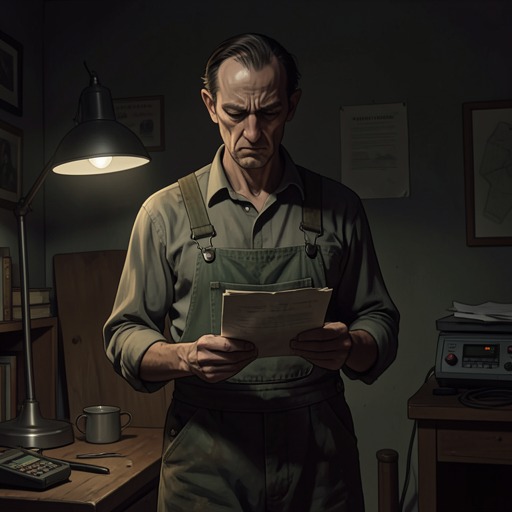
Jenny's father
American WomanJenny’s father is Jim Shimada, a Japanese American whose life is marked by the conflict between his American identity and the racial exclusion imposed on him by the United States. After wartime incarceration and imprisonment for resisting the draft, he tries to find a home in Japan, only to discover that he is regarded there as indelibly American. His history helps Jenny begin to understand the forces of racism and political power, but their connection does not become a reconciliation: as she grows into radical politics, the two increasingly quarrel and eventually break off contact.
Identity and Wartime Incarceration
Jim Shimada is the only child of Japanese immigrants. His parents earn a living through truck farming and, by the late 1930s, save enough to open a produce stand in Los Angeles. Jim excels at baseball, wins a scholarship to UCLA, and hopes to attend film school and make Westerns. Those prospects are interrupted by the government’s wartime treatment of Japanese Americans. After Pearl Harbor, Jim tries to enlist, but is refused because of his Japanese ancestry, not because he is too young. In the fall of 1942, at seventeen, he and his parents are sent to Manzanar in the Owens Valley.
The account initially presents his incarceration as part of a broad collective experience: nothing in particular distinguishes Jim from other people in the camp during his first months there. In the spring of 1943, the government introduces a loyalty oath asking internees whether they would serve in the U.S. Army if permitted and whether they would renounce loyalty to Japan. The second question provokes fear that an answer could be used against them as proof of prior allegiance to Japan. The passage places Jim inside this fraught political environment, where the state demands declarations of loyalty from people it has already excluded and confined. The available account does not establish how Jim answered the oath.
Draft Resistance and Exile in Japan
Jim resists the draft and spends a couple of years in prison. His opposition to the government’s wartime incarceration is part of the story Jenny later tells Thomas: her father, she explains, had been angry that the government put Japanese people in camps. Yet resistance does not make him an uncomplicated hero within the Japanese American community. It is unpopular among the incarcerated Japanese, and he is unfairly associated with a small, violent pro-Japan movement whose members include boys sent to Japan for schooling. His imprisonment and this rejection deepen his bitterness.
After the family moves to Japan, Jim intends to expatriate permanently. He appears to hope that he will no longer be shunned by white Americans for his race or rejected by Japanese Americans for refusing to submit to white authority. Instead, Japan does not receive him as he expects. He remains visibly and unmistakably American: slightly taller, marked by a Los Angeles accent, casually dressed in a way that seems sloppy there, and unable to master Japanese. Jenny, by contrast, absorbs the language easily. She is nine when they leave California and fourteen when her father decides to return; she remembers sobbing on the flight back across the Pacific. His attempt to escape rejection in one country thus ends in a return to the country whose treatment of him had helped drive him away.
Jenny’s Discovery of Her Father’s History
For Jenny, her father’s wartime experience becomes a key to understanding him, but it is a key she finds outside his own account. She learns about the incarceration at school in Japan. When she asks him about it after returning to California, he dismisses it as something from long ago. His reluctance to revisit the past contrasts with the importance the discovery assumes for his daughter: learning what he endured becomes the beginning of her understanding of history, politics, power, oppression, brotherhood, and racism.
The return to California also brings a disorienting encounter with its institutions. A school psychologist tests Jenny and, despite her passing the tests, places her three grades behind her expected level, apparently to account for her years of schooling in Japan. Jim accompanies her and tries to explain the five-year interruption in her education. His own strained effort to describe the Japanese school system to the psychologist exposes the difficulty of translating their experience into terms an American institution will accept. Jenny’s memory of the visit is also shaped by the miniature Statue of Liberty in the municipal building lobby, an emblem she regards with a mixture of challenge and irony as she confronts the country she has returned to.
Political Conflict and Estrangement
Jenny’s discovery of her father’s history does not bring them into political agreement. She grows increasingly involved in the antiwar movement, while he opposes her beliefs, despite her sense that his own experience might have made him more likely than most people to understand her. Their arguments become more furious but not more substantive: they center on whether she is arrogant, stupid, or naive enough to oppose the war, rather than on the war’s merits. His hostility is captured in the challenge of what she knows, a recurring measure of the distance between them.
When Jenny is eighteen, she moves to Berkeley without finishing high school. She begins attending a night class in modern political science, meets William, and becomes his lover. After a catastrophic visit in which her father and William trade insults, Jenny’s already tenuous connection with her father breaks down. She and her father stop speaking; William becomes her world, and his language becomes hers. The sequence makes the loss of her relationship with her father part of her transformation into a political and intimate life he cannot share.
Imprisonment and the Unresolved Relationship
During Jenny’s later imprisonment, she is told that her father is still waiting to see her. The detail leaves their estrangement unresolved: the record establishes that he wants to see her, but does not establish a reunion or a repaired relationship. The account instead emphasizes the unequal meanings that imprisonment carries for Jenny and Pauline, and how Jenny comes to feel marked by the treatment she receives as a supposedly exemplary prisoner. Jim’s history gives that later experience an additional resonance without making their situations equivalent: the daughter who learned about her father’s incarceration as a suppressed piece of history now experiences the state’s judgment herself.
Jim’s importance to the narrative lies not only in what the government does to him, but in the uneven passage of that experience between generations. He carries an injury he has largely refused to discuss; Jenny encounters it through a school lesson, then makes it part of her understanding of politics and her own identity. That recognition opens a path toward her radicalism, but it cannot overcome the quarrels, silences, and separations that define their relationship.