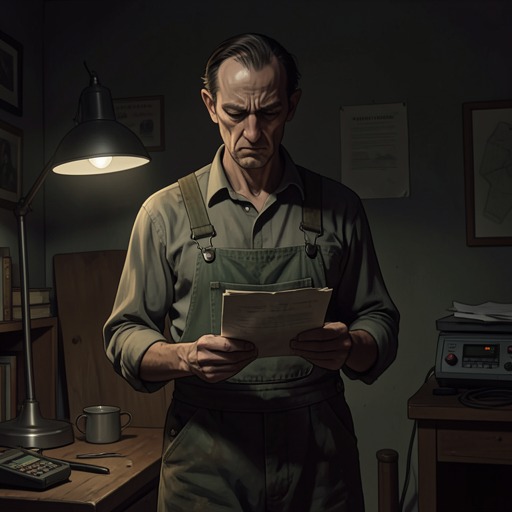
Jim Shimada’s persistent guilt and apprehension
American WomanJim Shimada’s persistent guilt and apprehension are the long afterlife of Japanese American wartime incarceration, sharpened by his daughter Jenny’s disappearance and the possibility that the past is once again closing in on their family. At his Stockton nursery, a slow car or an unfamiliar visitor can become a sign of surveillance, racist hostility, or Jenny’s return. The narrative does not settle which interpretation is correct; it shows how years of fear make uncertainty itself a condition of life.
Origins of Guilt and Suspicion
Jim’s unease reaches back to his experience of Japanese American incarceration at Manzanar. He recognizes in himself a guilt he regards as undeserved: the habitual shame of someone who has been treated as suspect despite being blameless. That feeling extends beyond his own history. It has made him resent his parents and other people who were wrongly accused, and he sees the contradiction in having once dismissed Japanese people in California as conformists while recognizing that he, too, had been shaped by the same pressures.
His fear of official scrutiny persists despite his efforts to live by the rules. He files his taxes on time, yet still imagines agents from the Federal Bureau of Investigation returning to his doorstep. The gap between lawful conduct and felt safety is central to his apprehension: compliance does not reassure him, because the source of his fear is not a particular misdeed but the memory of being vulnerable to accusation and state power.
A recollection of Manzanar gives that guilt a family dimension. At eighteen, Jim remembers the camp’s social life and dancing with a girl, while his parents entered the communal hall frightened and kept close to the wall. He saw them immediately but stiffened his expression and imagined himself unseen, as they seemed to imagine themselves unseen. The contrast between his own sense of being vividly alive and his parents’ fear remains disturbing in retrospect. He understands that the stripping away of their authority did not make him an adult; it made the whole family live in a condition of diminished agency. His memories therefore hold adolescent freedom beside his parents’ displacement, without resolving the two into a simple story of either liberation or victimhood.
The Nursery as a Place of Exposure
The greenhouse makes Jim’s private anxiety visible in the ordinary work of the nursery. A few days before a June 1975 episode, he noticed a dark, nondescript sedan with two men in front, apparently stopped across from his house before driving away. He went outside after seeing it, but the car was already receding. The brief sighting offered no explanation, only a detail that could be revisited later as evidence or dismissed as coincidence.
The greenhouse already carried another mark of Jenny’s absence. Three years and three months earlier, while Jim stayed inside with the drapes drawn, disconnected the telephone, and closed the business, someone had broken its large pane with a brick. A note attached to the brick expressed anti-Japanese hostility and accused the family of political disloyalty. The glass fragments remained among the plants and on the shelves for years, turning routine greenhouse work into repeated encounters with the physical remainder of an attack. Jim understood that the brick and the surveillance that followed were not demonstrably connected, though both seemed linked to Jenny. A supposed new customer, whose visits were frequent despite his evident lack of gardening knowledge, later stopped coming; Jim suspected the man had been watching him under the guise of shopping.
That history changes the meaning of later traffic on the road. As Jenny’s disappearance stretches into years, Jim sees slow-moving cars as possible watchers, but also wonders whether an old persecutor might still be responsible. He tells himself not to worry, treating indifference as a deliberate effort against a suspicion that has become habitual. The effort does not erase the fear; it only gives him a way to continue tending the nursery.
Suspicion, Recognition, and Jenny’s Arrest
A car that passes slowly, turns around, and returns makes Jim’s uncertainty briefly acute. He considers both the possibility of undercover surveillance and the possibility that the car belongs to the person who threw the brick. He is also reminded of Jenny. Without first wiping the shaving cream from his face, he runs outside and calls for the car to stop. His response shows how quickly a present-day ambiguity can become an imagined encounter with danger—or a chance to see his missing daughter.
The narrative later makes those suspicions more complicated. For a handful of occasions over the following two and a half months, Jim notices cars that seem furtive; he cannot tell whether they represent a real net tightening around Jenny or his old paranoia. After her arrest, the earlier vigilance can look like clairvoyance in retrospect, but that retrospective appearance does not prove that Jim correctly identified what each car was doing. The fear gains apparent confirmation without ever becoming certainty.
After learning of Jenny’s arrest, Jim stays near her legal proceedings and calls her lawyer each day from a motel. He learns that Jenny has accepted legal pads and disposable pens and is willing to work on a statement about her feelings and beliefs, but that she is not ready to see him. The statement appears not to advance. Jim waits through the week, eating at a diner beside a bail-bonds storefront while his nursery remains shuttered and his plants go without water. He knows that nothing may change, yet staying allows him to show that he has stayed. When he returns by bus, he crosses the dark highway toward his house expecting that someone might be waiting for him inside. The dread survives even the uneventful journey home.
Jenny’s Story and the Limits of Reassurance
The news coverage of Pauline initially deepens Jim’s sense that Jenny has vanished from view. Reports give extensive attention to Pauline’s condition and her lawyers’ claims, while Jenny is scarcely mentioned. Jim is both annoyed and relieved by that omission: Jenny’s absence from the headlines makes her seem discarded, but it may also leave her with a life to return to after prison. When a newspaper describes an unnamed person who knew Pauline during the period called the lost year and supports her defense, Jim recognizes Jenny as the source. Her presence in the story moves him, even as he protests to himself that she is placing herself in danger again. For once, he can imagine that she might have a future beyond confinement.
The different sentences Jenny and Pauline eventually receive give this family anxiety a broader social consequence. Pauline is convicted of the bank robbery but serves less than two years before her sentence is commuted; the public image of her as a victim allows her to emerge without lasting prison stigma. Jenny receives the minimum sentence for her participation in the selective-service recruitment-center bombings and enters work release after a year for good behavior. Yet the apparent leniency makes her feel marked as an exemplary exception, praised for being unusually good and treated as a representative of the model minority. Their legal treatment does not correspond neatly to what they did together: both are tried and sentenced only for acts committed before they met, while no one is charged with Mr. Morton’s murder. The resulting mismatch between actions, punishment, and public story helps explain why Jim’s fear cannot be reduced to concern about a single prosecution. His history has taught him that innocence, legality, and safety do not reliably coincide; Jenny’s case gives that lesson a new and intimate form.