Los Angeles
American WomanLos Angeles is the point where The cadre’s fugitive life becomes a public crisis: a safe house is surrounded, a televised confrontation ends in the deaths of nine members, and three survivors escape only to leave clues that bring investigators onto their trail. The city’s role extends beyond the siege. A hurried supply mission there exposes the group’s location, while radio and television carry the consequences far beyond California. In a separate historical thread, Los Angeles is also where Jenny’s family built a livelihood before the federal government’s wartime incarceration of Japanese Americans disrupted it.
The City and Its Historical Connections
Before the events that make Los Angeles a national focus, the city is part of Jenny’s family history. Her father, Jim Shimada, was the only child of Japanese immigrant parents. After years of truck farming, the family had saved enough by the late 1930s to open a small produce stand in Los Angeles. Jim excelled at baseball and won a scholarship to UCLA, with plans to study film and make Westerns. In 1942, however, he and his parents were sent to Manzanar under the federal government’s wartime incarceration policy. The account locates the family’s business in Los Angeles but distinguishes it from the later events: Jim’s confinement began at Manzanar, in the Owens Valley, not in the city.
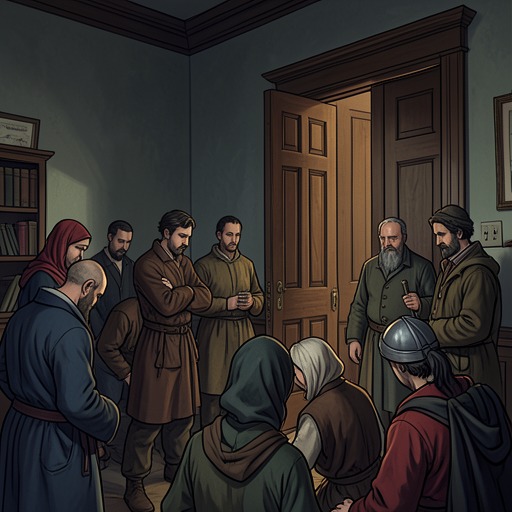
Los Angeles also becomes the setting for the final public confrontation involving most of the cadre. After Pauline’s abduction and conversion to the group’s cause, The cadre robbed a bank and moved to Los Angeles. Following the robbery, its long-postponed plan to divide into four independent but potentially cooperating groups of three was put into effect. Juan, Yvonne, and Pauline were assigned to the same cell. Their assignment was both a practical division of the organization and a test, since the discord among them was considered a risk to the others.
The Siege and Its Public Image
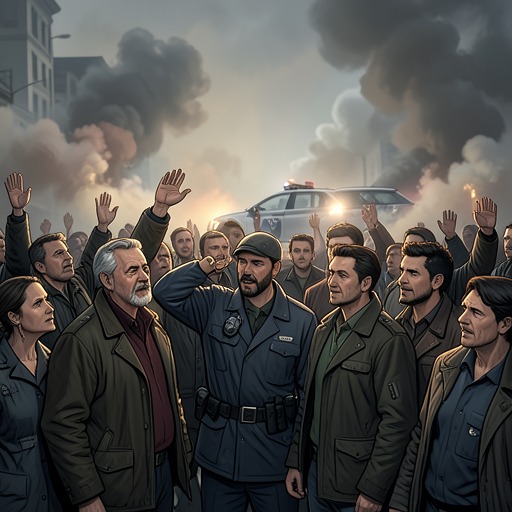
In the middle of May, Jenny was working at Wildmoor when a radio report announced that The cadre had been traced to a house in a Black neighborhood in Los Angeles. The broadcast said that all twelve members, including Pauline, were believed to be inside and that the surrounding FBI agents, local police, and SWAT teams had met gunfire when they called for surrender. The report unfolded in fragments: a correspondent described smoke, then fire, and later a person leaving through the back of the house before being stopped by police. Jenny froze with a can of varnish in her hand as the account continued. When the broadcast ended, she turned off the radio, not knowing that Juan, Yvonne, and Pauline had survived and were already traveling north.
The confrontation quickly became a national media event. The news showed the house surrounded by police vehicles, barricades, armed officers, snipers, and reporters. Nine members were eventually confirmed dead, while the three people missing from the scene were identified as Juan, Yvonne, and Pauline. Coverage reduced the catastrophe to a legible public image: the siege, the fire, the reported deaths, and photographs of the group from their earlier lives. The changing headlines and attention to other stories then opened a brief lull in coverage, even as the surviving members remained at large.
The broadcast reached beyond Los Angeles and shaped how the survivors’ supporters understood the event. A few days later, the three fugitives heard a recorded message from the group aired over a small radio in their house. Juan’s section recast the siege as a story of state violence and survival, while citing newspaper reporting about the police response and the group’s weapons. The transmission made their voices part of the same public arena as the news reports. Jenny, listening with the others, experienced the recording as an echo of a recent past that already seemed remote. The event in Los Angeles had become not only a police operation but also material for competing accounts of who had suffered, who had escaped, and what the deaths meant.
The Supply Run and the Loss of Secrecy
After the survivors reached Los Angeles, the cell’s first joint operation was a supply run. A cold spell had left several members wanting aspirin, long-sleeved shirts, and socks; the group also wanted to assess camping equipment in case it needed to leave the city. Juan took several hundred dollars for a possible purchase. The team traveled in a worn van and wore ordinary clothes, while carrying weapons concealed inside. The precautions were part of a routine they had rehearsed, but the mission depended on small details being managed correctly.
At a drugstore, Juan bought aspirin and a copy of the Los Angeles Times. Pauline read in the van while the others searched for a sporting-goods store. The paper carried a bulletin about the fugitives as well as an article about local candidates seeking Black voters. At Pacific Sports, Juan and Yvonne went inside to look at equipment while Pauline waited in the van. The stop became the turning point: a struggle with a security guard led to the loss of Juan’s handgun, which had been purchased in his own name years earlier. The survivors fled, leaving the van behind. In the rush, a parking ticket that gave the address of their safe house remained on the dashboard.
The three took other vehicles and eventually bought a secondhand van with cash, hoping to find a motel where they could stay. Their established procedure was not to return to a safe house after a disruption, since doing so might lead pursuers to it. They followed that rule without realizing that the lost handgun was already being traced and that the ticket had revealed the address they meant to protect. Police examined the abandoned van, recovered the ticket, and connected the evidence to the Los Angeles safe house. Their attempt to keep moving had not erased the trail; the discarded details of one short errand had made the earlier refuge discoverable.
Aftermath and Significance
At a motel near the freeway, the survivors turned on the television and saw their safe house surrounded. The live coverage placed the three of them at a distance from the operation but kept them inside its reach: the scene they watched was the destruction of the place they had just left and the deaths of the comrades they had been unable to help. Pauline was overwhelmed by the news. Later that night, the three agreed that Juan would become their leader. Their immediate purpose narrowed to preserving themselves and one another, as earlier disagreements and ambitions gave way to grief and the need to continue.
The Los Angeles events also altered public perceptions of The cadre. Before the deaths, the group had appeared to many observers as a small, self-absorbed organization whose actions had won little sympathy. The spectacular siege and the subsequent broadcast of the survivors’ message redirected attention toward the dead and the missing. Sandy, previously too shy to call out slogans at an antiwar rally, had spoken at a memorial for the dead members and was cheered. Afterward, a surviving member approached her and asked for help; Sandy called Rob Frazer. The city’s aftermath thus reached people who had not been present, drawing them into the fugitives’ network through mourning, publicity, and appeals for assistance.
Los Angeles carries two distinct historical pressures in the narrative. For The cadre, it is a place of concealment that becomes exposed through the material traces of a supply run, and the site of a siege whose images and reports travel nationwide. For Jenny’s family, it is an earlier place of work and opportunity, before wartime policy removed Jim and his parents from their home and livelihood. The contrast does not make the histories identical; it places a contemporary police pursuit beside the longer record of government action and racialized exclusion. In both strands, the city is more than a backdrop: it is where lives become visible to institutions and the public, often in forms that do not match the people’s own understanding of what has happened.