Los Angeles roundup, shootout, and house fire
American WomanThe Los Angeles roundup, shootout, and house fire was the apparent destruction of the cadre and the turning point that made its surviving members fugitives again. Police and federal forces surrounded a house where all twelve members, including Pauline, were believed to be present; after gunfire and a fire that devastated the building, the public was led to believe the group had been wiped out. In fact, Pauline, Juan, and Yvonne survived, and their escape transformed a presumed ending into a story of concealment, rescue, and political spectacle.
Background and Siege
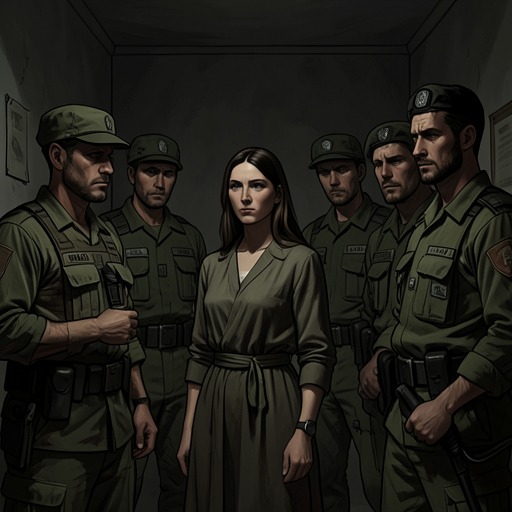
By the time the cadre was traced to a house in a Black neighborhood in Los Angeles, the group had already kidnapped Pauline, drawn her into its cause, and robbed a bank. The roundup brought FBI agents, local police, and SWAT teams to the house. Calls for those inside to surrender were answered with gunfire, and the situation escalated into an extended confrontation.
News coverage initially presented the siege as an event with no survivors. A reporter broadcasting from a neighboring roof struggled to relay what was happening: smoke gave way to visible flames, and explosions were attributed to ammunition inside the house heating up. One person was reported emerging from the back of the building and was intercepted by the SWAT team. The fire was so destructive that the remains could not be readily identified; the account at the time hardened into the belief that everyone inside had died. Jenny, listening to the broadcast, could not tell whether the confrontation had lasted fifteen minutes or an hour.
Escape and Immediate Aftermath
The account heard across the radio was incomplete. As Jenny stood frozen with a can of wood varnish in her hand, Pauline, Juan, and Yvonne were already alive and traveling north on Interstate 5. They were taken into an apartment, beyond the reach of the public story that all twelve members had perished. The contrast between the broadcast’s apparent finality and the fugitives’ survival is the event’s defining reversal: the house fire closed one chapter for the group in public, while privately its survivors were beginning another escape.
In the days that followed, the three were moved separately. Frazer helped arrange the car shuttlings, while Carol rented an old farm about an hour’s drive from Manhattan as a new safe house. Frazer also assigned Tom Milner to arrange storage for the fugitives’ guns among his old friends, until the weapons could be reclaimed. The escape therefore depended not only on surviving the siege but on a dispersed network of transport, shelter, and trusted contacts.
The discovery that anyone had survived emerged through a different public gathering. Earlier that week, Sandy had spoken at a memorial rally for the presumed-dead cadre. After the crowd began to disperse, a disheveled young woman approached her, claimed to have known the dead comrades, and offered Sandy a way to help. The woman was one of the people believed to have died. Sandy, previously too shy to shout slogans at an antiwar rally, had become a public speaker and then a frightened, reluctant link to the survivors; she called Frazer for assistance.
Competing Accounts of the Event
The siege continued to shape the cadre’s own public language after the escape. At a later broadcast, Yvonne supplied a detailed account of the police action, emphasizing its timing, equipment, casualties, and public cost. Juan then turned those particulars into a broader political indictment. His account asserted that the authorities had believed they destroyed all twelve people and announced that three had escaped. In this retelling, survival was not merely a fact to be reported: it became a challenge to the official appearance of total victory.
The distinction between what listeners knew and what had happened privately remained important. Jenny heard the radio report from the old house without knowing that the three fugitives were already driving north. The broadcast’s uncertainty and urgency reached her before the news of their escape did. Later, when Sandy helped connect the survivors with Frazer, the supposedly closed event reopened as a practical emergency involving people, cars, weapons, and places to hide.
Public Meaning and Consequences
The deaths and the fire reshaped public judgment of the cadre. Sandy’s memorial speech reflected a broader response: although the group’s actions had alienated many people, the spectacle of its apparent destruction seemed to wash away, for some, the doubts surrounding those actions. The event made the members’ deaths—and the uncertainty about who had actually died—more visible than the aims that had led to the conflict.
Pauline became especially central to the competing stories. News commentators speculated that she must have been tortured or brainwashed to explain her allegiance, while Jenny resisted treating that explanation as established fact. Later, Pauline’s public image continued to eclipse the political history of the cadre: she was treated as a compelling individual story, while the dead and surviving members risked being forgotten along with what they had hoped to accomplish.
The eventual legal outcomes did not neatly account for the events that followed the escape. Pauline was convicted of bank robbery and served less than two years before her sentence was commuted; Jenny received the minimum sentence for her earlier participation in selective-service recruitment-center bombings and entered work release after a year. Neither was tried for the later acts they committed together, and no one was charged with Mr. Morton’s murder. The siege thus left more than a false impression of total death: it began a chain of flight and public narration whose consequences were only partially reflected in the criminal record.