Luck and providence
American WomanLuck and providence is the shifting belief that Jenny’s survival and the absence of intended casualties in her earlier bombings reflected righteousness rather than chance. As she comes to recognize how little control good intentions gave her over violent outcomes, luck changes from a private creed that protects her sense of moral certainty into an explanation that makes her feel more culpable, not less. The distinction matters: chance may spare one person and kill another, but it cannot certify the justice of the act.
A fragile faith in good fortune
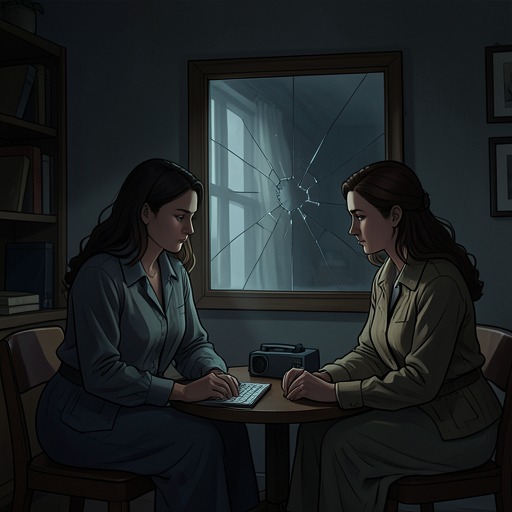
After Pauline apologized for their argument, Jenny was relieved that their relationship had been restored. She also felt that their mystical luck remained intact. The episode had begun with a rupture between them: Pauline threw a heavy glass ashtray, which missed Jenny and went through the closed kitchen window. In the aftermath, Jenny spoke to their landlord, Mr. Minski, about paying for the damage, while Pauline later returned to their room and apologized. Jenny chose not to recount that conversation to Pauline, because she did not want needless reflection to undo the renewed closeness between them. Luck here is not yet a theory of how events work so much as a fragile reassurance attached to survival and intimacy: the danger passed, the relationship was repaired, and Jenny could keep believing that something had preserved them.
That reassurance is tested by the East Bay wildfire. As smoke and reports of the fire reached their home, Jenny and Pauline sat close together and listened to the urgent broadcasts. The danger was real and approaching, yet they felt strangely distant from the world, as if it could not touch them. The passage sets their sense of protection against evidence that offers no guarantee of safety. Their composure does not establish that they are favored or secure; it records how, for a moment, they experience themselves as insulated even while the fire threatens the city.
Chance and the moral audit of violence
In prison, Jenny revisits the political violence she had once defended as a way to force attention and produce understanding. She remembers a monk’s self-immolation as an experience that had transformed her, and considers whether she had wanted to impose a similarly overwhelming shock on others. But the memory no longer confirms her old faith in righteous action. She now asks what could guarantee that an attempt to awaken others would not also harm them. Her answer is stark: even the people who try hardest to avoid harm cannot control every consequence.
That recognition changes how she understands her bombings with William. They had taken pride in acting carefully and in targeting buildings they believed would be empty. Jenny now sees that their success in avoiding deaths may have depended less on care or virtue than on luck. The absence of a returning employee at a targeted building does not prove that the bombing was morally sound; it may only mean that, by chance, no one was there. The apparent line between a supposedly empty building and a supposedly enemy-held place in a village offers no dependable moral safeguard: civilians may be present where the perpetrators do not expect them. Jenny’s retrospective reasoning thus turns her earlier confidence against itself. High intentions could not make violence reliable, and a favorable outcome could not vindicate the means.
Mr. Morton and the unequal distribution of luck
The harshest consequence of this revision concerns Mr. Morton. Jenny had previously wanted to understand his death through Juan’s motives; now she considers that bad luck, rather than a theory about impure intentions, may have been decisive. This does not make the killing less consequential. It breaks the comforting symmetry in which good motives bring safety and bad motives bring punishment. In Jenny’s account, chance can keep a person from becoming a killer while they believe they are acting to save others, and it can also leave an innocent person dead.
Her memory of Mr. Morton sharpens that change. She no longer sees him merely as an abstraction within a political conflict. She imagines the circumstances of his encounter with a young woman who takes hold of his arm and presents a gun, while his outdated glasses leave him with an imprecise view. The contrast is important: where political abstractions had made violence easier to interpret, attention to Mr. Morton as a particular person makes its human cost harder to evade. Jenny’s account does not present luck as an excuse. Instead, recognizing its role removes the moral protection she had drawn from believing that violence remained controlled.
Comradeship, judgment, and consequences
The collapse of Jenny’s faith in moral certainty is bound to her relationship with Pauline. Jenny remembers their bond as something she had genuinely wanted: a comradeship in which mistakes and remorse could be shared. She contrasts it with the cadre’s failed version of solidarity and with her earlier relationship with William, in which she had felt she was seeking his approval. With Pauline, she had believed that they could at least face their errors together. Now, preparing to confront the past alone, Jenny understands that this closeness could not erase the consequences of what either woman had done.
The different punishments awaiting the two women further complicate any idea that outcomes neatly express moral desert. Pauline will be convicted of bank robbery and serve less than two years before her sentence is commuted; Jenny will receive the minimum sentence for the selective-service recruitment-center bombings and later enter work release. Yet the novel presents these legal differences as entangled with class and racial privilege, not as a clear measure of guilt or luck. Their time together will not be charged as an offense, and no one will be charged with Mr. Morton’s murder. The resulting mismatch between actions, official records, and punishment leaves suffering that the legal process does not resolve.
Luck and providence therefore links Jenny’s private survival to her larger moral awakening. Earlier, a run of favorable outcomes could feel like evidence that she and William had acted rightly, or that she and Pauline were somehow protected. In retrospect, those outcomes look contingent, while Mr. Morton’s death exposes the cost of treating contingency as moral proof. The concept does not supply Jenny with a new assurance that events have a just design. It strips away the old assurance, leaving her to recognize both the limits of her control and the human consequences that good intentions could never settle.